
Triage every repair by safety first, active water or structural risk second, and systems that keep the unit habitable third — then assign a response window (Immediate, 24–72 hours, or Scheduled) based on how fast damage or harm compounds. The shelter-first prioritization hierarchy places life-safety at the top, active water and structure risks next, then core systems like heating, plumbing, and electrical that keep a home livable. Everything else is scheduled work.
Key Takeaways
Prioritizing urgent repairs correctly requires a repeatable triage rule, a complete intake checklist, and defined response windows applied consistently across every ticket.
| Point | Details |
|---|---|
| Triage order | Safety first, then active water or structural risk, then habitability systems — everything else is scheduled. |
| Intake essentials | Collect photos, exact location, access instructions, safety flag, and tenant impact before assigning any priority. |
| Response windows | Immediate: within 2 hours; High: within 24 hours; Medium: within 48–72 hours; Low: scheduled within 7–30 days. |
| KPIs to track | Monitor time-to-first-response and repeat-fix rate; a repeat-fix rate above 5% signals incomplete repairs or deferred root causes. |
| Maddladder | Licensed handyman services in Kansas City with priority scheduling for subscription clients and one-time service starting at $75/hour. |
Table of Contents
- How do you prioritize urgent repairs with a triage framework?
- What should every repair intake checklist include?
- How to standardize intake forms and communicate status to tenants
- How to assign the right resource and estimate time and cost
- When should you defer a repair, and how do you mitigate risk in the meantime?
- How do you balance preventive maintenance with reactive repairs?
- What tools and KPIs make repair prioritization objective?
- How Maddladder implements urgent repair prioritization
- Copy/paste templates: intake form, triage matrix, and tenant follow-up
- The trade-offs nobody talks about in urgent repair prioritization
- Maddladder handles urgent repairs in Kansas City so you don't have to
- Sources
How do you prioritize urgent repairs with a triage framework?
Three frameworks cover most real-world situations. Pick the one that fits your operation's complexity.
Emergency / urgent / routine tiers
The simplest and most portable system. Every incoming repair request lands in one of three buckets:
- Emergency: Immediate threat to life, safety, or structural integrity. Gas leaks, active flooding, electrical hazards, no heat below 50°F. Response within 2 hours.
- Urgent: Damage is spreading or habitability is compromised, but no immediate danger to life. Roof leak with active drip, failed water heater, broken exterior lock. Response within 24–72 hours.
- Routine: No safety risk, no spreading damage. Cosmetic issues, minor fixture wear, non-critical appliance faults. Scheduled within 7–30 days.
The 1-3-9 daily triage variant
Borrowed from time-management practice and adapted for maintenance operations: each morning, identify 1 emergency-tier item to resolve today, 3 urgent-tier items to schedule within 72 hours, and 9 routine items to batch for the week. The constraint forces real prioritization instead of treating every ticket as equally important.

Numeric priority scoring
When you manage multiple properties or a large work-order queue, qualitative tiers alone get political fast. A simple formula cuts through it:
Priority Score = Impact × Frequency × Cost-to-Fix (inverse)
Score each factor 1–5. A burst pipe scores: Impact 5 (flooding, habitability) × Frequency 4 (recurring risk) × Cost-to-Fix 2 (low inverse because it's expensive) = 40. A squeaky door hinge scores: 1 × 1 × 5 = 5. Higher scores go first.
Use qualitative tiers for fast intake decisions. Switch to numeric scoring when you're comparing five or more open tickets and need a defensible queue order for stakeholders.
Pro Tip: Set a threshold score — anything above 25 gets same-day attention regardless of how full the schedule is. Below 10 goes on the batch list.
71% of homeowners delayed at least one repair project due to financial pressure — and deferred work consistently produces higher emergency costs later. A scoring system makes deferral decisions defensible rather than arbitrary.
What should every repair intake checklist include?
Capturing the right information at first contact is the fastest way to triage accurately. Missing one key field — access instructions, for example — can add hours to response time. Inspection industry guidance identifies photos, tenant impact, and access details as the three highest-yield data points for quick triage.
Intake checklist — collect every item before assigning priority:
- Photos (minimum 2): Wide shot showing location context, close-up showing the defect. Photos alone often change a priority call.
- Exact location: Unit number, room, specific fixture or system. "The bathroom" is not enough; "second-floor hall bath, supply valve under sink" is.
- Access instructions: Is a key needed? Is a pet present? Are there hours the tenant is unavailable?
- Tenant impact: Is the unit currently uninhabitable? Is a vulnerable occupant (elderly, infant, medical equipment) affected?
- Safety signals: Burning smell, visible sparks, standing water, structural cracking, gas odor. Any yes answer escalates immediately.
- Timeline of the problem: When did it start? Has it gotten worse? An active leak vs. a dry water stain are entirely different priorities.
- Prior attempts to mitigate: Has the tenant shut off a valve, placed a bucket, or done anything else? This tells you the current state.
Sample clarifying questions for tenants or on-site staff:
- "Is water actively dripping or pooling right now, or is this a stain from a past event?"
- "Do you smell anything burning or unusual near the panel or outlets?"
- "Is the heat completely out, or just reduced?"
- "Can you still use the unit safely while we schedule a visit?"
How the answers change priority is direct: an active drip under a sink with water pooling on a wood subfloor is urgent (spreading damage, structural risk). A dry stain on drywall with no active moisture is routine. A burning smell near an outlet is an emergency regardless of anything else the tenant says.
How to standardize intake forms and communicate status to tenants
Ambiguous intake creates slow triage. A standardized form removes the guesswork.
Essential form fields and why each matters
| Field | Why it matters |
|---|---|
| Requestor name and contact | Enables follow-up without hunting for information |
| Property address and unit | Routes the ticket to the right property file instantly |
| Date and time of report | Starts the SLA clock; creates a paper trail |
| Problem description (free text) | Captures nuance the dropdown fields miss |
| Photo upload (required) | Cuts back-and-forth; often resolves ambiguity in 30 seconds |
| Access instructions | Prevents a wasted trip |
| Safety flag (yes/no) | Triggers emergency escalation automatically |
| Tenant impact (yes/no + description) | Informs habitability and legal exposure |
Tenant communication templates by priority
Emergency (send within 30 minutes of intake): Urgent (send within 2 hours of intake): Deferred / routine (send within 24 hours): For high-priority issues, a second notification goes out when the technician is en route, and a third closes the loop after the visit with a summary of what was done and any follow-up scheduled.
How to assign the right resource and estimate time and cost
Getting the right person to the right job on the first visit is where prioritization either pays off or falls apart.
Skills matrix: in-house vs. specialist
Not every urgent repair needs a licensed contractor, and sending one when a handyman suffices wastes money and time. A basic skills matrix prevents both over- and under-assignment.
In-house technician or handyman (appropriate for): Drywall patching, fixture replacement, door hardware, minor caulking, toilet flapper or fill valve, outlet cover replacement, smoke detector swap, furniture assembly, grab bar installation, smart thermostat swap.
Licensed specialist required (escalate immediately for): Panel work or breaker replacement, gas line repair, main water line issues, structural framing, roof decking, HVAC refrigerant, permitted work of any kind.
ETA bands and cost considerations
- Immediate (within 2–4 hours): Gas leaks, active flooding, electrical hazards, no heat in winter. Expect after-hours premiums of 1.5–2× standard rate. The cost is almost always justified by the liability and damage exposure avoided.
- Within 24 hours: Broken exterior lock, failed water heater, significant roof leak with active drip. Standard rates apply if scheduled during business hours.
- Within 48–72 hours: Non-critical system faults, moderate leaks with mitigation in place, HVAC underperforming but functional. Batch with nearby jobs to reduce trip costs.
- Scheduled (7–30 days): Cosmetic repairs, minor fixture wear, non-urgent upgrades. Batching these together cuts per-job cost significantly.
First-visit action checklist
- Secure the area. Shut off utilities if needed (water, gas, circuit breaker). Post signage.
- Mitigate active damage. Place buckets, apply temporary sealant, cover exposed areas.
- Document the current state. Photos and notes before any work begins — this protects everyone legally.
- Assess scope. Determine whether the full repair can be completed now or requires a follow-up visit with parts or a specialist.
- Communicate findings. Brief the tenant or property manager on what was found, what was done, and what comes next.
- Schedule follow-up. If the repair is incomplete, book the next visit before leaving.
Pro Tip: Always document the pre-repair condition with timestamped photos. In a dispute with a tenant or insurer, that record is the difference between a covered claim and an out-of-pocket loss.
When should you defer a repair, and how do you mitigate risk in the meantime?
Deferral is sometimes the right call. The decision rule is straightforward: defer only when the risk of harm or spreading damage is low, no regulatory obligation requires immediate action, and the cost of deferral is less than the cost of emergency scheduling.
Defer when all three are true:
- No immediate safety risk to occupants or crew
- Damage is contained and not actively spreading
- No lease, code, or habitability obligation requires faster action
Do not defer when any of these apply:
- A tenant's habitability is compromised (no heat, no water, structural risk)
- Mold or moisture is active and spreading
- A code violation or inspection deadline is pending
- The repair cost grows materially with each week of delay
Temporary mitigations while deferred
- Apply hydraulic cement or waterproof tape to slow minor leaks
- Place absorbent mats and buckets; check daily
- Post clear signage on hazardous areas (loose step, cracked tile)
- Provide written tenant instructions on what to avoid and who to call if conditions worsen
- Schedule an interim safety check within 48–72 hours to confirm the situation hasn't escalated
The cost of waiting
Delaying maintenance consistently converts manageable repairs into expensive emergencies. A $150 caulk repair around a window frame, deferred through one winter, can become a $2,000 moisture remediation job by spring. The math on deferral almost never favors waiting past the point where damage is actively spreading.
How do you balance preventive maintenance with reactive repairs?
Reactive-only operations are expensive by design. Routine maintenance extends the life of a home, reduces the risk of costly repairs, and includes many tasks that don't require a professional at all — clearing filters, flushing drains, testing detectors. The goal is to shrink the emergency queue by catching failures before they happen.
Integrating preventive tasks into the prioritization workflow
Preventive work competes with reactive work for the same crew time and budget. The fix is to treat seasonal checks as fixed appointments, not optional tasks. Block time on the calendar before peak-risk seasons, not during them.
Seasonal checklist for shelter-first systems:
- Spring: Inspect roof for winter damage, clear gutters, check exterior caulking and window seals, test sump pump, service AC before first hot week
- Summer: Check attic ventilation, inspect crawl space for moisture, test smoke and CO detectors, flush water heater
- Fall: Service heating system before first cold snap, schedule HVAC maintenance before peak demand, inspect weatherstripping, clean dryer vent
- Winter: Monitor pipes in unheated spaces, check for ice dams, inspect water heater pressure relief valve, test GFCI outlets
Pro Tip: Scheduling preventive HVAC service in September — before the first cold snap — avoids the November rush when every HVAC company in Kansas City is booked solid and after-hours rates apply.
A seasonal maintenance schedule also creates a natural audit of deferred items. If the fall inspection reveals three items from last spring's list still open, that's a signal the prioritization system needs adjustment, not just more time.
What tools and KPIs make repair prioritization objective?
Spreadsheets work at one or two properties. Beyond that, a CMMS (Computerized Maintenance Management System) or work-order platform is the difference between a system and a pile of texts and sticky notes.
CMMS features that materially speed triage
- Photo attachment on ticket creation — eliminates the "send me a picture" back-and-forth
- Custom priority fields — lets you enforce the emergency/urgent/routine taxonomy at intake
- SLA timers — automatically flags tickets that are approaching or past their response window
- Mobile updates — technicians close tickets and upload photos from the field, keeping the queue current
- Recurring task scheduling — automates preventive maintenance so it doesn't fall off the calendar
KPIs to track
| KPI | What it measures | Target |
|---|---|---|
| Time-to-first-response | Speed from intake to first technician contact | Emergency: under 2 hrs; Urgent: under 24 hrs |
| Percent emergency work | Share of total tickets classified as emergency | Below 15% signals a healthy preventive program |
| Repeat-fix rate | Tickets reopened within 30 days for the same issue | Below 5% |
| Cost-per-emergency | Average spend on emergency-tier tickets | Track trend; rising cost signals deferred maintenance |
Starting small
If a full CMMS is out of reach now, a shared Google Sheet with consistent columns (date, property, description, priority tier, assigned tech, status, date closed) captures the data you need to spot patterns. The discipline of consistent fields matters more than the platform. Once you have 90 days of data, the repeat issues and the high-cost emergencies become obvious — and that's when the case for a CMMS writes itself.
Fast response times reduce downstream costs and tenant turnover. Tracking time-to-first-response is the single KPI that most directly captures whether the prioritization system is working.
How Maddladder implements urgent repair prioritization
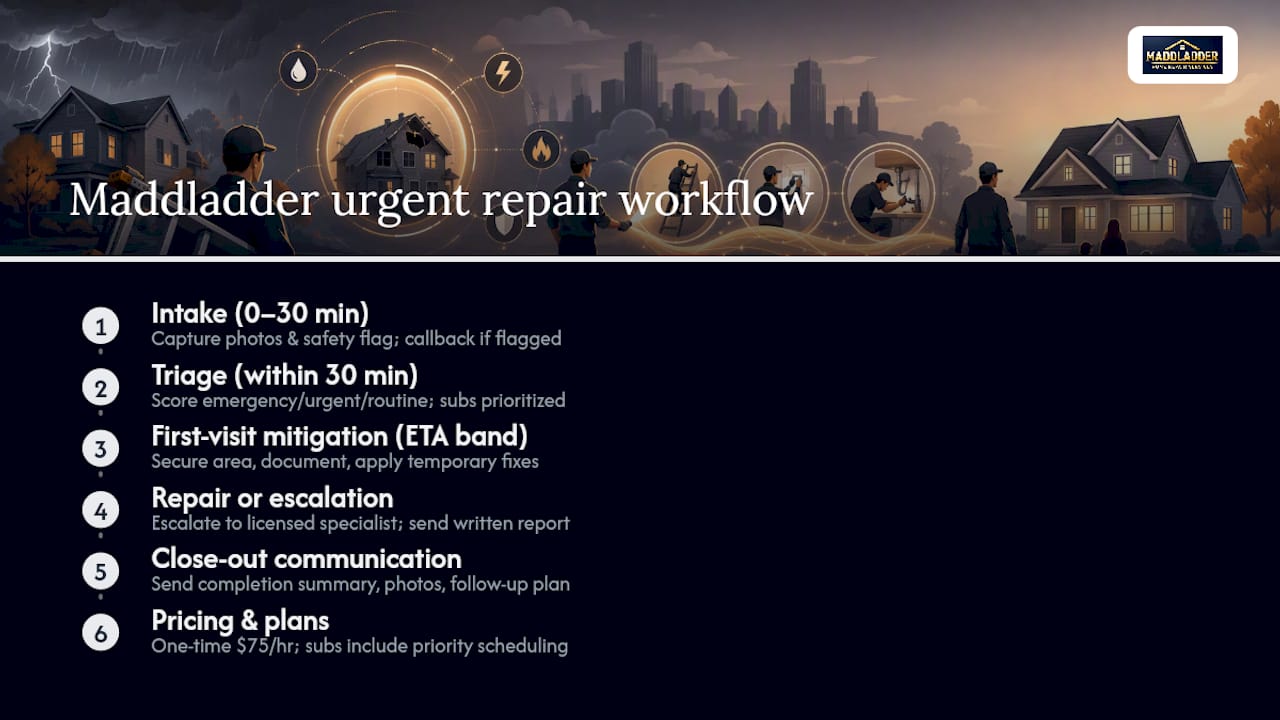
Here's how a real intake-to-resolution workflow runs for an urgent repair through Maddladder's operation in the Kansas City metro area.
Step 1 — Intake (0–30 minutes): Tenant or property manager submits a request by phone or online form. The intake captures photos, location, access instructions, and a safety flag. Any yes on the safety flag triggers an immediate callback.
Step 2 — Triage (within 30 minutes of intake): The request is scored against the emergency/urgent/routine framework. Subscription plan clients (Home Care and Property Manager tiers) receive priority scheduling — their tickets move to the front of the queue before one-time service requests at the same tier.
Step 3 — First-visit mitigation (within the assigned ETA band): The technician arrives, secures the area, documents pre-repair conditions, and applies any temporary mitigation needed. For minor plumbing and electrical repairs — faucets, toilets, outlets, switches — the repair is often completed on the first visit.
Step 4 — Repair or escalation: If the scope requires a licensed specialist (panel work, gas line, structural), Maddladder documents findings and coordinates the handoff. The client gets a written summary of what was found and what the next step is.
Step 5 — Close-out communication: After the visit, the client receives a summary message confirming what was completed, any follow-up scheduled, and a photo record of the finished work.
Pricing context: One-time handyman services start at $75/hour. Subscription plans (Essential, Home Care, Property Manager) include priority scheduling and bundled maintenance visits, which changes both response speed and per-visit cost. Property managers running multiple units typically find the Property Manager tier pays for itself within the first emergency call it prevents.
Pro Tip: When booking an urgent repair, tell the intake team the specific safety signal — burning smell, active drip, no heat — not just the general problem. That one sentence determines whether you get a same-day visit or a next-day slot.
Copy/paste templates: intake form, triage matrix, and tenant follow-up
Intake form fields (copy into your CMMS or form tool)
- Property address and unit number
- Requestor name, phone, and email
- Date and time of report
- Problem description (free text)
- Room or system affected
- Photos attached (required: minimum 2)
- Is water actively leaking? (Yes / No)
- Is there a safety hazard? (Yes / No — if yes, describe)
- Is the unit currently uninhabitable? (Yes / No)
- Access instructions (key location, pet, restricted hours)
- Has any mitigation been attempted? (Yes / No — if yes, describe)
Triage matrix
| Priority | Criteria | Response window |
|---|---|---|
| Immediate | Life-safety risk, active flooding, gas leak, no heat below 50°F | Within 2 hours |
| High | Spreading damage, habitability compromised, broken exterior lock | Within 24 hours |
| Medium | Contained damage, system degraded but functional, tenant inconvenienced | Within 48–72 hours |
| Low | Cosmetic, no safety risk, no spreading damage | Scheduled within 7–30 days |
Priority SLAs
- Immediate: Technician contact within 30 minutes; on-site within 2 hours
- High: Scheduled within 24 hours; confirmation sent to tenant within 2 hours of intake
- Medium: Scheduled within 72 hours; confirmation sent within 24 hours
- Low: Added to next batch schedule; confirmation within 48 hours
Tenant follow-up template (post-emergency mitigation)
Useful resources for tenant-friendly communication:
- Keep follow-up messages under 100 words — tenants read short messages; they skim long ones
- Send within 2 hours of completing the visit, while details are fresh
- Always include the next step, even if it's "no further action needed"
- Tenant-friendly repair communication builds trust and reduces repeat contacts about the same issue
The trade-offs nobody talks about in urgent repair prioritization
Speed, cost, and contractor availability pull in different directions, and pretending otherwise produces bad decisions.
The conventional advice is to always respond immediately to anything that looks urgent. In practice, dispatching a technician at 11 PM for a non-spreading issue costs 1.5–2× the daytime rate and often produces a lower-quality repair because parts aren't available until morning anyway. The better rule: respond immediately to genuine emergencies (active flooding, gas, electrical hazard, no heat in winter), and hold firm on 24-hour windows for everything else. Tenants who understand the distinction accept it. Tenants who don't have been trained by inconsistent responses.
The other underappreciated trade-off is between preventive investment and reactive firefighting. Most property owners know preventive maintenance is cheaper in theory. What they underestimate is how fast the reactive cycle compounds: one deferred gutter cleaning leads to a fascia rot repair, which leads to a soffit replacement, which leads to a pest entry point. Each step is individually small and deferrable. Together they're a $6,000 project that started as a $150 cleaning.
Repairs that involve water, heat, or structural integrity should be prioritized for a response within a day to prevent costly emergencies. Everything else gets scored and scheduled. That single constraint, applied consistently, prevents the majority of expensive emergencies.
On crew safety: always follow OSHA guidelines for working in hazardous conditions — shut off utilities before work begins, use appropriate PPE, and never send a single technician into a confirmed gas or electrical hazard without proper equipment and a second person on standby. General information here is not a substitute for site-specific safety assessment by a qualified professional.
Maddladder handles urgent repairs in Kansas City so you don't have to
When the triage system works and the right crew shows up fast, property damage stays contained and tenants stay housed. That's exactly what Maddladder delivers for homeowners, landlords, and property managers across the Kansas City metro area.

Maddladder's repair and replacement services cover the full range of urgent handyman work: minor plumbing and electrical repairs, drywall, fixture replacement, safety upgrades, and smart home installs. One-time service starts at $75/hour with free estimates, so you know the cost before anyone shows up. Subscription plans — Essential, Home Care, and Property Manager — move your tickets to the front of the queue and bundle preventive visits that reduce the emergency calls in the first place. Property managers running multiple units find the Property Manager tier particularly effective: priority response, recurring maintenance, and a single point of contact for every property.
To get started, request a free estimate or call directly. On the first call, have your intake information ready (address, photos if possible, the specific issue), and Maddladder will confirm a response window before the call ends.
Sources
The recommendations in this article draw on the following resources. Consult them directly for funding options, inspection standards, and technical guidance.
- Homeowners delay repairs, face safety and financial risks
- How to Prioritize Home Repairs When Money Is Tight | by Angus Peterson | Jun, 2026 | Medium
- Nachi