
TL;DR:
- Delaying home repairs in Kansas City can lead to significant water, mold, and structural damage that becomes costly. Rapid response is critical because weather conditions accelerate damage growth, often within 24 to 48 hours. Being prepared with trusted local contractors and understanding response timelines can save homeowners thousands of dollars.
A small water stain on your ceiling might seem like a low-priority problem you can deal with "next weekend." But for Kansas City homeowners, that kind of thinking can turn a $150 fix into a $6,000 restoration project within days. Kansas City's unpredictable storms, heavy spring rains, and persistent summer humidity create conditions where minor issues compound fast. This article breaks down exactly what happens when you delay repairs, how local weather accelerates that damage, and what you can do right now to protect your home and your wallet before a manageable problem becomes a disaster.
Table of Contents
- The true cost of delaying home repairs
- Kansas City's climate: Why fast response is critical
- What counts as a 'quick' response? Timing and expectations
- Smart repairs: How to act fast without overpaying
- A contractor's perspective: What most homeowners still miss about repair urgency
- Need fast, reliable home repairs in Kansas City?
- Frequently asked questions
Key Takeaways
| Point | Details |
|---|---|
| Early action saves money | Responding quickly to home repairs prevents minor issues from becoming expensive emergencies. |
| Kansas City climate accelerates damage | Humidity and storms make prompt repairs crucial to avoid mold and costly restoration. |
| Know repair urgency levels | Differentiate between emergency and routine repairs to prioritize action and manage costs. |
| Smart response beats panic spending | Verify provider pricing and get temporary fixes to balance urgency with financial sense. |
The true cost of delaying home repairs
After understanding why repair speed matters, let's get specific about what happens when you hesitate.
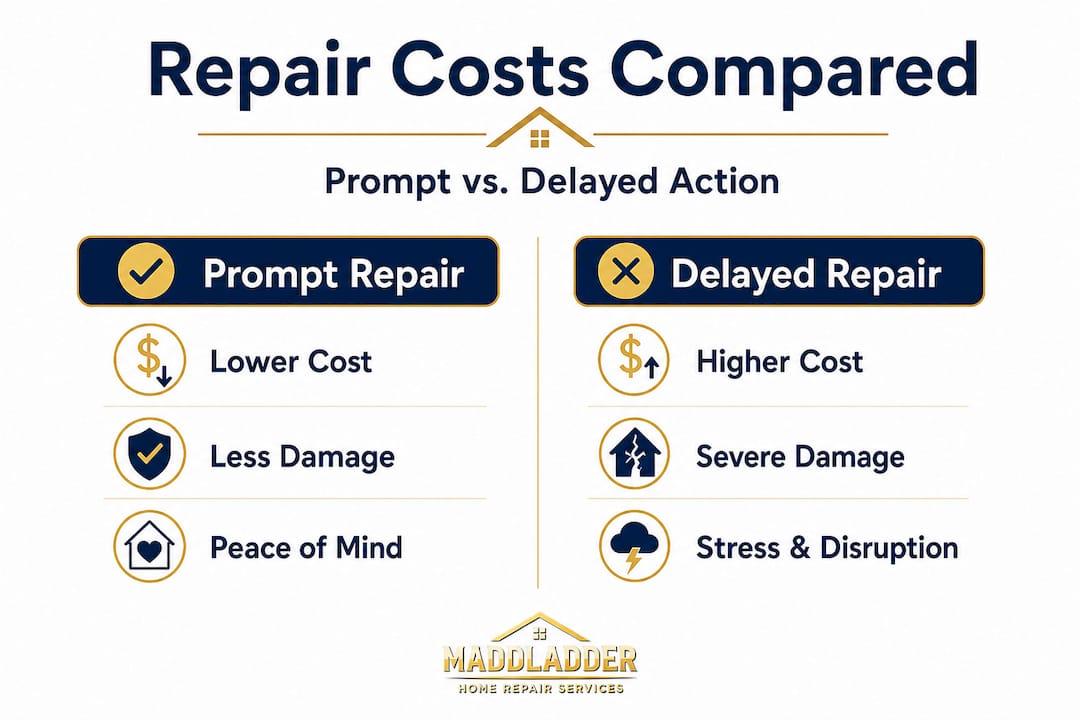
Most homeowners assume a leaky faucet, a small crack in the drywall, or a slow drain can sit for a few weeks without consequence. The math tells a very different story. Reactive maintenance costs rise sharply because emergencies are more expensive than planned work, and damage compounds at every stage of neglect. A hairline crack in a pipe fitting that costs $80 to fix today can fail completely next month, flooding your basement and triggering a $4,000 to $10,000 restoration bill.
The price gap between preventive and emergency repair is staggering:
| Repair Type | Preventive Cost | Emergency/Delayed Cost |
|---|---|---|
| Slow drain or small leak | $100 to $200 | $800 to $3,500 |
| Minor drywall damage | $75 to $150 | $500 to $1,500 |
| Loose electrical outlet | $50 to $100 | $300 to $2,000+ |
| Small roof flashing gap | $150 to $300 | $2,000 to $8,000 |
Beyond the dollar amounts, delays introduce serious safety and liability risks. Water intrusion weakens structural components. Faulty wiring left unrepaired raises fire risk. Mold that grows silently behind walls can cause respiratory problems for your family. If you rent your property, unaddressed hazards can expose you to legal liability.
Here is what delayed repairs actually cost Kansas City homeowners beyond the repair bill itself:
- Higher emergency call-out fees from contractors working nights or weekends
- Insurance claim complications when insurers determine damage was preventable
- Health costs from mold exposure, particularly for children and elderly residents
- Property value reduction when deferred maintenance becomes visible to buyers or appraisers
- Temporary relocation costs if a failure renders part of the home uninhabitable
The key insight from saving time and costs is that speed of action is one of the most reliable ways to control your total repair budget over time. Understanding handyman value means recognizing that a skilled pro who handles a problem on day one is almost always cheaper than a specialist called in on day thirty when the damage has multiplied.
Kansas City's climate: Why fast response is critical
Knowing what delay can cost you, it's important to understand how quickly Kansas City's weather can make things worse.
Kansas City sits in a region that receives significant spring and summer storm activity, with annual rainfall averaging around 38 to 40 inches. Add in the sticky, high-humidity summers where indoor relative humidity can climb well above 60%, and you have a perfect environment for rapid mold growth and structural decay. Most homeowners don't realize that mold can begin colonizing damp materials in as little as 24 to 48 hours under the right conditions.
"For water-related problems, the first 24 to 48 hours are critical; acting quickly helps minimize property damage and reduces mold risk."
That window is brutally short. A storm rolls through on a Thursday night, water sneaks under a door or through a compromised soffit, and by Saturday morning you may already have active mold colonies forming behind baseboards or inside wall cavities. By the following weekend, what started as damp drywall has potentially become a mold remediation job.
Common Kansas City scenarios where speed is everything:
- Storm damage to siding, soffits, or roof flashing that allows water inside
- Plumbing leaks from temperature swings that stress pipe joints, especially in older homes
- Wet drywall from basement flooding during heavy rain events
- Window seal failures that let humid outdoor air condense inside walls
- Foundation cracks that admit groundwater after a saturation event
Addressing minor plumbing fixes promptly is especially important in older Kansas City neighborhoods where pipe materials may already be near the end of their useful life. Similarly, drywall repair guidance consistently emphasizes that wet drywall must be dried and repaired quickly, not just dried and left, because residual moisture remains trapped. For any fixture issues exposed to weather or humidity, a solid fixture replacement checklist helps you stay ahead before small failures turn severe.
The bottom line: Kansas City's climate doesn't give you the luxury of a two-week "let's wait and see" approach. It punishes hesitation faster than almost any other region in the Midwest.
What counts as a 'quick' response? Timing and expectations
Once you recognize the urgency, it's useful to know what a reasonable repair timeline looks like.
Not every repair is a fire drill. But knowing which category a problem falls into helps you make smarter decisions about when to call and what to expect. Many homeowners expect fast turnaround for urgent issues, with roughly 46% expecting a response within four hours for true emergency situations. That expectation is reasonable for situations like burst pipes, active leaks, or electrical hazards.
Here is a practical breakdown of response time expectations by repair type:
| Repair Category | Response Target | Examples |
|---|---|---|
| Emergency | Within 2 to 4 hours | Burst pipes, electrical shorts, major storm entry |
| Urgent | Same day or next morning | Active slow leak, failed HVAC in extreme weather |
| Standard | Within 2 to 3 business days | Drywall damage, fixture replacement, minor plumbing |
| Routine | Within 1 to 2 weeks | Cosmetic repairs, non-critical maintenance |
When you call for same-day repair options, you should also ask the right questions upfront so there are no surprises on the invoice.
Steps to take when a repair feels urgent:
- Identify whether the problem poses an immediate safety risk (water near electrical, structural instability)
- Stop the source if possible, such as shutting off the water supply valve
- Document damage with photos before any cleanup or repair begins
- Call your repair contact and describe both the problem and any mitigation steps you have already taken
- Confirm whether after-hours or weekend rates apply and get a verbal estimate range before work begins
- Ask if a temporary fix can be done immediately while a full repair is scheduled for the next day
Pro Tip: Keep the location of your main water shutoff valve memorized. In a plumbing emergency, every minute you spend searching for it is another minute of active water damage.
Emergency response can sometimes carry a premium fee, which is fair given the scheduling disruption for the contractor. What is not fair is discovering that fee only after the work is done. Always ask about after-hours rates upfront, and understand that a modest urgency premium paid today is almost always less than the cost of unchecked damage tomorrow.
Smart repairs: How to act fast without overpaying
With clear timelines and expectations in mind, here's how you can navigate urgent repairs without breaking the bank.
Speed and smart spending are not opposites. The key is knowing how to triage what you are dealing with and communicate clearly with your repair professional from the first call. Some providers charge an urgency premium for after-hours response, so always confirm pricing and scope even while acting quickly. Knowing this ahead of time puts you in control of the conversation.
Here is how to act fast without getting caught off guard financially:
- Assess severity before you call. Is this an active safety hazard or a problem that will worsen over the next 12 to 24 hours? If it falls into either category, call now. If it is purely cosmetic, you have time to compare options.
- Request temporary mitigation first. A good handyman can often deploy a temporary fix, such as a water barrier, a patch, or a shutoff, that stops damage from spreading while a full repair gets scheduled during standard hours.
- Confirm scope in writing or by text. Before anyone starts work, agree on what is being done, what parts or materials are included, and what the labor rate is.
- Know your baseline costs. Reviewing flexible pricing tips before an emergency helps you recognize a fair rate when you hear one, rather than making panicked decisions.
- Build your contact list now, not during a storm. Keep phone numbers for a trusted local handyman, a plumber, and an electrician saved and accessible. When water is coming through your ceiling, that is not the time to start reading reviews.
Pro Tip: A maintenance plan or subscription service with a trusted local handyman gives you priority scheduling and often eliminates the after-hours scramble entirely. When you already have a relationship, you move to the front of the line.
Urgency does not have to mean desperation. Homeowners who prepare in advance by knowing their home's vulnerable spots, having repair contacts saved, and understanding what a fair emergency rate looks like are the ones who walk away from a storm with a $300 repair bill instead of a $3,000 restoration invoice.
A contractor's perspective: What most homeowners still miss about repair urgency
With the facts and action steps established, let's look at the overlooked nuances that only experience reveals.
Here is something the standard "fix it fast" advice usually glosses over: most homeowners who delay repairs do not do it because they are careless. They do it because they are waiting for a full quote, trying to find the "best" price, or simply underestimating what is actually happening inside their walls. We understand that instinct completely. But in Kansas City, that hesitation has a real cost that most advice columns never quantify clearly.
The conventional wisdom is to get three quotes before committing to any repair. That approach is perfectly sound for a kitchen remodel or a deck build. It is genuinely risky when you are dealing with water intrusion during heavy rains or spring storms, where humidity and warmth can turn damp insulation into a mold colony over a single weekend. In those situations, spending two days collecting bids is spending two days letting damage grow.
What experienced contractors see over and over is that temporary repairs are dramatically underused. Homeowners either want the full fix done immediately or they wait entirely. There is a very powerful middle option: get someone in the door today to stop the damage, then schedule the full repair properly. A waterproof membrane over a flashing gap, a capped pipe fitting, or a foam-sealed crack does not cost much and can buy you days or weeks without consequence.
We also see a lot of homeowners avoid calling during a post-storm surge because they assume everyone charges triple. Some do. But established local pros who value long-term customer relationships often absorb the inconvenience rather than gouge on pricing, because they know repeat business and referrals are worth more than one inflated invoice. Building a relationship with a reliable local handyman before you need an emergency call is one of the best investments a Kansas City homeowner can make. Staying aware of home repair trends also helps you anticipate which systems in your home are most likely to need attention before they fail, so you can act on your schedule rather than your home's.
The uncomfortable truth is this: repair urgency is not just about the damage in front of you. It is about every hour of delay that makes the next repair more expensive, more disruptive, and more likely to involve specialists instead of a straightforward fix.
Need fast, reliable home repairs in Kansas City?
If quick action can mean the difference between prevention and disaster, here's how to get help that keeps up with KC's needs.
At MaddLadder, we built our service model around one simple reality: Kansas City homeowners need a repair partner who shows up fast, charges fairly, and knows the local conditions that turn small problems into big ones. Whether you are dealing with storm-related damage, a slow plumbing issue, or a list of deferred repairs, we are ready to help.

Our rapid repair and replace service is designed for exactly the scenarios this article describes: time-sensitive problems that need skilled hands quickly. We also handle plumbing and electrical services for those trickier repairs that go beyond general maintenance. And if you want to see everything we can help with, our full service menu covers everything from drywall and fixture replacement to smart home upgrades and safety installations. Free estimates, flexible pricing, and a team that knows Kansas City. That is what we offer.
Frequently asked questions
How soon should I fix a water leak in my Kansas City home?
You should address water leaks within 24 to 48 hours to avoid mold growth and significant structural damage, especially given Kansas City's humid climate.
What is an emergency vs. routine home repair?
Emergency repairs include burst pipes, electrical hazards, or active storm damage that require immediate action. Routine repairs are non-critical issues, like cosmetic fixes, that can be scheduled with flexibility without risk of escalating damage.
Does responding quickly to repairs really save money?
Yes, significantly. Preventive repairs typically cost a fraction of emergency fixes, and reactive maintenance costs compound quickly when damage is allowed to spread over days or weeks.
Will I always pay more for a quick emergency repair?
Not necessarily. While some providers charge a premium for after-hours response, the cost of that premium is almost always far less than the escalating damage bill you face if you wait.
What services handle urgent repairs in Kansas City?
Local handymen, licensed plumbers, and electrical contractors typically offer emergency response options, and some, like MaddLadder, specialize in rapid-response repairs across the full Kansas City metro area.