

TL;DR:
- Flexible pricing models like time-and-materials and subscription plans give Kansas City homeowners better control over repair costs.
- Older homes with hidden issues benefit from adaptable pricing to avoid unexpected expenses during repairs.
- Combining various pricing strategies with negotiated vendor rates maximizes savings and reduces repair-related risks.
Unpredictable repair bills are one of the most stressful parts of owning a home in Kansas City. You budget for a small fix, then discover rotted framing behind the drywall or a plumbing line that hasn't been touched since 1975. Fixed pricing sounds safe, but it often leaves you either overpaying for simple jobs or facing nasty surprises when the scope changes. The truth is that flexible pricing strategies, from time-and-materials contracts to tiered subscription plans, give Kansas City homeowners and property managers real control over what they spend and when they spend it.
Table of Contents
- Understanding flexible pricing models in home maintenance
- How flexible pricing protects you from unpredictable repairs
- Subscription plans for routine upkeep and ROI
- Negotiated vendor rates, markups, and hybrid approaches
- A fresh perspective: what most Kansas City homeowners miss about flexible pricing
- Get peace of mind and save with MaddLadder's smart solutions
- Frequently asked questions
Key Takeaways
| Point | Details |
|---|---|
| Flexible pricing advantage | Models like T&M and cost-plus adapt to surprise repairs and save money in Kansas City’s varied homes. |
| Subscription ROI | Routine maintenance plans deliver predictable costs and can cut emergency repairs by thousands annually. |
| Avoid vendor markups | Working with negotiated rates eliminates unnecessary fees and maximizes savings for property managers. |
| Hybrid options for Kansas City | Combining approaches gives homeowners and managers the best balance between predictability and adaptability. |
Understanding flexible pricing models in home maintenance
Most people think of pricing as a binary choice: you either get a flat fee or you pay by the hour. Reality is more nuanced, and understanding your options can save you hundreds of dollars on every project.
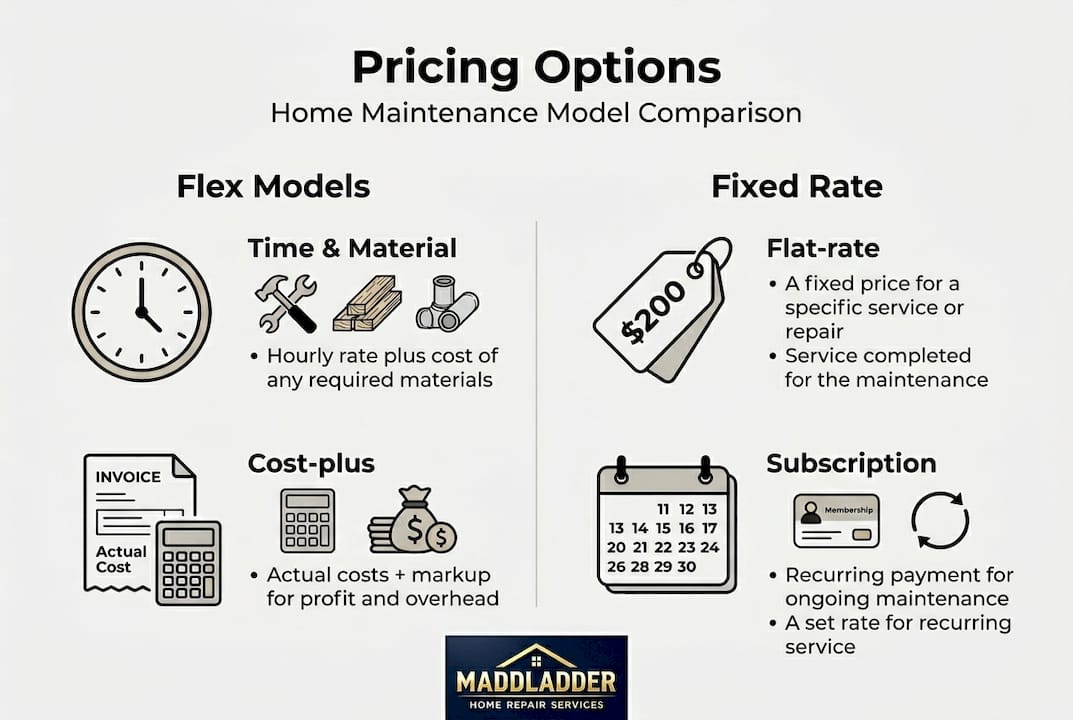
Time-and-materials (T&M) pricing means you pay for actual labor hours plus the cost of materials used. There's no guessing on the contractor's end, and there's no padding built into the quote to cover worst-case scenarios. Cost-plus pricing works similarly but adds a defined percentage on top of material costs as the contractor's profit. Both models thrive on transparency. Subscription-based plans are the newest evolution, offering a monthly or annual fee in exchange for regular check-ins, minor repairs, and priority scheduling.
Here's how these stack up against flat-rate pricing:
| Pricing model | Best for | Risk level | Transparency |
|---|---|---|---|
| Flat-rate | Simple, well-defined tasks | Low upfront | Moderate |
| Time-and-materials | Complex or uncertain scope | Variable | High |
| Cost-plus | Large renovation projects | Moderate | High |
| Subscription | Routine upkeep, rentals | Low overall | High |
Kansas City homes present unique challenges. Many neighborhoods like Brookside, Waldo, and Westport feature houses built between the 1920s and 1960s. Behind the charm, you'll often find knob-and-tube wiring, cast-iron drain pipes, and insulation that has long since lost its effectiveness. These hidden issues make flexible T&M or cost-plus models the smarter choice because they adapt to unknown scope changes instead of penalizing you with emergency upcharges.
According to the industry pricing overview from Workbench Guide, most contractors who work on older residential stock prefer T&M precisely because there's no way to price hidden problems in advance. Locking in a flat rate either overcharges the customer upfront or leaves the contractor absorbing losses.
Our transparent pricing guide walks through how open-book billing actually works in practice and why Kansas City homeowners respond well to it. Staying informed on home repair trends also helps you know when a hybrid pricing strategy adds the most value.
Pro Tip: If your home was built before 1980, strongly consider T&M or a hybrid plan for any project touching walls, floors, or plumbing chases. Hidden conditions behind finished surfaces are almost guaranteed, and a flat-rate quote won't protect you from what's lurking there.
Key signs your home needs a flexible approach:
- The home is more than 40 years old
- You've had recurring issues with the same system (HVAC, plumbing, electrical)
- You manage multiple rental units with varying conditions
- You've experienced cost overruns on previous flat-rate projects
- You need emergency repairs where scope is genuinely unknown
How flexible pricing protects you from unpredictable repairs
With a clear understanding of pricing methods, let's see how flexibility can directly protect your wallet from unexpected repair costs.
Picture this: a pipe bursts in a 1940s bungalow in Hyde Park on a January night. A flat-rate plumber quotes a fixed price to replace the visible section of pipe. Then they open the wall and find corroded supply lines running through three rooms. The flat-rate quote either didn't account for that or it did, and you paid for it regardless. T&M would have billed only for what was actually discovered and repaired, with full visibility at every step.
Flat-rate pricing eliminates billing variance and speeds up approval for property managers, which is genuinely useful for routine work. But it lacks flexibility when scope changes mid-repair, which is exactly when Kansas City's older housing stock bites you hardest.
Here's a realistic cost comparison:
| Scenario | Flat-rate cost | T&M actual cost | Difference |
|---|---|---|---|
| Simple faucet replacement | $175 | $160 | $15 savings with T&M |
| Drywall repair (unknown cause) | $400 | $290 | $110 savings with T&M |
| Emergency pipe repair, old home | $850 | $620 | $230 savings with T&M |
| HVAC filter + minor tune-up | $220 | $240 | $20 more with T&M |
Proactive maintenance reduces long-term repair costs significantly. Catching small issues early, like a dripping faucet or a hairline crack in caulking, can prevent repairs that cost three to five times more when left unaddressed.
Consider transparent plumbing cost practices, which show that customers who understand itemized billing report higher satisfaction and fewer disputes, even when total costs are similar. Transparency itself is a form of value.
Here's a practical approach to handling repairs under flexible pricing:
- Request an itemized estimate before work begins, even for T&M jobs. A good contractor can give you a realistic range.
- Set a not-to-exceed cap for T&M projects if your budget is firm. This gives you the flexibility of T&M with a safety ceiling.
- Review material costs upfront so you're not surprised by supplier markups built into the bill.
- Ask about known risk areas before opening walls or floors. Experienced local handymen often know what to expect in homes of a certain age or neighborhood.
- Document scope changes in writing so there's no confusion about what drove additional costs.
Following our repair scheduling guide helps you organize these steps before anyone shows up at your door. Knowing whether your contractor holds a valid handyman license also matters when disputes about scope or billing arise.
Subscription plans for routine upkeep and ROI
Once you see how repairs benefit from flexibility, let's explore how subscriptions make routine upkeep even more manageable.
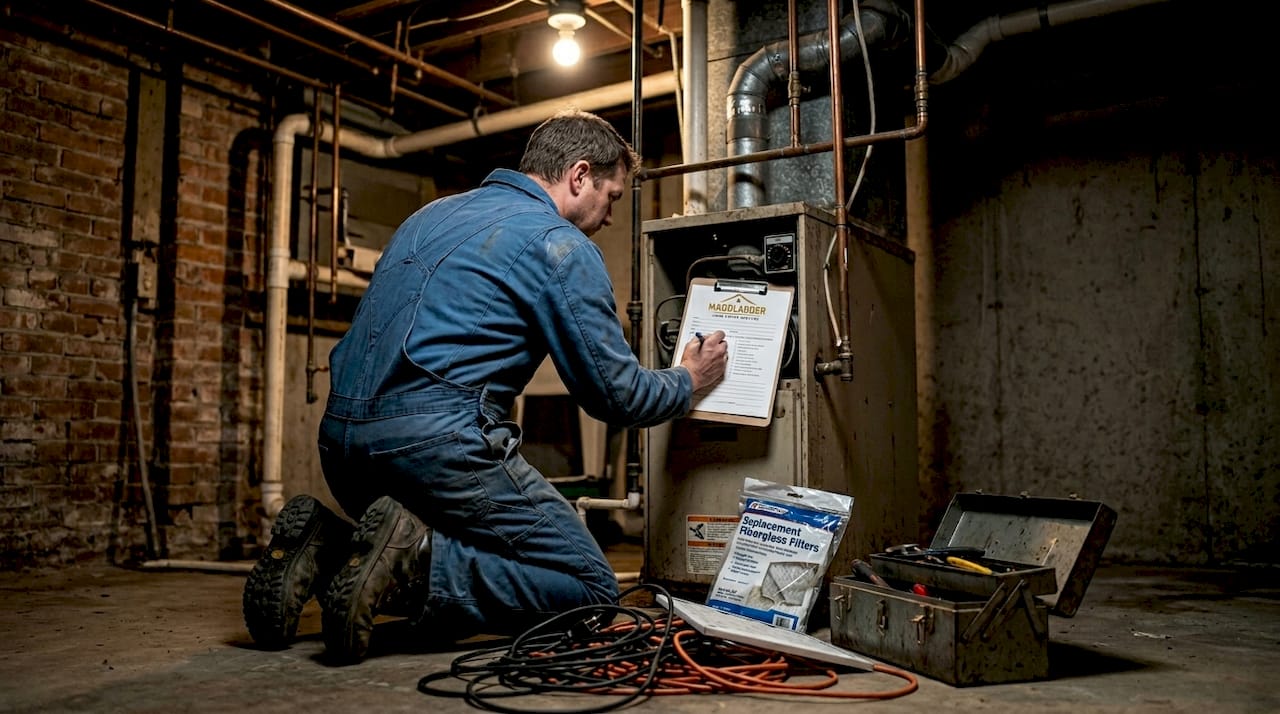
Subscription maintenance plans have quietly become one of the smartest tools for busy Kansas City homeowners and property managers. Instead of reacting to problems, you're paying a predictable monthly or annual fee to prevent them. Services like HomeSmiles 365 in Kansas City offer plans starting around $99 per month that include quarterly visual inspections, HVAC filter deliveries, and proactive minor fixes before they escalate.
Think of it like a gym membership for your house. You're paying consistently whether or not you use every service each month, but the cumulative benefit of showing up regularly far outweighs the cost of fixing what breaks from neglect.
Here's what a quality subscription plan typically covers:
- Quarterly walk-through inspections of key systems
- Seasonal HVAC filter replacements
- Minor caulking, weatherstripping, and seal repairs
- Gutter and downspout checks before spring and fall storms
- Priority scheduling for repairs when issues arise
- Discounted hourly rates on labor beyond the plan scope
The ROI math is compelling. An HVAC tune-up costs around $2,000 when bundled with a service plan, compared to $3,500 or more for a full replacement when a neglected unit fails. For property managers, proactive maintenance can shrink vacancy periods from the 30 to 45 day industry average down to just 14 days, generating $2,000 to $4,000 in additional annual rental income per unit.
Kansas City's climate makes subscriptions particularly valuable. Harsh winters stress pipes and seals. Hot, humid summers push HVAC systems to the limit. Spring brings heavy rain and flooding risks. A year-round maintenance plan that accounts for all four seasons is not a luxury here. It's basic risk management.
Our guide on home improvement savings shows real before-and-after cost comparisons for homeowners who switched from reactive to proactive maintenance. The savings are consistent and significant.
External resources like preventing costly repairs and a solid maintenance checklist for 2026 give you specific checks you can either do yourself or hand off to your service provider.
Pro Tip: If you manage rental properties, look for subscription plans that specifically include landlord-tenant documentation. Having a written record of every inspection and repair protects you legally and helps justify security deposit decisions.
Negotiated vendor rates, markups, and hybrid approaches
To round out your options, it's crucial to see how savvy managers combine pricing strategies and work with vendors for maximum savings.
One of the least talked-about advantages available to property managers and repeat customers is negotiated vendor rates. When a management company or handyman service maintains ongoing relationships with suppliers, they often get materials at a lower cost than a one-off buyer. The question is whether those savings get passed to you or absorbed as profit.
Vendor markups of 5% to 15% on materials are common in the industry. Some contractors mark up materials to offset low labor rates. Others do it simply because the customer never asks. Zero-markup or negotiated vendor rates can reduce your overall repair costs by 10% to 15% on materials alone. Combined with proactive maintenance, property managers who work with vendors this way have seen emergency repair costs drop by as much as 40%.
Here's how marked-up versus negotiated pricing plays out over a year:
| Cost category | Marked-up pricing | Negotiated pricing | Annual savings |
|---|---|---|---|
| Materials (annual) | $3,200 | $2,720 | $480 |
| Emergency repairs | $4,500 | $2,700 | $1,800 |
| Routine labor | $2,400 | $2,400 | $0 |
| Total | $10,100 | $7,820 | $2,280 |
Hybrid pricing approaches combine the best elements of each model:
- Flat-rate for routine tasks (smoke detector checks, filter swaps, minor caulking)
- T&M for investigative or unknown-scope repairs (water damage, electrical faults)
- Subscription for seasonal inspections and priority access
- Negotiated material rates applied across all work types
This blend is especially effective for property managers who oversee units of different ages and conditions. A newer building might need only light subscription coverage and occasional flat-rate repairs. A 1950s fourplex in Westport needs T&M for anything structural plus a robust seasonal inspection plan.
Explore our pricing overview to see how these models are structured in practice. Understanding the true handyman value for busy Kansas City homes helps you decide which combination fits your situation best.
A fresh perspective: what most Kansas City homeowners miss about flexible pricing
With all the evidence laid out, here's an honest viewpoint from local pros about what really makes flexible pricing effective in Kansas City.
Most homeowners approach pricing with one goal: avoid surprises. That instinct is understandable, but it leads to a trap. They lock into flat-rate contracts thinking they're protected, then feel blindsided when the contractor discovers conditions that weren't visible from the surface. Flat-rate quotes don't eliminate surprises. They just shift who absorbs the financial shock.
The smarter mindset is to expect variability and plan for it. Kansas City's housing stock almost guarantees it. Avoiding vendor markups of 5 to 15% by working with transparent providers is one concrete step most homeowners never think to take. Asking "do you pass through materials at cost?" before hiring anyone is a question that pays for itself immediately.
DIYers often resist subscriptions because they believe they can handle routine upkeep themselves. That's fair for some tasks. But busy managers with multiple units, or homeowners who travel frequently, lose far more in deferred maintenance than they save by skipping a $99 monthly plan. Our inclusive pricing transparency guide explains exactly what to look for when evaluating any pricing offer.
The real advantage of flexible pricing isn't just financial. It's relational. When you work with a contractor on a T&M or subscription basis, they have an incentive to be honest about what they find, because their billing reflects reality, not a number they committed to before seeing the inside of your walls.
Get peace of mind and save with MaddLadder's smart solutions
Ready to take action? Here's how MaddLadder helps you leverage flexible pricing in Kansas City for risk-free repairs and maintenance.
MaddLadder serves homeowners, landlords, and property managers across the Kansas City metro with honest, licensed handyman services built around your actual needs, not a one-size-fits-all price sheet. Whether you need minor plumbing and electrical repairs handled quickly or want to invest in smart home upgrades like programmable thermostats and security cameras, we offer one-time services starting at $75/hour and subscription plans designed for both homeowners and property managers.

Browse our full service lineup and request a free estimate today. Our team responds quickly, explains pricing clearly, and shows up ready to work.
Frequently asked questions
What's the difference between flat-rate and flexible pricing for home repairs?
Flat-rate pricing charges a fixed fee regardless of actual time or materials, while flexible models like T&M bill for exactly what was used, making them more accurate for unpredictable or complex repairs.
Are home maintenance subscriptions worth it for Kansas City homeowners?
For homeowners with older properties or multiple rental units, yes. Subscription plans deliver predictable budgeting and prevent costly failures through quarterly inspections and seasonal upkeep, though DIYers with newer homes may not need them.
How do negotiated vendor rates help property managers save money?
Working with providers who pass through negotiated rates saves 10% to 15% on materials and can cut emergency repair costs by up to 40% compared to contractors who apply standard markups.
Can I combine subscription, flat-rate, and flexible pricing for my property?
Absolutely. Many Kansas City property managers use hybrid pricing models that apply flat-rate billing for routine tasks, T&M for complex repairs, and subscriptions for seasonal inspections, giving them both predictability and adaptability.
What's the typical ROI from proactive maintenance in Kansas City?
Property managers who invest in proactive maintenance typically see $2,000 to $4,000 in annual savings through lower vacancy periods and avoided emergency repair costs like HVAC replacements.