
TL;DR:
- Inclusive home repair pricing covers labor, materials, disposal, permits, and accessibility modifications upfront.
- Different pricing models—flat-rate, hourly, subscription—suit specific repair needs and home conditions.
- Transparency and access to resources help Kansas City residents reduce costs and ensure fair, accessible repairs.
You open a home repair invoice expecting a clean number and instead find a wall of line items: "miscellaneous labor," "material handling fee," "disposal surcharge." Sound familiar? For Kansas City homeowners and property managers, confusing bills are more common than they should be. Inclusive home repair pricing flips that script. It means one clear price that covers everything upfront, including labor, materials, and any accessibility modifications your home needs. In this guide, you will learn exactly what inclusive pricing means, how it works in the Kansas City market, how to compare pricing models, and how to find providers who actually deliver on the promise of fairness.
Table of Contents
- Defining inclusive home repair pricing
- How inclusive pricing works in Kansas City: Real examples
- Flat-rate vs. hourly vs. subscription models: Pros, cons, and local results
- Making inclusive and accessible repairs affordable: Practical tips for Kansas City
- Why true inclusivity in home repair pricing demands more than transparency
- Get started with fair, accessible home repairs in Kansas City
- Frequently asked questions
Key Takeaways
| Point | Details |
|---|---|
| All-in pricing defined | Inclusive home repair pricing bundles labor, materials, and accessibility needs for true transparency. |
| Local KC models | Kansas City offers flat-rates, subscriptions, and nonprofit help for accessible repairs. |
| Pros and cons | Understand flat-rate, hourly, and subscription pricing—each fits different job types and risks. |
| Save and protect | Bundle repairs, insist on itemized quotes, and check grants to cut costs, especially for aging and accessibility. |
| Beyond the price | True inclusivity also means addressing legacy issues, safety, and equity, not just straightforward billing. |
Defining inclusive home repair pricing
The term "inclusive home repair pricing" does not appear in a textbook, but it describes something very real. Think of it as the opposite of surprise billing. Transparent, all-inclusive pricing means the final price you are quoted covers labor, materials, and incidentals without hidden fees. No add-ons at the door. No "we forgot to mention" charges after the job is done.
For Kansas City homeowners, this matters for one simple reason: predictability. When you know the full cost before work begins, you can budget confidently, compare providers fairly, and avoid the stress of an inflated final bill. Property managers especially benefit because they handle multiple units and need consistent cost forecasting across their portfolio.
Here is what a truly inclusive repair price typically bundles together:
- Labor costs (all hours needed to complete the job)
- Materials and parts (no separate trip-charge markups)
- Disposal fees (hauling away old fixtures, drywall, or debris)
- Permit costs where applicable
- Accessibility modifications such as grab bars, ramps, or widened doorways when part of the scope
Transparency is only half the story, though. The other half is accessibility. True inclusive pricing also means proactively designing repairs for people who are aging in place or living with disabilities. This is not just about covering costs. It is about making sure the work itself serves everyone in the home, not just the average able-bodied resident.
"Inclusive pricing is not a discount. It is a commitment to honesty about what a job actually costs, so homeowners can make informed decisions without fear."
For deeper context on what general repair work looks like in this market, the Kansas City home repair basics guide breaks down common service categories and what to expect from local providers. Understanding the scope of work is the first step toward evaluating whether a price is truly all-in.
One thing to watch: some companies use the word "transparent" loosely. A price list on a website is not the same as an itemized, scope-specific quote. Always push for a written estimate that names every cost element before you approve any work.
How inclusive pricing works in Kansas City: Real examples
Kansas City has a growing number of service providers experimenting with inclusive and transparent pricing models. You can see it in maintenance subscription plans like HomeSmiles 365 at $99 per month, and in tiered remodel packages where kitchen refreshes start around $75,000 for an essential scope. Property managers in KC often rely on in-house maintenance teams to keep repair costs predictable across multiple units.
Here is how the three most common pricing structures compare in the Kansas City market:
| Pricing model | Typical KC example | Best for | Watch out for |
|---|---|---|---|
| Flat-rate | Drywall patch: $150 fixed | Single, well-defined jobs | Padded rates on simple tasks |
| Hourly | Handyman at $75 to $100/hr | Complex or open-ended work | Overruns on unclear scopes |
| Subscription | $99 to $199/month plans | Regular maintenance needs | Paying for services you rarely use |
The numbers behind home repair spending tell a clear story. Average annual home repair spend in the US runs about $2,041 for planned maintenance and $1,143 for emergencies in 2025, and total US repair needs reached $198.4 billion in 2024, with low-income households making up 37.6% of that need. In Kansas City specifically, a plumber typically charges between $167 and $443 per job depending on complexity.

Those numbers put inclusive pricing in perspective. When emergencies hit, a homeowner without a clear pricing framework can easily overpay by hundreds of dollars. Knowing the benchmark helps you push back.
Pro Tip: Even with a flat-rate or subscription provider, always request an on-site visit before final pricing is confirmed. Photos and phone descriptions miss details that change costs, especially in older KC homes with non-standard construction.
Kansas City also has local nonprofit programs that extend inclusive pricing to low-income and vulnerable residents. Organizations like Rebuilding Together KC offer free or subsidized repairs with an explicit focus on accessibility upgrades for elderly and disabled homeowners. Pairing these resources with a private provider who offers transparent pricing can dramatically reduce out-of-pocket costs for qualifying households. For more context on what repairs actually deliver in value, the home repair value examples page is a useful reference, and if you are ready to act, scheduling repairs in KC walks you through the process step by step.
Flat-rate vs. hourly vs. subscription models: Pros, cons, and local results
Pricing structures are not interchangeable. Each one fits certain situations better than others, and choosing the wrong model for your repair type can cost you real money.
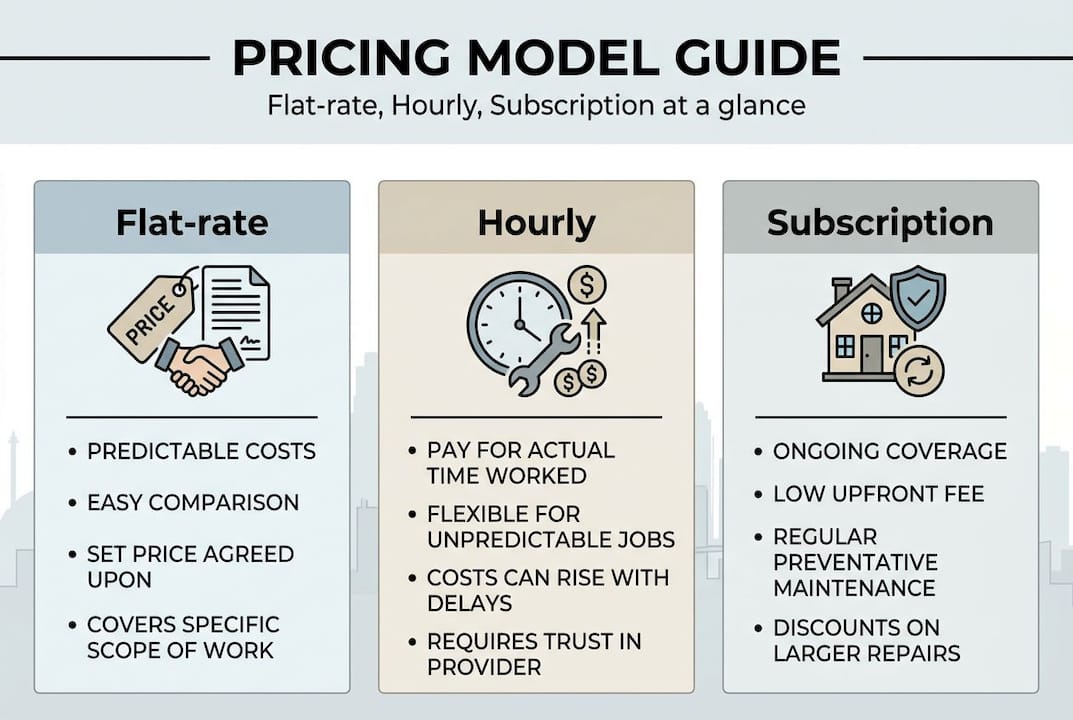
| Model | Pros | Cons | Best KC use case |
|---|---|---|---|
| Flat-rate | Predictable, easy to compare | Can be padded for simple jobs | Defined repairs: drywall, fixture swap |
| Hourly | Flexible, fair for complex work | Risk of scope creep and overruns | Older homes, multi-step projects |
| Subscription | Consistent maintenance coverage | Monthly cost even in slow months | Landlords managing multiple units |
Flat-rate pricing earns praise for eliminating surprises, but it can be criticized when providers pad simple jobs to protect their margins. Hourly pricing is flexible and fair in theory, but without a clear scope of work, it opens the door to overruns. Subscriptions offer steady coverage but can feel like an ongoing cost if you are not using the service regularly.
Here is how to decide which model fits your situation:
- Use flat-rate for jobs with a clear, defined scope: replacing a light fixture, patching drywall, installing a grab bar.
- Use hourly when the full scope is unknown upfront, like diagnosing an electrical issue or repairing water damage in an older home.
- Use a subscription if you manage rental properties or want regular seasonal maintenance without the hassle of scheduling each job separately.
- Combine models when it makes sense: a subscription for routine maintenance plus flat-rate add-ons for specific projects.
Edge cases matter here. Older homes can increase repair costs by 20 to 50% due to extra structural work, non-standard materials, or outdated systems. Accessibility modifications are priced higher than standard repairs but promote long-term safety and livability. These factors make flat-rate pricing less reliable for older KC stock unless the provider has done a thorough site assessment first.
Pro Tip: Ask any flat-rate provider what happens if they encounter unexpected conditions mid-job. A trustworthy provider will give you a clear change-order process in writing before work starts, not after.
For a detailed look at one common repair category, the drywall repair costs KC guide shows exactly how pricing plays out in practice.
Making inclusive and accessible repairs affordable: Practical tips for Kansas City
Knowing the pricing models is useful. Knowing how to apply that knowledge to your specific situation is where real savings happen. Here is how to get the most out of inclusive pricing in Kansas City.
- Bundle jobs together. Bundling repairs can save 10 to 20% compared to scheduling them separately. If you need a grab bar installed and a door threshold lowered, do both in one visit.
- Always request itemized quotes. A single lump-sum number is not transparent pricing. Ask for a line-by-line breakdown so you can verify what is included.
- Use online estimators as benchmarks only. They give you a ballpark, but site-specific factors like home age and condition change the real number significantly.
- Verify the scope in writing. Before any work starts, confirm in writing what is and is not included in the quoted price.
- Ask about accessibility grant programs. The Whole Homes Repair Act and similar legislation support grant-subsidized accessibility improvements for aging-in-place remodels, which can offset costs significantly for qualifying homeowners.
For elderly or low-income Kansas City residents, local and national resources can fill funding gaps. Rebuilding Together KC, Area Agency on Aging, and HUD's Home Repair Assistance programs all offer support for accessibility upgrades. These programs pair well with private providers who already operate on inclusive pricing principles.
Pro Tip: Before hiring any KC repair provider, ask to see a sample contract and a fee breakdown from a recent comparable job. A provider who cannot or will not share this information is not operating transparently.
For a full breakdown of what accessibility upgrades look like in this market, the affordable accessibility upgrades guide covers options, costs, and funding sources specific to Kansas City homeowners.
Why true inclusivity in home repair pricing demands more than transparency
Here is a perspective that does not get enough airtime: transparent pricing is necessary, but it is not sufficient. A provider can publish every cost line online and still leave a 70-year-old homeowner in a 1940s Brookside bungalow without a workable path to an accessible bathroom.
The real gap in Kansas City is not information. It is infrastructure. Older homes require structural accommodations that flat fees rarely account for. Low-income households face funding shortfalls that no pricing model alone can fix. True inclusivity means providers and policymakers working together on grants, subsidized programs, and proactive outreach, not just posting a price list.
We believe the next step for Kansas City is not just more transparent pricing. It is treating accessibility modifications as standard practice, not premium add-ons. When a grab bar or a ramp is treated as a default option rather than a specialty service, the entire community benefits. Explore real-world improvement success stories to see what that looks like in practice. The pricing conversation is just the beginning.
Get started with fair, accessible home repairs in Kansas City
If this guide gave you a clearer picture of what fair pricing actually looks like, the next step is finding a provider who lives up to it.

At MaddLadder, we build every quote around transparency: labor, materials, and any accessibility needs, all spelled out before work begins. Whether you need a one-time repair or a recurring maintenance plan, our repair services cover the full range of Kansas City home needs. Check out our transparent pricing options to see exactly what you can expect to pay, and reach out for a free estimate tailored to your home. No surprises. No runaround. Just honest work at a fair price.
Frequently asked questions
What does inclusive home repair pricing actually cover?
Inclusive pricing means the quoted price covers all labor, materials, permits, disposal, and special needs like accessibility features without surprises. Final price includes labor, materials, and incidentals without hidden fees, so you know the full cost before work begins.
Why are repairs for older homes or accessibility upgrades more expensive?
Repairs on older homes or accessibility upgrades cost more due to extra work, materials, or specialized labor needed for safety and compliance. Older homes increase repair costs by 20 to 50% because of structural complexity, and accessibility modifications require specialized installation to meet safety standards.
How can I verify if a Kansas City repair provider is truly inclusive?
Ask for fully itemized quotes, confirm whether accessibility needs are included in the base price, and compare site-specific estimates with online benchmarks. Always get site-specific quotes that account for your home's age and condition rather than relying on generic online calculators.
Is flat-rate or subscription pricing better for my rental property?
Flat-rate gives cost certainty for one-off jobs, while a monthly subscription works well for regular repairs across multiple units. Flat-rate is praised for transparency but can be padded, so subscriptions may offer better value if your maintenance needs are consistent and frequent.
Are there programs in Kansas City to help cover the cost of accessibility renovations?
Yes, nonprofits like Rebuilding Together KC offer free repairs and accessibility upgrades for qualifying low-income homeowners, and federal programs tied to the Whole Homes Repair Act can provide additional grant funding for eligible residents.