

TL;DR:
- Replacing fixtures in Kansas City homes can lead to hidden code requirements, permits, and safety issues if not properly managed. Homeowners should evaluate fixtures carefully, follow strict electrical and plumbing protocols, and consider professional help to ensure compliance and safety. Proper inspection and documentation prevent costly repairs and legal liabilities, especially in older properties with complex wiring or plumbing systems.
Replacing a light fixture or swapping out a faucet sounds like a weekend project, but in Kansas City homes, those simple swaps can quietly trigger code requirements, permit obligations, and safety hazards that catch homeowners completely off guard. Whether you manage a rental property in Overland Park or own a 1970s bungalow in Waldo, the gap between "looks fine" and "passes inspection" can cost you thousands if you skip the right steps. This checklist covers what to check, what to document, and when the rules require more than a screwdriver.
Table of Contents
- How to evaluate which fixtures need replacement
- Light fixture replacement checklist
- Checklist for plumbing fixtures: Sinks, toilets, and more
- Electrical code compliance and hazards in fixture replacement
- Fixture replacement pitfalls and professional tips
- Kansas City fixtures: Why professional oversight often saves money (and stress)
- Get expert help in Kansas City for stress-free fixture replacements
- Frequently asked questions
Key Takeaways
| Point | Details |
|---|---|
| Check for code triggers | Even a simple fixture swap can require upgrades under Kansas City and 2026 NEC codes. |
| Inspect before replacing | Assess water hardness, wiring, and box support before starting any replacement. |
| Prioritize safety steps | Always disconnect power and water, and double-check connections for safety and compliance. |
| Permits for complex work | Moving pipes or running new circuits means a permit and inspection are mandatory in Kansas City. |
| Pro help is worth it | Professional oversight can prevent costly mistakes and callbacks, especially in older homes. |
How to evaluate which fixtures need replacement
With the importance established, let's look at how to identify which fixtures need attention first.
Not every worn fixture screams for replacement. Some fail quietly, and others become code issues before they ever stop working. Start with a visual and functional audit of every fixture in the home, checking for the following signs:
- Discoloration, rust, or corrosion around the base or housing
- Flickering lights that persist even after bulb changes
- Faucet handles that are stiff, leaking, or stripped
- Toilets that rock, run continuously, or require multiple flushes
- Outlet covers or switch plates that are cracked, yellowed, or warm to the touch
- Any fixture that is more than 20 to 25 years old and has never been updated
Kansas City's water supply is notoriously hard, and that matters more than most homeowners realize. Hard water deposits calcium and magnesium inside faucet aerators, showerheads, and supply lines, which quietly chokes water pressure and accelerates wear on washers and valves. If you notice low pressure at a single fixture, mineral buildup is often the first suspect before you assume something bigger is wrong.
For property managers, timing matters. Spring maintenance in Kansas City should include cleaning or replacing exterior light fixtures and inspecting all units for fixture damage before summer. For rental turnover, check every fixture between tenants before the next lease begins. Catching a dripping faucet at turnover is infinitely easier than dealing with water damage claims mid-lease.
Pro Tip: Before starting any remodel or bulk fixture replacement, test your home's water pressure and hardness. Pressure above 80 PSI can stress new fixtures and void warranties. A simple test kit from any hardware store takes five minutes and can save you from replacing a brand-new faucet six months later.
Understanding how often to replace fixtures goes hand in hand with proactive inspection. Most plumbing fixtures last 15 to 25 years under normal conditions, but Kansas City's hard water can cut that lifespan noticeably shorter without routine maintenance.
Light fixture replacement checklist
Once you've identified a fixture that's ready to go, start with lighting. It's one of the most common swaps, and also one of the most mishandled.
"Loose connections cause overheating; incorrect polarity risks shock. Exceeding bulb wattage creates a fire hazard at the fixture housing itself."
Follow these steps every time you replace a light fixture, without exception:
- Turn off the circuit breaker for the room or circuit, not just the wall switch. Wall switches only interrupt the hot wire, and power can still reach the box.
- Verify power is off using a non-contact voltage tester before touching any wires. This costs about $15 and is non-negotiable.
- Remove the old fixture carefully, noting how the existing wires are connected. Photograph the wiring before disconnecting anything.
- Inspect the electrical box for condition and support rating. Boxes rated for "fan support" or marked with a weight rating can hold heavier fixtures. A standard box rated for 35 pounds will fail under a heavy chandelier.
- Connect wires in the correct order: ground (green or bare copper) first, then neutral (white to white), then hot (black to black). Never reverse polarity.
- Check for aluminum wiring in older Kansas City homes. Aluminum wiring is grayish silver, not copper-colored, and requires special connectors and anti-oxidant compound. Do not use standard wire nuts on aluminum without proper remediation.
- Secure the fixture to the mounting bracket firmly. No wobble, no gap at the ceiling or wall.
- Install bulbs within the rated wattage printed inside the fixture canopy. Exceeding that rating causes heat buildup that can melt insulation.
- Restore power and test, then check the fixture housing for unusual heat after five to ten minutes of operation.
The installation checklist confirms this sequence: turn off power at the breaker, verify with a voltage tester, connect ground first, match hot to hot and neutral to neutral, then test for heat and function after completion.
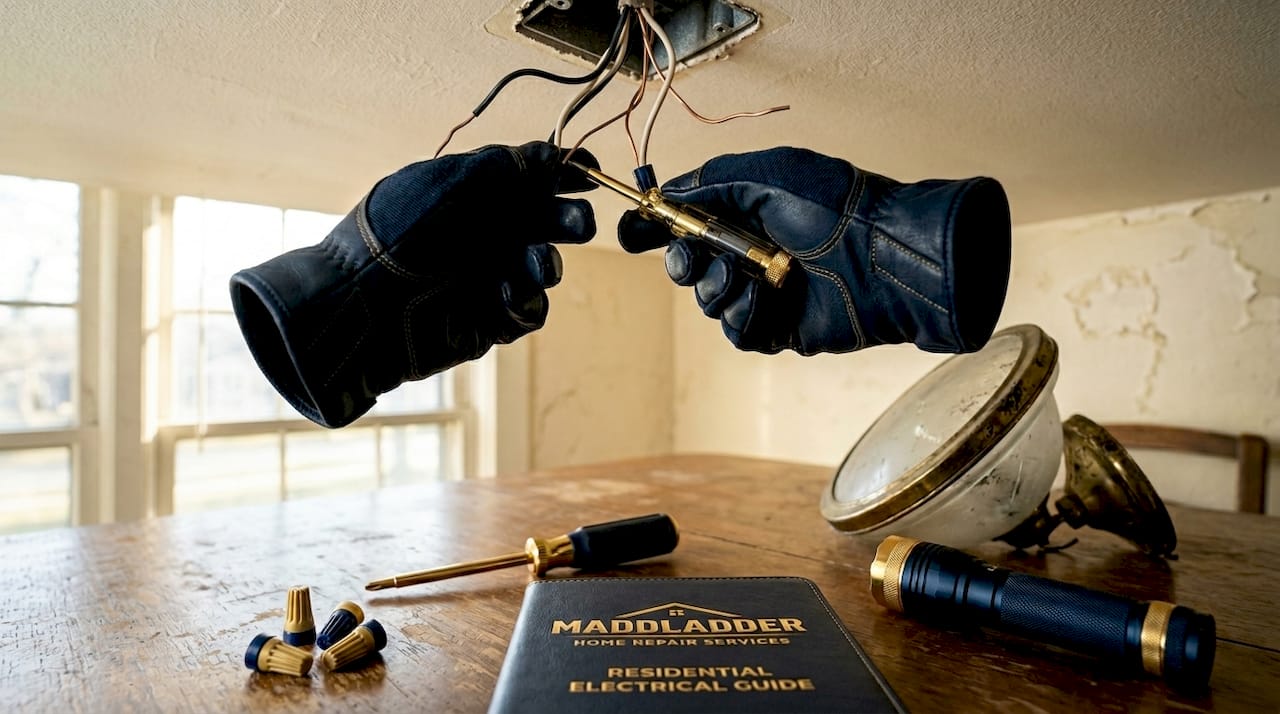
Common mistakes in Kansas City homes include skipping the voltage test, assuming the old box can support a new heavier fixture, and ignoring polarity rules, all of which create fire and shock risks that do not show up immediately.
Pro Tip: If you are replacing a fixture in a bathroom or kitchen, check whether a GFCI outlet or GFCI breaker is required for that circuit. Wet locations require GFCI protection under current code, and that requirement may apply to your existing setup even if it predates the rule.
For anything beyond a basic one-for-one swap, review what counts as safe DIY electrical repairs in Kansas City before picking up a wire stripper.
Checklist for plumbing fixtures: Sinks, toilets, and more
Lighting is just one part of the job. Plumbing fixtures often carry even more rules in Kansas City, especially once you start moving anything beyond a straight swap.
The first decision is scope. Are you swapping a toilet for a new one in the same footprint, or are you relocating a sink across the bathroom? Those are very different projects under Kansas City code.
- Define the scope clearly before buying materials. A like-for-like swap (same location, same connections) rarely requires a permit. Moving drain lines, water supply lines, or gas lines always does.
- Pull permits for any line relocation or alteration. Kansas City requires permits when moving or altering drain, water, or gas lines, and inspections verify that pipes are properly supported, tested, and leak-free after installation.
- Install accessible shutoff valves at every fixture if they are not already present. This is both a code requirement in many situations and practical sense for future repairs.
- Verify venting is adequate for new fixture locations. Improper venting causes slow drains, gurgling, and sewer gas infiltration.
- Test water pressure at the fixture after installation. Anything below 40 PSI or above 80 PSI signals a problem.
- Check for leaks using the paper towel test: place dry paper towels around every connection and check after 30 minutes. Slow drips at supply lines are responsible for a significant portion of interior water damage claims.
Here is a quick reference for Kansas City permit requirements by fixture type:
| Fixture type | Like-for-like swap | Line relocation | Permit required? |
|---|---|---|---|
| Toilet | No permit needed | Drain line move | Yes |
| Sink/faucet | No permit needed | Supply or drain reroute | Yes |
| Shower/tub | No permit needed | Drain or supply change | Yes |
| Water heater | Usually required | Always required | Yes |
| Gas line fixtures | Always required | Always required | Yes |
The full Kansas City plumbing remodel guide outlines the scope definition, permit process, rough-in inspection, and final sign-off steps in detail.
Property managers especially benefit from tracking fixture inspections for rentals, since code violations in rental units can result in failed inspections and costly repair orders.
Electrical code compliance and hazards in fixture replacement
Once plumbing is addressed, your work also needs to stand up to electrical codes and inspection requirements. Many homeowners are surprised to learn that even a simple fixture swap can trigger upgrade requirements in older homes.
Here is how the scope of work changes what code demands:
| Scope of work | Permit required? | Inspection needed? | Possible upgrade trigger? |
|---|---|---|---|
| Simple fixture swap (same location, same wiring) | No | No | No |
| Outlet or switch relocation | Yes | Yes | Yes |
| New circuit addition | Yes | Yes | Yes |
| Major remodel (kitchen, bath) | Yes | Yes | Yes, AFCI/GFCI |
The key requirements under current National Electrical Code (NEC) standards include:
- AFCI protection (arc-fault circuit interrupters) in bedrooms, living rooms, and most habitable spaces
- GFCI protection in bathrooms, kitchens, garages, outdoors, and unfinished basements
- Proper grounding and bonding throughout the system
- Code upgrades triggered during remodels, even if the original installation predates the current rules
Both NEC fixture requirements and the 2026 electrical safety checklist confirm that remodels trigger upgrades to current code even in older homes, and the 2026 standards place additional emphasis on GFCI protection for outdoor equipment and layered surge protection.
Skipping code compliance has real consequences. Insurance companies can deny claims on fire damage if unpermitted electrical work is discovered. Fines for unpermitted work in Kansas City can reach into the hundreds or thousands of dollars. And most importantly, electrical fires from faulty fixtures and wiring are preventable.
For a full breakdown of when permits and inspections apply, the Kansas City electrical upgrades guide covers local requirements in practical terms.
Fixture replacement pitfalls and professional tips
With the technical steps covered, here are the most common mistakes Kansas City homeowners and property managers make, and how to avoid them before they become expensive problems.
Top mistakes to watch for:
- Skipping the voltage tester and assuming the breaker is enough
- Using the wrong wire connectors on aluminum wiring in older homes
- Mounting heavy fixtures to standard boxes not rated for the weight
- Over-tightening a toilet to stop rocking, which cracks the porcelain base instead of fixing the flange
- Rushing past the final leak test after plumbing work
- Failing to document the pre-installation condition, which matters enormously for insurance and rental records
Older Kansas City properties, particularly those built before 1980, present a specific set of challenges. Aluminum wiring, missing ground wires, and undersized junction boxes are all common findings, and each requires specific remediation before a new fixture can be safely installed. A missing ground wire, for example, does not mean you skip grounding. It means the outlet or fixture must be GFCI-protected and labeled "No Equipment Ground."
Pro Tip: For property managers, photograph every fixture before and after replacement. Date-stamped photos create a record that protects you during security deposit disputes, insurance claims, and city inspections. Store them with the lease file.
The guidance on when to hire a pro is clear on this point: DIY swaps are reasonable for experienced homeowners in straightforward situations, but code compliance, permits, and edge cases like old wiring or heavy fixtures call for a licensed professional.
"Property managers should prioritize professional inspections for rentals. Code violations discovered during a tenant complaint can result in city-ordered repairs and mandatory re-inspection fees that dwarf the original installation cost."
Kansas City fixtures: Why professional oversight often saves money (and stress)
Here is something most DIY articles won't tell you: the fixture itself is almost never the expensive part. The expensive part is what you find once you open the wall or ceiling.
Most homeowners picture permits and inspections as hurdles reserved for kitchen overhauls or room additions. That is a costly assumption. In Kansas City, even a bathroom fixture swap in a pre-1990 home can surface missing grounds, undersized wiring, or improper bonding that must be corrected before the work passes. Code upgrades apply to what you touch, not just what you planned to do.
The misconception that "it worked fine before" equals "it meets code" is one of the most persistent and expensive beliefs in home improvement. A fixture that has operated safely for 30 years may still be a liability the moment you disturb the circuit, because the act of opening that box puts the entire installation under current code scrutiny.
We've seen this repeatedly in Kansas City's older neighborhoods, where a $200 fixture swap turns into a $1,500 project once aluminum wiring or missing junction box support is discovered. That's not the handyman's fault. That's the hidden cost of deferred maintenance in aging housing stock.
The Kansas City plumbing remodel guide puts it plainly: pros are recommended when code compliance, permits, and edge cases are involved. For property managers specifically, the liability from a missed inspection in a rental unit is far greater than the cost of bringing in a licensed technician from the start.
If you manage multiple properties or own an older home, explore rental upgrade strategies that account for both safety and long-term maintenance costs. Planning ahead beats reactive repairs every time.
Get expert help in Kansas City for stress-free fixture replacements
Tackling a fixture checklist on your own is absolutely possible for straightforward swaps. But when the job involves older wiring, permit requirements, multiple fixtures, or rental units that need to pass inspection, having a licensed professional handle it is the smarter call.

MaddLadder serves homeowners and property managers across the Kansas City metro with dependable, code-aware service and free estimates. Whether you need fixture repair and replacement for a single item or a full property walkthrough, the team handles the details so you don't have to guess. For larger projects, professional installation help covers everything from mounting and wiring to final testing. And when your checklist includes anything touching pipes or panels, plumbing and electrical support is available with the expertise to keep your home or rental inspection-ready. Call for a free estimate or book online today.
Frequently asked questions
Do I need a permit to replace fixtures in Kansas City?
You need a permit in Kansas City if you move or alter drain, water, or gas lines. Simple like-for-like fixture swaps in the same location typically do not require a permit unless wiring or plumbing is being changed.
How do I know if my electrical fixture replacement needs to be inspected?
Inspections are required when you add a new circuit, relocate an existing one, or perform significant electrical upgrades during replacement. Per NEC remodel requirements, permits and inspections also apply when work triggers AFCI or GFCI upgrade obligations.
What is the biggest mistake people make with light fixture swaps?
The most common and dangerous mistake is ignoring loose connections and polarity. Loose wire connections cause overheating, reversed polarity creates shock risk, and exceeding bulb wattage can start a fire inside the fixture housing.
Is it okay for DIY homeowners to replace their own fixtures?
Simple swaps are reasonable for experienced homeowners when no lines are being moved and the wiring is straightforward. Pros are strongly recommended for permit-required work, complex wiring, older homes with aluminum wiring, or any rental property that needs to pass a city inspection.