
TL;DR:
- Basic plumbing repairs in Kansas City are affordable and homeowner-friendly with proper tools and knowledge.
- Preventing damage, like burst pipes, is best achieved by insulation, maintenance, and knowing shut-off locations.
- DIY fixes save significant costs compared to professional services, but complex or risky repairs require licensed professionals.
Calling a plumber in Kansas City can cost you between $175 and $550 for even a basic repair, and that's before any parts. The good news is that a surprising number of the most common plumbing headaches in KC homes are well within a homeowner's reach to fix. This article walks you through the problems you'll likely face, the exact steps to address them safely, and the honest cost comparison that helps you decide when to grab a wrench and when to grab your phone.
Table of Contents
- What to know before your first repair
- Clearing clogged drains the safe way
- How to stop leaks: Faucets and pipes
- Solving running toilets and low water pressure
- Comparison table: DIY vs. pro repair costs in Kansas City
- Water heater upkeep and the Kansas City hard water factor
- What most DIY plumbing guides don't tell you
- Get expert help — when you need it most
- Frequently asked questions
Key Takeaways
| Point | Details |
|---|---|
| Know your shut-off | Find and clearly label your main water shut-off before starting any repair. |
| Use safe drain methods | Avoid chemical cleaners—mechanical and natural unclogging methods are safest for pipes. |
| DIY saves money | Fixing minor issues yourself can save hundreds in plumber fees. |
| Watch for local hard water | Kansas City's hard water shortens appliance life, so perform annual maintenance and consider a water softener. |
| Know your limits | Call a professional for complex, dangerous, or persistent plumbing problems. |
What to know before your first repair
Before diving into specific repairs, you should be prepared with basic tools and know-how. Getting this foundation right prevents bigger headaches down the road.
The single most important thing you can do as a Kansas City homeowner is locate your main shut-off valve before anything goes wrong. It's almost always near the front of your home's foundation, often in a utility closet or crawl space. Walk there right now if you don't already know where it is. In an emergency, every second counts.
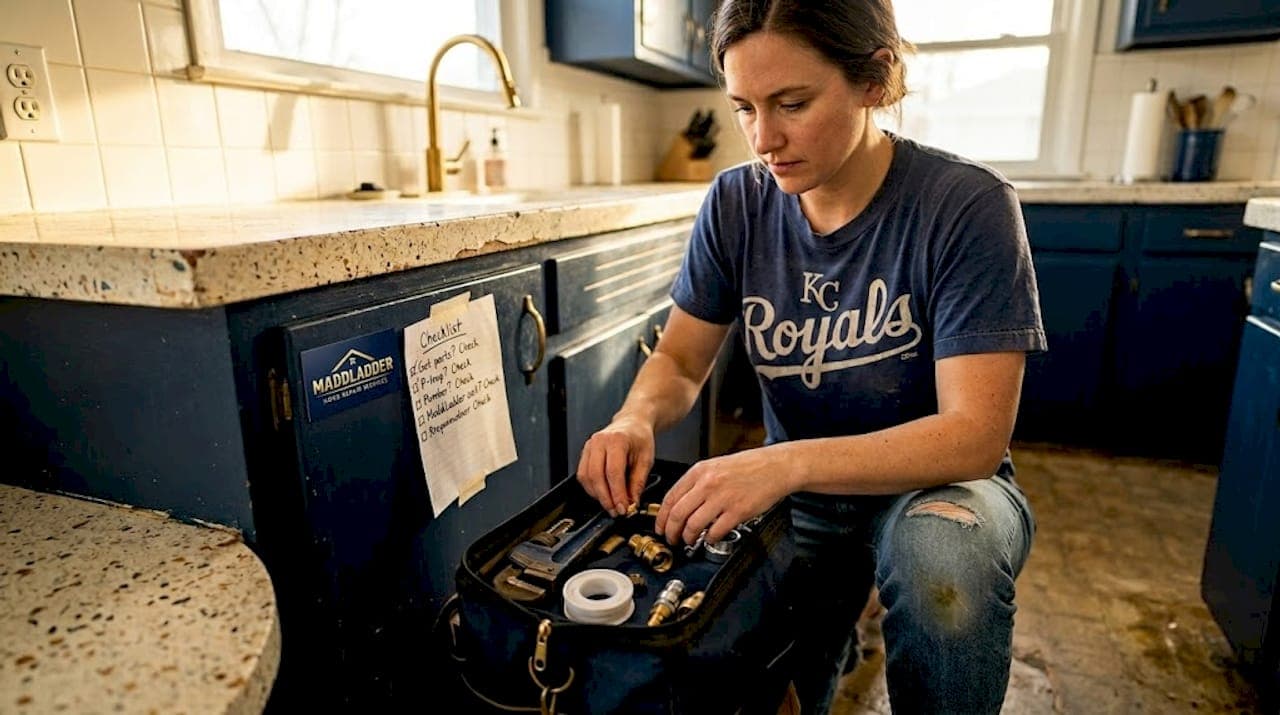
Your basic toolkit should include:
- Adjustable pliers and a pipe wrench
- A plunger (both cup and flange styles)
- A hand auger or drain snake
- Plumber's tape (Teflon tape)
- Replacement washers and O-rings in various sizes
- Epoxy putty for emergency pipe sealing
- A flashlight or headlamp
Pro Tip: Label your main shut-off valve with a piece of bright tape. If you ever have a burst pipe at 2 a.m., you won't be hunting for it in the dark.
Before any repair, check out this essential DIY guide for Kansas City homes to get a broader picture of what you can realistically tackle. And when you're ready to start a repair, always shut off your water first, then turn on a nearby faucet to release pressure from the lines.
"The three most common DIY plumbing mistakes are overtightening fittings, using the wrong tools for the job, and forgetting to shut off the water before starting." The result is usually a worse problem than the one you started with. Avoid these mistakes by slowing down and reading ahead before you touch anything.
Overtightening is particularly sneaky because it feels like you're being thorough. In reality, cranking too hard on plastic fittings or ceramic components can crack them instantly.
Clearing clogged drains the safe way
With the basics out of the way, let's tackle one of the most common minor headaches: slow or stopped-up drains.
Most Kansas City homeowners reach for a bottle of chemical drain cleaner first. That's the wrong move. Chemical cleaners are hard on your pipes over time, especially in older homes with galvanized steel or older PVC. Natural drain unclogging methods are both pipe-friendly and just as effective for most blockages.
Clogged drains are typically caused by hair, grease, soap scum, or food debris. Here's the right order of attack:
- Plunger first: Create a tight seal over the drain and use firm, rhythmic strokes. This works surprisingly well for most sink and tub clogs.
- Baking soda and vinegar second: Pour half a cup of baking soda down the drain, follow with half a cup of white vinegar, let it fizz for 15 minutes, then flush with hot water. This breaks down soap and grease buildup.
- Drain snake third: If the plunger doesn't cut it, a hand auger lets you physically break up or pull out the clog. Feed it slowly into the drain while rotating the handle.
Pro Tip: If your drain is still sluggish after using a snake, the problem is likely inside the P-trap. That's the curved pipe section directly below the sink. Place a bucket under it, unscrew the slip nuts on both ends, remove the trap, clean it out, and reinstall. It takes about five minutes and solves a lot of otherwise stubborn clogs.
Consistent maintenance beats emergency fixes every time. Flush your kitchen drain with boiling water once a week to prevent grease buildup, and use a drain hair catcher in every shower.
In Kansas City, older neighborhoods like Westport and Hyde Park have homes with cast iron drain lines that are especially prone to buildup over time. If you find yourself fighting the same slow drain every few weeks, that's a signal to have the line inspected rather than continuing to patch it.
How to stop leaks: Faucets and pipes
Once clogs are cleared, leaks are the next most urgent and costly repair to master. Here's how to address the most common types.
Leaky faucets are most often caused by worn washers, O-rings, or damaged cartridges. A single dripping faucet can waste thousands of gallons per year, which quietly inflates your water bill. The fix is straightforward and requires no special skills once you know the steps.
For a leaky faucet repair:
- Shut off the water supply at the valve beneath the sink
- Turn on the faucet to release remaining pressure
- Remove the handle (usually held by a screw under a decorative cap)
- Pull out the cartridge or unscrew the stem to access the washer
- Replace the worn washer, O-ring, or entire cartridge
- Reassemble and test slowly
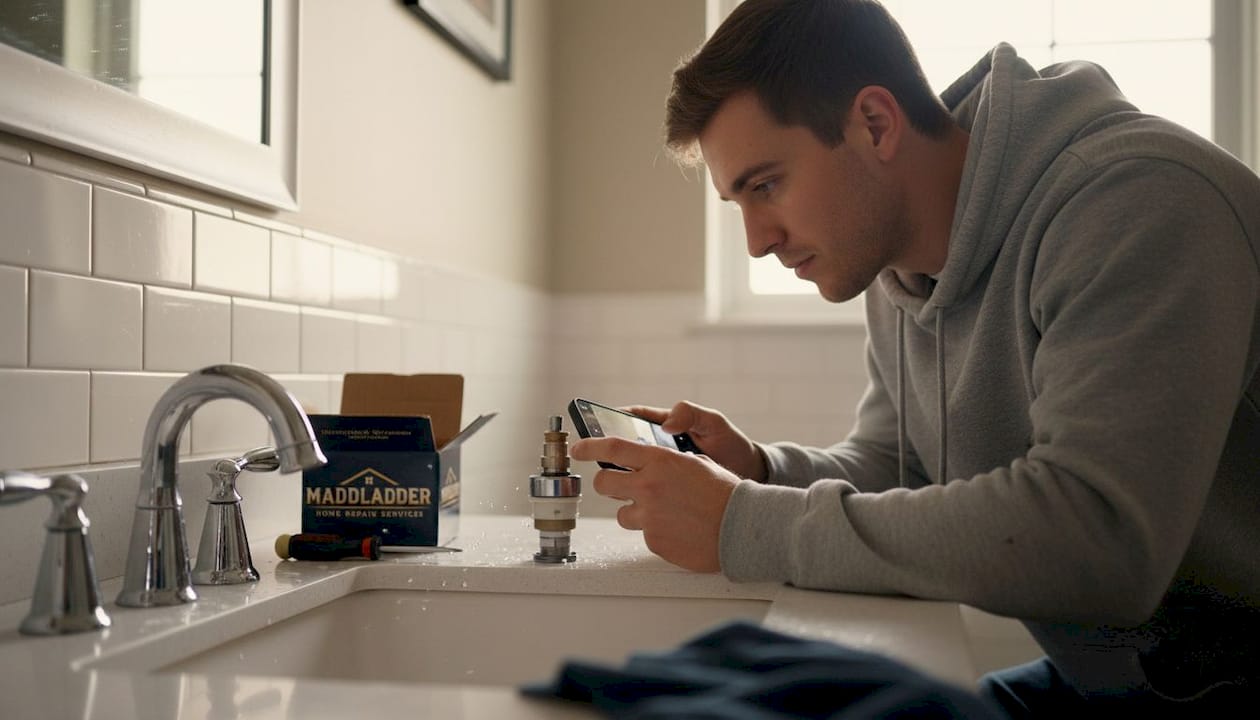
Cartridge-style faucets are the most common in modern KC homes and are the simplest to fix. Take a photo of the assembly before disassembly so you remember how it goes back together.
Pipe leaks are a different animal. Small leaks at pipe joints or pinholes in copper lines need a temporary fix while you figure out next steps. Temporary pipe leak fixes include epoxy putty applied to a dry surface, a rubber pipe clamp, or self-fusing silicone tape wrapped tightly around the leak. All three require turning off the water first.
When it comes to burst pipe repairs, temporary patches are exactly that: temporary. If a pipe has fully burst, shows corrosion across a wide section, or the same pipe has leaked more than once, call a licensed plumber. A patch that holds for a week can fail behind a wall and cause thousands in water damage.
Pro Tip: Wrap self-fusing tape in overlapping layers, stretching it as you go. Tighter is better. It bonds to itself and creates a waterproof seal without adhesive.
Solving running toilets and low water pressure
With leaks and clogs explained, there are two other annoyances, running toilets and slow taps, that have easy DIY solutions.
A toilet that keeps running after a flush wastes up to 200 gallons of water per day. Running toilets are usually caused by a faulty flapper or a float that's set too high. Here's how to fix it:
- Remove the tank lid and set it aside safely
- Flush the toilet and watch the flapper (the rubber seal at the tank bottom)
- If the flapper doesn't seat fully or shows warping, replace it (they cost about $5 at any hardware store)
- If the water level is too high and spilling into the overflow tube, adjust the float arm or the adjustment screw on the fill valve to lower the water level
- Flush again and confirm the tank fills to about one inch below the overflow tube
Pro Tip: Bring your old flapper to the hardware store. There are dozens of flapper sizes and designs, and matching them visually saves you a second trip.
Kansas City's municipal water tends to be moderately hard, which means mineral deposits build up inside faucet aerators over time, steadily reducing your water pressure.
Low water pressure from aerator buildup is easy to fix. Unscrew the aerator from the tip of the faucet by hand or with a cloth-wrapped wrench, drop it in a cup of white vinegar overnight, rinse it out, and reinstall. If the aerator is too corroded to clean, replacements cost two to four dollars. This one simple task restores full water pressure in most cases without touching any pipes.
If low pressure affects your whole house rather than just one fixture, the problem could be at the main supply or pressure regulator. That requires a professional evaluation.
Comparison table: DIY vs. pro repair costs in Kansas City
Now that you know the basics, let's see how much you really save with DIY efforts versus hiring a professional in Kansas City.
Plumbers in Kansas City charge between $95 and $140 per hour, plus a service call fee of $65 to $95. Most minor repairs end up costing between $175 and $550 total when you factor in parts and labor.
| Repair | DIY material cost | Professional cost in KC | Savings |
|---|---|---|---|
| Clogged drain | $0 to $15 | $175 to $250 | $160 to $235 |
| Leaky faucet | $5 to $30 | $200 to $300 | $170 to $270 |
| Running toilet | $5 to $20 | $175 to $275 | $155 to $255 |
| Faucet aerator cleaning | $0 to $5 | $150 to $200 | $145 to $195 |
| Minor pipe patch | $10 to $25 | $250 to $550 | $225 to $525 |
The math strongly favors doing it yourself for these routine repairs. For a deeper look at what professional repairs should actually cost, the cost breakdown for KC home repairs is worth bookmarking, and you can also review MaddLadder's service pricing to understand what you'd pay for assisted repairs.
Where DIY stops making sense is when a repair requires specialized tools, permits, or carries a risk of making things significantly worse. Sewer line snaking beyond a basic hand auger, water heater replacement, and any work involving gas lines all fall firmly in the professional category.
Water heater upkeep and the Kansas City hard water factor
Another system that feels intimidating is your water heater, especially with Kansas City's tough water. Here's how you can extend its life affordably.
Hard water accelerates mineral buildup inside your water heater's tank, shortening its expected lifespan to roughly 8 to 12 years. Flushing the tank once a year slows that process considerably.
| Water heater type | Average lifespan (standard water) | Lifespan with hard water | Flushing frequency |
|---|---|---|---|
| Tank (gas or electric) | 12 to 15 years | 8 to 12 years | Once a year |
| Tankless | 18 to 20 years | 12 to 15 years | Once a year |
To flush your tank water heater:
- Turn the thermostat to the pilot or low setting
- Shut off the cold water inlet valve at the top of the unit
- Connect a garden hose to the drain valve at the bottom
- Run the other end to a floor drain or outside
- Open the drain valve and let the tank empty completely
- Flush briefly with cold water to clear out sediment
- Close the drain valve, refill the tank, then restore the thermostat setting
If you consistently hear popping or rumbling from your water heater, that's mineral sediment on the heating element. Annual flushing prevents that noise and keeps the unit running efficiently.
Consider a whole-house water softener if you are dealing with repeat fixture scale, white deposits on faucets, or faster-than-expected water heater wear. In Kansas City, it's a legitimate long-term investment that protects pipes, appliances, and fixtures across the entire home.
What most DIY plumbing guides don't tell you
Most plumbing guides give you the steps. Fewer tell you the things that actually trip people up.
The biggest overlooked problem we see in Kansas City homes is pipe insulation, or more accurately, the complete lack of it. Forgetting to insulate exposed pipes in unheated spaces like garages, crawl spaces, and exterior walls is one of the leading causes of burst pipes during Kansas City winters. This city regularly sees temperatures drop below 10 degrees Fahrenheit, which is more than enough to freeze an uninsulated line within hours. Foam pipe insulation costs less than a dollar per foot at any hardware store. Spending $20 now prevents a $2,000 mess later.
The second thing guides gloss over is knowing when a "small" problem is actually a symptom. A slow drain that keeps coming back every few weeks isn't really a clog problem. It's a drainage slope or line integrity issue. A faucet you've replaced washers on twice in one year probably has a corroded valve seat. A toilet that runs intermittently, sometimes called a ghost flush, often signals a larger internal tank issue rather than just the flapper. These patterns are your early warning system.
The third issue is skipping the main shut-off practice run. We strongly recommend that every Kansas City homeowner know where their shut-off is and confirm it actually works. Valves that haven't been turned in years can seize. If you discover that during a burst pipe emergency, you're in real trouble.
For repairs that cross into gray areas where you're not sure if you need a licensed handyman or a full plumber, it's always worth asking before you start rather than after something goes wrong.
Get expert help — when you need it most
If a repair goes sideways or a job feels out of reach, here's a trusted next step for Kansas City homeowners.
MaddLadder's team handles the plumbing jobs that are too involved for a quick DIY fix but don't necessarily require a full plumbing contractor. Our plumbing and electrical services cover minor leaks, fixture replacements, and installs throughout the Kansas City metro.

We offer free estimates, transparent hourly rates, and subscription maintenance plans designed for homeowners who want to stay ahead of repairs rather than react to them. When you're stuck deciding between fixing something yourself and calling for backup, our repair or replace help page can point you in the right direction. Check our transparent pricing to see what to expect before anyone even shows up at your door.
Frequently asked questions
What plumbing repairs should a Kansas City homeowner NOT attempt themselves?
Avoid sewer line work, gas leaks, major pipe replacements, and any repair requiring a permit. These require licensed professionals and should not be treated as DIY projects under any circumstances.
How often should I flush my water heater in Kansas City?
Flush your water heater once a year to reduce mineral buildup and extend its working life. Kansas City's hard water accelerates sediment buildup compared to areas with softer municipal supplies, making annual flushing especially important here.
What do I do if my DIY repair causes a leak or flood?
Immediately shut off your main water supply and call a licensed plumber for emergency assistance. Knowing in advance where your main shut-off valve is located makes this response far faster and less stressful.
Are water softeners worth it for Kansas City homes?
Yes. Hard water is genuinely common in this area, and a softener protects your pipes and fixtures over the long term while also reducing scale on faucets, showerheads, and water-using appliances.
What should Kansas City homeowners do to prevent frozen pipes?
Insulate exposed pipes in unheated areas and know exactly where your main shut-off valve is before winter arrives. During extreme cold snaps, let a thin stream of water run from faucets on exterior walls to keep water moving through vulnerable lines.