
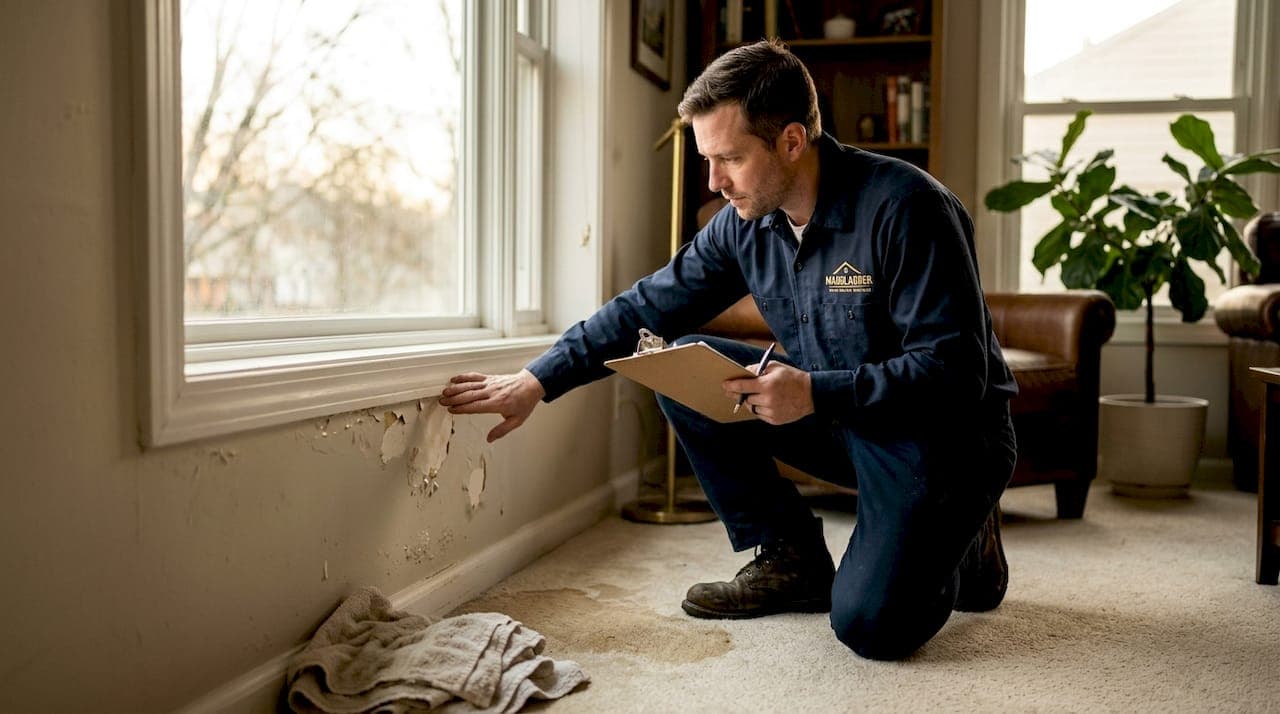
TL;DR:
- Quick response times significantly increase the likelihood of successful repairs and reduce costs in home emergencies.
- Delaying professional mitigation can double repair costs within 24 hours, especially for water damage.
When a pipe bursts or an electrical outlet starts sparking, most Kansas City homeowners focus on finding someone, anyone to help. But there's a sharper issue at play: contractor response speed is one of the strongest predictors of both who gets the job and how much that job ultimately costs you. The longer a problem sits unaddressed, the more it grows. This guide breaks down what response time actually means for your home, why delays cost far more than most people realize, and exactly what you can do to get fast, reliable help the moment something goes wrong in your Kansas City home.
Table of Contents
- The case for speed: How response time affects outcomes
- Time and damage: What delays really cost
- Beyond water: Why rapid mitigation matters for all repairs
- How to get the fastest response in Kansas City
- The hidden cost of waiting: What most Kansas City homeowners miss
- Fast, dependable repair service for Kansas City homes
- Frequently asked questions
Key Takeaways
| Point | Details |
|---|---|
| Speed prevents escalating costs | Delaying repairs can double your expenses with each passing day, especially for water damage. |
| First response wins | Most homeowners hire the first contractor who responds with clear action, so fast service means faster solutions. |
| Damage grows unseen | Structural and mold problems often start before you notice, making a quick call crucial to minimize risk. |
| Act for all repairs | Not just emergencies—electrical and other systems need rapid attention to avoid bigger failures. |
| Preparation speeds service | Having details and photos ready helps you secure the fastest possible home repair response. |
The case for speed: How response time affects outcomes
Let's start with a number that should change how you think about home repair calls. Contractors who respond within five minutes are 21x more likely to qualify a homeowner lead than those who wait even 30 minutes. That's not just a sales statistic. It tells you something important about urgency itself. When you reach out for help in an emergency, your problem is actively getting worse while you wait for a callback.
Here's another number worth sitting with: 78% of homeowners hire the first contractor who responds with a clear next step. That means most people don't shop around when something breaks. They call, and whoever picks up first and gives a concrete answer gets the job. That behavior makes complete sense when you factor in the stress of a home emergency and the cost of every hour things go unrepaired.
What the data really shows:
| Response window | Impact on homeowner |
|---|---|
| Under 5 minutes | Highest likelihood of lead qualification and trust |
| 5 to 30 minutes | Still competitive but drop-off begins |
| 30 to 60 minutes | Significant drop in engagement; homeowner likely moved on |
| Over 1 hour | Severe drop-off; damage escalation risk increases significantly |
Beyond who books the job, speed has a direct effect on the physical outcome. Water intrusion is the clearest example. Mold can begin growing within 24 to 48 hours of moisture exposure, and once it takes hold inside walls or under floors, remediation becomes a much larger project than a simple repair.
"Damage can progress quickly and can increase the scope of repair, especially for water intrusions leading to mold risk." — ServiceMaster Restore
If you're looking for same-day solutions for KC homes, understanding this timeline is the first step toward protecting your property. Fast response isn't just customer service. It's damage control.
Consider what actually happens during a two-hour delay after a slow pipe leak is discovered. Water soaks into the subfloor. Drywall at the base of the wall begins absorbing moisture. Insulation behind the wall holds water like a sponge. By the time a contractor arrives, what started as a plumbing fix has grown to include drywall replacement, subfloor treatment, and possibly mold testing. Efficient repair strategies start not with the repair itself, but with how quickly the right person arrives.
Key takeaways from response time research:
- Contractors responding within 5 minutes convert leads at dramatically higher rates
- Homeowners prioritize speed over price in emergency situations
- Delays beyond one hour signal to homeowners that the service may not be reliable
- Early intervention keeps repair scope narrow and costs manageable
Knowing the right time to call and scheduling home repairs proactively whenever possible also reduces the chances that you're ever stuck waiting in the middle of a crisis.
Time and damage: What delays really cost
Understanding the urgency is one thing. Seeing the dollars attached to that urgency makes the case impossible to ignore.
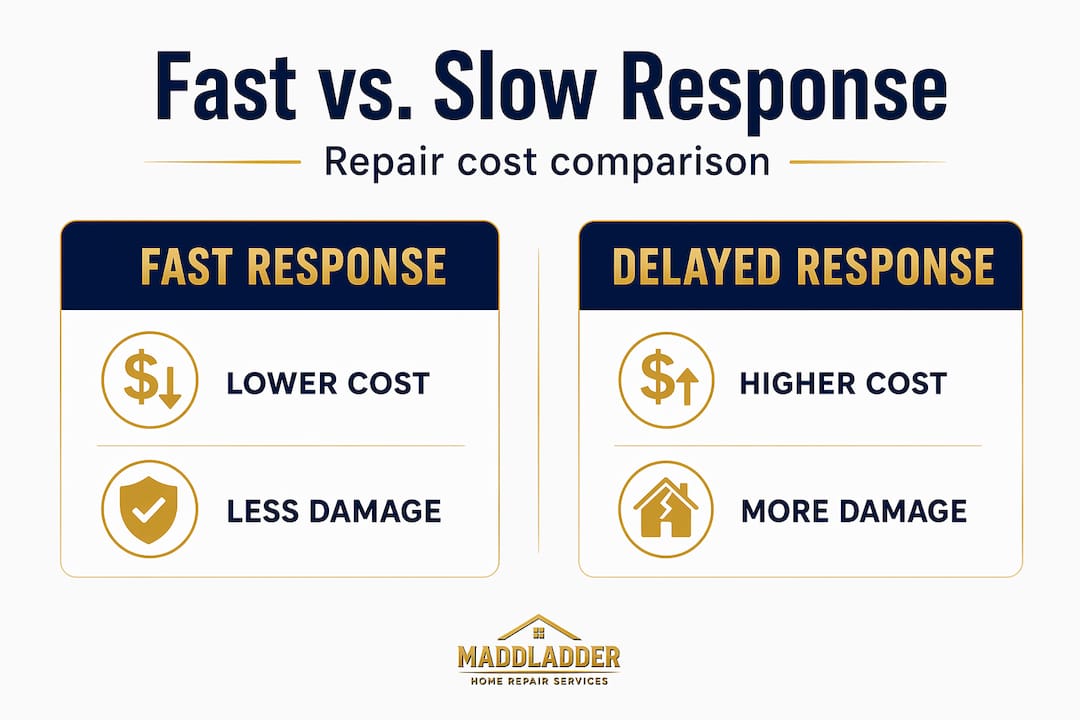
For water damage specifically, delaying professional mitigation can roughly double your total restoration cost for every 24 hours you wait. Read that again. A repair that costs $800 on day one could become a $1,600 repair by day two, and potentially $3,200 or more by day three. That's not a worst-case projection. That's the documented pattern.
According to property restoration experts, the interval between damage and mitigation significantly affects both the scope of work needed and the total recovery cost.
Comparison: Acting fast vs. waiting 48 hours
| Damage scenario | Cost with fast response | Cost after 48-hour delay |
|---|---|---|
| Small pipe leak | $300 to $600 (plumbing fix) | $1,200+ (drywall, subfloor, mold test) |
| Roof breach after storm | $400 to $800 (patch and seal) | $2,000+ (interior water damage added) |
| Foundation crack with moisture | $500 (sealant, minor repair) | $3,000+ (structural assessment, drainage) |
| HVAC failure in summer | $150 to $300 (service call) | $700+ (secondary issues from heat and humidity) |
One dangerous trap Kansas City homeowners fall into is the DIY patch. You see a damp spot on the ceiling, press some caulk around a pipe fitting, and assume the problem is contained. But hidden moisture doesn't care about surface-level fixes. It continues wicking into wood framing, insulation, and drywall cavities. The surface looks dry. The damage underneath keeps building. Cutting costs with fast repairs means addressing root causes quickly rather than masking visible symptoms.
A 3-step response process every Kansas City homeowner should know:
- Stop the source first. Whether it's shutting off the water supply valve, flipping a circuit breaker, or covering a roof breach with a tarp, limit the ongoing damage immediately.
- Document everything before cleanup. Take photos and video of all visible damage before you move anything or soak up water. This protects you for insurance purposes and gives any incoming repair professional a clear picture.
- Call your repair service within the first 30 minutes. Not after you've cleaned up. Not after you've "assessed things for a bit." The clock is running, and a professional assessment in the first hour will always cost less than one at hour six.
Pro Tip: Keep your main water shutoff location written down and shared with every adult in your household. In a leak emergency, the 30 seconds it takes to find the shutoff can mean the difference between a $400 repair and a $4,000 one.
Beyond water: Why rapid mitigation matters for all repairs
Water damage gets the most attention in conversations about repair urgency, and that's fair. But the same time-sensitive logic applies to a wide range of home system failures.
Other repair types where speed prevents escalation:
- Electrical issues. A tripped breaker that keeps resetting, a burning smell from an outlet, or flickering lights are all signs of a circuit problem. Left unaddressed, these aren't just inconveniences. They're fire risks. Electrical repair steps for Kansas City landlords and homeowners make clear that any suspected wiring issue should be treated as urgent, not scheduled for "when it's convenient."
- HVAC failures. Kansas City summers are brutally humid. When an air conditioning unit fails in July, the resulting heat and humidity inside your home can warp hardwood floors, trigger condensation in walls, and put vulnerable family members at real health risk. A same-day service call becomes a quality-of-life issue fast.
- Exterior breaches. A cracked window seal, a gap in exterior trim, or storm damage to siding allows moisture and pests into wall cavities. What looks like cosmetic damage is often the beginning of a much larger problem.
- Plumbing slow drains. A single slow drain might seem minor, but it can signal a partial blockage that, if left, turns into a full clog and a backed-up sewage situation.
Understanding handyman value in KC often comes down to recognizing that one phone call handled quickly prevents three more calls down the road.
Critically, fast response means two distinct things according to property restoration experts: rapid communication and dispatch (getting a professional on the way quickly) and rapid mitigation actions (the professional taking the right steps immediately upon arrival). Both matter. A contractor who shows up fast but spends two hours assessing before doing anything isn't truly providing a fast response.

Pro Tip: When you call a repair service, ask directly: "What's your first action when you arrive?" The answer tells you whether they come ready to act or ready to spend an hour writing up paperwork.
How to get the fastest response in Kansas City
Knowing that speed matters is only useful if you know how to actually get it. Here's a practical playbook for Kansas City homeowners.
Step by step: Securing a rapid repair response
- Have a go-to service saved before you need it. The worst time to search for a reliable handyman is when your basement is flooding. Identify a trusted service provider in advance, save their number, and know what they cover. This single habit eliminates the frantic search during a stressful moment.
- Know your home's basics before you call. When you reach a repair service, being able to say "I have a 2004 single-story home in Overland Park, the leak is from the supply line under the kitchen sink, and I've already shut off the water" will get a faster, more accurate response than "something's leaking in my kitchen." Specific information helps the service team dispatch the right person with the right parts the first time.
- Describe urgency clearly and accurately. There's a difference between "water is actively flowing" and "there's a damp spot I noticed this morning." Use honest, specific language so the service team can prioritize appropriately. Overstating urgency causes trust problems. Understating urgency delays a response that could prevent serious damage.
- Ask about response time upfront. A reliable service provider will give you a real answer, not a vague one. If a company can't tell you approximately when someone will arrive, that's important information.
- Follow up with photos. Text or email a couple of photos of the damage immediately after calling. This helps the incoming professional show up prepared, not surprised.
The research backs up this approach. 78% of homeowners hire the first contractor who responds with a clear next step. That same dynamic works in your favor as a homeowner. When you call with clear, specific information and a direct question, you're far more likely to get a clear, actionable answer right away.
For detailed guidance on what to expect, the step-by-step repair scheduling process can help you plan ahead rather than react in a panic.
The hidden cost of waiting: What most Kansas City homeowners miss
Here's the uncomfortable truth we've seen play out repeatedly: most homeowners don't call for help when the problem starts. They call when the problem becomes impossible to ignore.
A damp smell in the basement gets attributed to "that old house smell." A slightly soft spot in the floor near the bathroom gets walked around. A flickering light switch gets taped over with a reminder to "check that later." These decisions feel reasonable in the moment. In reality, they're the most expensive choices a homeowner can make.
The thing about mold, structural fatigue, and wiring degradation is that they don't wait for you to notice them. Visible mold lags behind moisture intrusion, meaning that by the time you can actually see it on a surface, colonies are likely already established inside the wall cavity, under the floor covering, or in the insulation. The surface shows you the ending of a process that started days or weeks earlier.
This is why we'd argue that the best use of a home repair service isn't emergency response. It's early intervention. Catching a small drywall repair issue early, for example, can reveal hidden moisture before it becomes a mold remediation project. A routine plumbing inspection can catch a fitting that's about to fail before it actually does.
The homeowners who consistently spend the least on repairs over time are not the ones who wait and hope. They're the ones who take action at the first sign of a problem, even when it seems minor. Speed isn't just about emergencies. It's a long-term financial strategy for your home.
Fast, dependable repair service for Kansas City homes
The stakes for Kansas City homeowners are real. Delayed repairs escalate costs, create health risks, and turn minor fixes into major projects. The good news is that having the right team ready before anything goes wrong completely changes the equation.

MaddLadder serves the Kansas City metro with rapid dispatch and skilled technicians who show up ready to act, not just assess. Whether you need repair and replace services for water-damaged drywall and fixtures, or immediate help with plumbing and electrical solutions before a small issue becomes a large one, MaddLadder is built for exactly this kind of fast, reliable response. We offer free estimates, flexible pricing starting at $75/hour, and subscription maintenance plans that keep your home protected year-round. Contact MaddLadder today to get a free estimate or schedule your first service call before the next emergency finds you unprepared.
Frequently asked questions
How fast can mold grow after a water leak in my home?
Mold can start growing within 24 to 48 hours of water exposure, making fast professional action critical to keeping remediation costs manageable.
Does a fast repair response actually save me money?
Yes. Waiting just 24 hours with water damage can roughly double your total restoration cost, so acting in the first hour has a direct and measurable financial impact.
How can I improve my chances of getting faster service?
Have your home details ready, describe the issue specifically, and choose a provider that prioritizes rapid communication and dispatch so the right professional shows up with the right tools on the first visit.
Is a quick response only important after floods or leaks?
No. Fast response prevents escalation in electrical, HVAC, exterior, and plumbing systems, where small failures ignored for even a day can grow into expensive and dangerous situations.
What's the biggest mistake homeowners make when requesting urgent repairs?
The biggest mistake is waiting until damage is visible. Mold colonies and moisture damage often develop inside walls well before you see any surface signs, so acting on early warning signals always yields better outcomes than waiting for obvious damage.