
TL;DR:
- Proactive property maintenance, including scheduled inspections and documentation, significantly reduces long-term repair costs and tenant turnover. Implementing a structured schedule and effective communication system protects asset value, ensures tenant satisfaction, and minimizes emergency repairs. Using proper tools, vendor management, and criticality-based planning enhances efficiency and maintains the property's long-term health.
Property maintenance is the proactive, ongoing process of preserving a property's condition, safety, and value through scheduled inspections, timely repairs, and effective management practices. A solid guide to property maintenance separates landlords who protect their investment from those who spend weekends chasing emergencies. Whether you own a single rental unit in Kansas City or manage a portfolio of residential properties, the same core principles apply: prevent problems before they start, document everything, and communicate clearly with tenants. This guide covers the full picture, from seasonal checklists to vendor contracts, so you can build a system that works without constant firefighting.
What are the essential property maintenance tasks and schedules?
Effective property upkeep runs on a calendar, not on crisis calls. The most reliable property managers divide tasks into monthly, quarterly, semi-annual, and annual categories. This structure prevents small issues from compounding into expensive repairs.

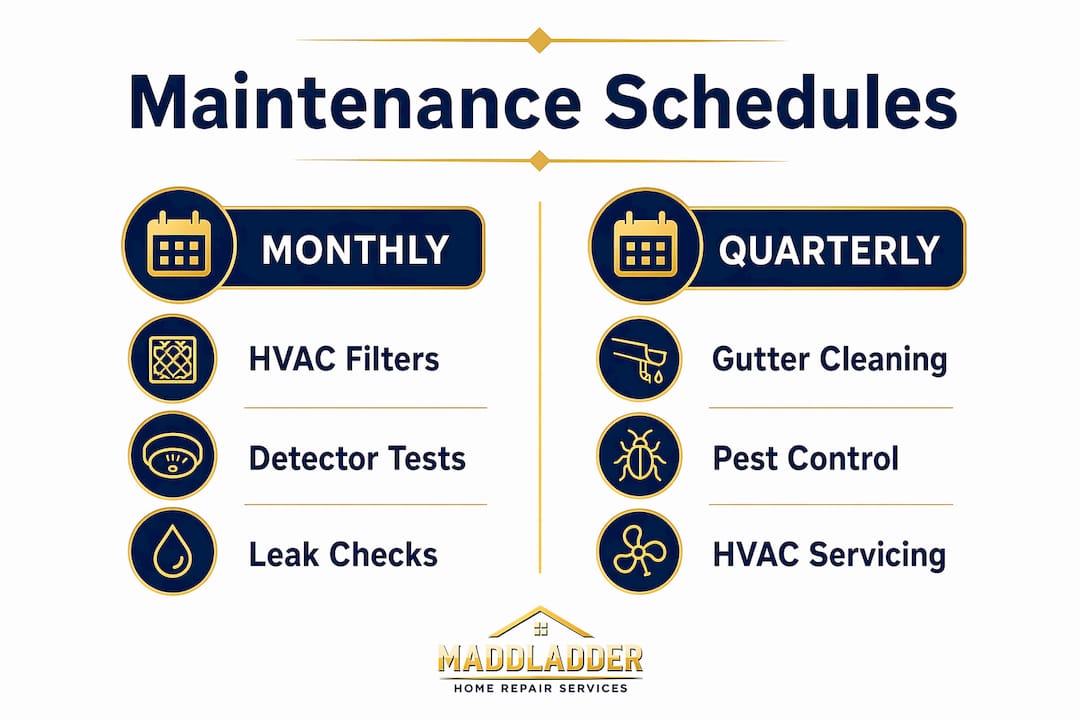
Monthly tasks include replacing HVAC filters, testing smoke and carbon monoxide detectors, checking for plumbing leaks under sinks, and inspecting common areas for safety hazards. These take less than an hour per unit but catch the problems that grow quietly.
Quarterly tasks cover gutter cleaning, exterior caulking inspections, pest control checks, and HVAC system servicing. Caulking is one of the most underrated items on any property maintenance checklist. A $50 re-caulk job left undone can become a $15,000 water damage remediation project within two years.
Annual tasks include chimney cleaning, roof inspections, water heater flushing, and full electrical walkthroughs. For rental properties specifically, annual inspections also create a paper trail that protects you legally.
| Frequency | Key Tasks | Property Type Focus |
|---|---|---|
| Monthly | HVAC filters, smoke detectors, leak checks | All property types |
| Quarterly | Gutters, caulking, pest control, HVAC service | Residential and rental |
| Semi-annual | Exterior paint inspection, plumbing pressure check | Rental and commercial |
| Annual | Roof, chimney, water heater, full electrical review | All property types |
Residential properties and rental units share most of the same tasks, but rental properties add tenant turnover inspections and move-in condition documentation. Commercial properties layer in ADA compliance checks and fire suppression system testing.
Pro Tip: Set calendar reminders for every recurring task at the start of the year. Scheduling maintenance in advance costs you nothing. Forgetting it can cost thousands.
Preventive vs. reactive maintenance: which costs more?
Preventive maintenance is scheduled work performed before a failure occurs. Reactive maintenance is the repair you make after something breaks. The financial difference between the two is not marginal.
Property owners with preventive programs spend 40–60% less on repairs over a 10-year period compared to those running purely reactive models. That gap compounds over time because reactive repairs often involve emergency labor rates, collateral damage, and tenant displacement costs.
"Deferred maintenance costs $3 to $5 in future emergency repairs and lost asset value for every dollar delayed." — SafetyCulture
The facade sealant example makes this concrete. A $50–$100 sealant repair left unaddressed allows water infiltration that can escalate to $15,000–$40,000 in structural remediation. That is not a hypothetical. It is a documented pattern in building maintenance.
| Approach | Average 10-Year Cost | Tenant Impact | Risk Level |
|---|---|---|---|
| Preventive | 40–60% lower | Higher satisfaction | Low |
| Reactive | 150x higher per incident | Higher turnover | High |
Reactive maintenance also damages tenant relationships. Tenants who experience repeated unresolved issues do not renew leases. That single unit turnover costs roughly $3,500 in lost rent, cleaning, and re-leasing fees. Preventive programs protect both the asset and the income stream.
For landlords still skeptical about the upfront time investment, consider preventive home maintenance as a capital allocation decision, not a chore list. You are buying down future risk at a steep discount.
What tools and systems make property maintenance trackable?
The best maintenance program in the world fails without a system to track it. Computerized Maintenance Management Systems, known as CMMS, are the industry standard for organizing work orders, scheduling recurring tasks, and logging asset history. Platforms like Buildium, AppFolio, and Maintenance Connection each offer CMMS features scaled for different portfolio sizes.
Beyond software, every property manager needs four core documentation tools:
- Asset register: A list of every major system and appliance, including model numbers, installation dates, and warranty expiration dates.
- Work order log: A record of every repair request, who handled it, what parts were used, and when it was completed.
- Maintenance history file: A property-level archive of all completed work, organized by system and date.
- Technician sign-off sheets: Written confirmation that work was completed to spec, which is critical for warranty validation.
Failing to document maintenance activities, parts used, and technician sign-offs can void manufacturer warranties and block insurance claims. That documentation gap costs property owners money twice: once when the repair happens and again when the claim gets denied.
Key performance indicators worth tracking monthly include Planned Maintenance Completion Rate, Average Response Time, and Cost Per Work Order. Tracking KPIs like Planned Maintenance Completion Rate monthly keeps asset preservation on track and creates accountability across your maintenance team or vendor roster.
Pro Tip: Even if you manage a single property, keep a shared Google Sheet with your asset register and work order log. It takes 20 minutes to set up and saves hours when a warranty dispute or insurance claim arises.
Mobile apps for field technicians also reduce lag time between task assignment and completion. When a technician can receive, update, and close a work order from their phone, your completion rate improves and your paper trail stays current.
How does communication affect tenant retention and maintenance outcomes?
Maintenance quality is not just about what gets fixed. It is about how fast and how clearly you communicate throughout the process. Properties that resolve maintenance requests within 24 hours achieve a 12% higher tenant retention rate. Requests left unresolved beyond 72 hours increase move-out likelihood by 18%. Those numbers translate directly to revenue.
The communication protocol matters as much as the repair speed. Tenants who receive a confirmation message when their request is logged, an update when a technician is scheduled, and a follow-up after the work is complete report significantly higher satisfaction. Effective tenant communication during maintenance reduces emergency fatigue and improves renewal rates.
Vendor management is the other side of this equation. Unreliable vendors create a chain reaction: delayed repairs lead to frustrated tenants, which leads to turnover, which leads to higher costs. Standardizing vendor SLAs improves tenant satisfaction by 10% and reduces the cost creep that comes from inconsistent pricing and unpredictable response windows.
- Define response time requirements in every vendor contract (24 hours for urgent, 72 hours for standard).
- Require written estimates before any work begins.
- Review vendor performance quarterly using your work order log data.
- Maintain at least two approved vendors per trade category to avoid single-vendor dependency.
Unresolved move-in maintenance issues within 48 hours reduce tenant renewal probability by 18%. The first impression a tenant gets of your maintenance responsiveness sets the tone for the entire lease. Get that first repair right, and you build trust that carries through the full tenancy.
How do you build a customized property maintenance plan?
A property maintenance plan is only useful if it fits your specific property, budget, and tenant profile. Generic checklists are a starting point, not a finish line. Here is how to build one that actually works.
Step 1: Conduct a full property assessment. Walk every system and document its current condition, age, and estimated replacement timeline. Prioritize assets using criticality criteria: probability of failure, safety impact, and replacement cost. This approach, known in professional maintenance as Failure Mode and Effects Analysis (FMEA), schedules maintenance based on criticality to get the most impact from a limited budget.
Step 2: Build your recurring task calendar. Use the monthly, quarterly, and annual framework from Section 1. Assign each task to a specific week of the month so nothing gets pushed indefinitely.
Step 3: Set your maintenance budget. A widely used benchmark is 1.5% of the property's monthly rent value allocated to maintenance reserves. A unit renting for $1,500 per month should carry roughly $22.50 per month in reserves, or $270 annually. Adjust upward for older properties or those with aging HVAC systems.
Step 4: Integrate your documentation system. Every task on your calendar should generate a work order entry and a completion record. Connect your seasonal maintenance schedule to your asset register so you always know what was last serviced and when.
Step 5: Review and adjust quarterly. A maintenance plan that never gets updated becomes outdated within a year. Review your KPIs, vendor performance, and budget variance every quarter and make adjustments before small gaps become systemic problems.
| Plan Component | Action Required | Review Frequency |
|---|---|---|
| Property assessment | Document condition and age of all systems | Annually |
| Task calendar | Assign recurring tasks by week and month | Quarterly |
| Budget allocation | Set reserves at 1.5% of monthly rent | Annually |
| Documentation system | Log every work order and completion | Ongoing |
| KPI review | Track completion rate, response time, cost | Monthly |
Pro Tip: Start with your three highest-risk systems, typically HVAC, roof, and plumbing, and build your plan outward from there. Trying to overhaul everything at once leads to paralysis. Prioritize by failure impact first.
Key takeaways
Effective property maintenance requires a preventive mindset, structured scheduling, and consistent documentation to protect asset value and retain tenants long-term.
| Point | Details |
|---|---|
| Preventive maintenance saves money | Structured programs cost 40–60% less than reactive repairs over 10 years. |
| Response time drives retention | Resolving requests within 24 hours increases tenant retention by 12%. |
| Documentation protects your investment | Logging all work orders and sign-offs preserves warranties and supports insurance claims. |
| Vendor SLAs reduce hidden costs | Standardized contracts improve satisfaction by 10% and prevent cost creep. |
| Criticality-based planning maximizes budgets | Prioritize assets by failure probability, safety risk, and replacement cost first. |
What i've learned after years of watching maintenance programs succeed and fail
The biggest mistake I see property owners make is treating maintenance as a cost center instead of a capital strategy. When you view every repair as money leaving your pocket, you delay it. When you view it as protecting an appreciating asset, you schedule it.
The owners who consistently outperform their peers are not spending more money on maintenance. They are spending it earlier and smarter. A $200 HVAC service call in october prevents a $2,400 emergency replacement in january. That math is not complicated, but it requires discipline to act on before the crisis arrives.
I have also watched tenant relationships deteriorate not because of bad repairs, but because of silence. A tenant who submits a request and hears nothing for four days does not care that you were busy. They start looking at other listings. The fix is not faster technicians. It is a simple text message saying "We received your request and a technician will contact you by Thursday." That one message changes the entire dynamic.
The property managers who build real retention are the ones who treat communication as part of the maintenance process, not an afterthought. If you are managing properties in a competitive rental market, your responsiveness is a differentiator that no amount of fresh paint can replace.
Start small if you need to. Pick one system, build one checklist, and track one KPI for 90 days. You will see results fast enough to motivate the next step.
— Jennifer
Let Maddladder handle the hard parts of property upkeep
Knowing what needs to be done and having the time and skills to do it are two different things. Maddladder serves homeowners, landlords, and property managers across the Kansas City metro with licensed, dependable handyman services built for exactly this kind of ongoing upkeep.
From general repairs and replacements to minor plumbing and electrical work, Maddladder covers the tasks that show up on every property maintenance checklist. The Property Manager subscription plan is designed specifically for landlords who want predictable pricing and priority scheduling without the overhead of managing multiple vendors. Free estimates, quick response times, and service across the KC metro make it straightforward to get professional support when you need it. Call or request a free estimate today.
FAQ
What is the 1% rule for property maintenance budgets?
The 1% rule suggests setting aside 1% of a property's total value annually for maintenance. Many property managers use 1.5% of monthly rent as a more practical per-unit benchmark.
How often should landlords inspect rental properties?
Landlords should conduct formal inspections at least twice per year, plus a move-in and move-out walkthrough for every tenant. Monthly visual checks of common areas and systems are also standard practice.
What happens if maintenance requests go unresolved for more than 72 hours?
Unresolved requests beyond 72 hours increase tenant move-out likelihood by 18%. Prompt acknowledgment and scheduling, even before the repair is complete, significantly reduces that risk.
Do i need a CMMS if i only manage one or two properties?
A full CMMS platform is not required for small portfolios. A structured spreadsheet with an asset register, work order log, and maintenance history file provides the same core benefits at no cost.
What is the most cost-effective maintenance task for landlords?
HVAC filter replacement is the highest-return maintenance task for most residential properties. It costs under $20 per unit monthly and directly extends system lifespan while reducing energy costs and emergency repair risk.