
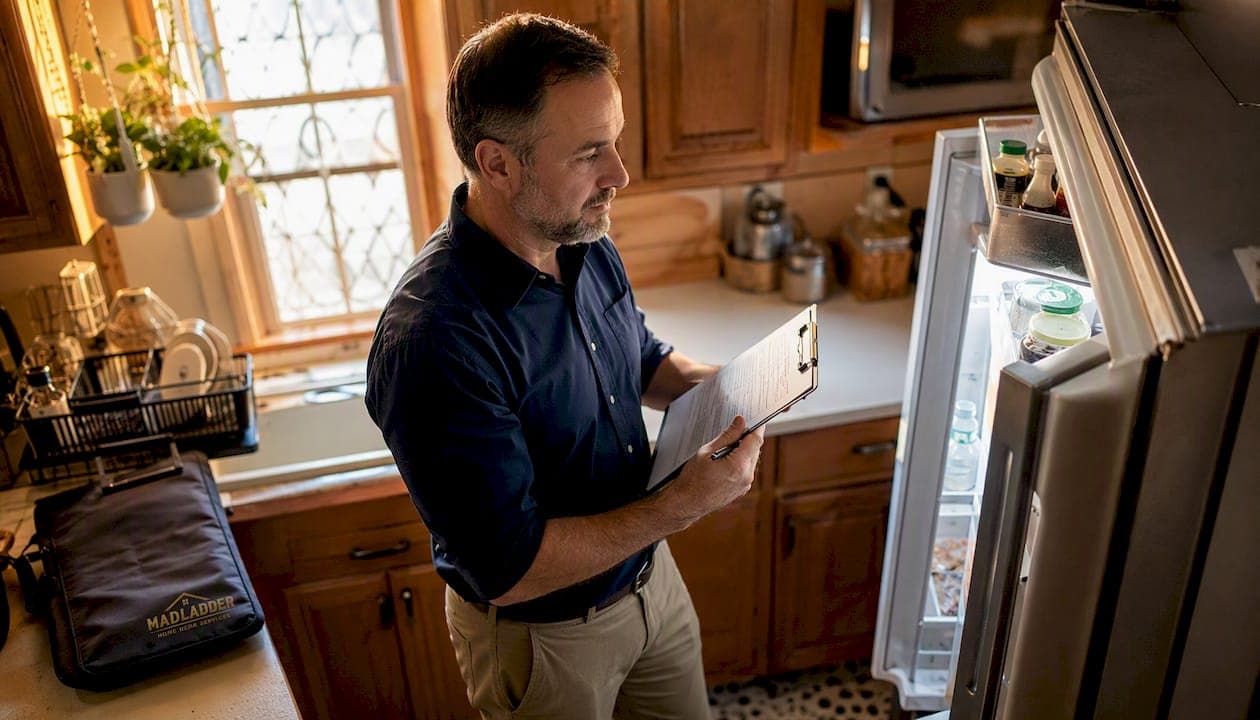
Treat appliances as capital assets. Inventory every unit, set objective replacement triggers, and schedule preventive maintenance before something breaks. That single shift, from reactive to systematic, is what separates landlords who absorb surprise repair bills from those who forecast them. This week: build your appliance inventory, apply the Age-Adjusted 50% Rule to any pending repair decisions, schedule your next coil and vent cleaning, and confirm you have a vetted local handyman on call. Maddladder serves Kansas City landlords on exactly that last point, with licensed technicians, free estimates, and subscription maintenance plans designed for rental portfolios.
- Build or update your appliance inventory with install dates and repair history.
- Apply age-based replacement thresholds before approving the next repair.
- Schedule one preventive maintenance task (coil clean, vent clear, filter swap) this week.
- Confirm your vendor list includes a licensed, insured local handyman.
Table of Contents
- What are the best appliance care tips for rentals?
- How do you build an appliance inventory and replacement policy?
- What does a preventive maintenance schedule look like for rental properties?
- How do you triage appliance failures and spot safety emergencies?
- How do you hire and vet appliance repair technicians?
- How do you forecast appliance replacements and build a capital reserve?
- What lease language and documentation practices reduce repair disputes?
- Key Takeaways
- Why a systems approach to appliance care pays off
- Maddladder keeps Kansas City rentals running
- Useful sources for landlords
What are the best appliance care tips for rentals?
The best approach combines a documented inventory, standardized replacement rules, and a recurring maintenance schedule. Operationalizing turnover with photos, checklists, and replacement thresholds reduces downtime and supports consistent decisions across a portfolio. Without that structure, every repair becomes an emotional judgment call, and those calls tend to cost more over time.
How do you build an appliance inventory and replacement policy?
Start with a master spreadsheet or property-management app. For each unit, record: unit address, appliance type, brand, model number, serial number, install date, warranty expiration, repair history, and cumulative repair cost to date. Serial numbers matter more than most landlords realize. Many manufacturers encode production dates in serial numbers, and free online decoders can estimate age when the original install date is unknown.
Once the inventory exists, apply a consistent replacement policy. The flat "50% rule" (replace if repair costs more than half the replacement price) ignores age entirely. A better standard is the Age-Adjusted 50% Rule:
| Appliance | Typical Lifespan | Replace Threshold (>60% of life used) | Repair Threshold (age-based) |
|---|---|---|---|
| Refrigerator | — | Repair cost ≥30% of replacement | Repair if cost <40% of replacement |
| Range/Oven | Up to 20 years | Repair cost ≥30% of replacement | Repair if cost <40% of replacement |
| Dishwasher | 7 years | Repair cost ≥30% of replacement | Repair if cost <40% of replacement |
| Washer/Dryer | 8–12 years | Repair cost ≥30% of replacement | Repair if cost <40% of replacement |
| Water Heater (tank) | 8–12 years | Repair cost ≥30% of replacement | Repair if cost <40% of replacement |

Lifespan baselines come from HUD guidance and industry lifecycle data. Use them as planning floors, not guarantees.
Pro Tip: Set a hard dollar cap alongside the percentage rule. If a repair quote exceeds $300 on an appliance older than 8 years, trigger a replacement analysis regardless of the percentage. That cap prevents small-dollar rationalizations from accumulating into a money pit.
What does a preventive maintenance schedule look like for rental properties?
A practical cadence blends turnover checks with scheduled preventive work at four intervals:
- At every turnover: Clean refrigerator coils and door gaskets, check dryer lint trap and vent hose, inspect dishwasher spray arms and door seal, test range burners and oven igniter, run garbage disposal with cold water, and confirm water heater temperature is set to 120°F. Take dated photos of every appliance.
- Quarterly (30–60 minutes per unit): Test GFCI outlets near appliances, check washing machine hoses for bulging or cracking, inspect refrigerator ice maker line, clear dryer exterior vent cap, and verify range hood filter is clean.
- Semi-annually (1–2 hours): Inspect water heater anode rod, check dishwasher drain hose for kinks, test smoke and CO detectors near gas appliances, and review repair history for any appliance that has needed two or more calls in 12 months.
- Annually (professional service, 2–4 hours): HVAC coil cleaning, water heater flush, dryer vent cleaning from roof or exterior cap, and gas range leak check with a licensed technician.
Track this in a property-management app, a shared Google Calendar, or a simple spreadsheet with recurring reminders. The tool matters less than the consistency.
Pro Tip: Dryer vent cleaning and refrigerator coil cleaning are the two highest-ROI preventive tasks on this list. Both take under 30 minutes, cost almost nothing, and are among the most common causes of emergency calls and fire risk when neglected. Do them at every turnover without exception.
How do you triage appliance failures and spot safety emergencies?
Most failures follow a pattern: something stops working, a tenant reports it, and the property manager has to decide whether to send a handyman or call a licensed contractor. A quick triage flow keeps that decision fast and safe.
Verify first. Confirm the issue is real (not a tripped breaker, a clogged filter, or a wrong setting). Secure the unit if there is any risk of water damage or electrical hazard. Minimize damage by shutting off the relevant supply line or breaker. Then decide: is this a handyman repair, a licensed-contractor job, or an emergency callout?
Common failure signs by appliance:
- Refrigerator: Not cooling, excessive frost, water pooling under unit, loud compressor noise.
- Range/Oven: Burner won't ignite, oven temperature inconsistent, control panel unresponsive.
- Dishwasher: Not draining, door latch failure, water on floor after cycle.
- Washer/Dryer: Washer won't spin or drain; dryer takes two cycles to dry a load (classic clogged vent sign).
- Water Heater: No hot water, rust-colored water, popping sounds, water pooling at base.
- Garbage Disposal: Humming but not spinning (jammed), complete silence (tripped reset button), persistent leak at flange.
Safety red flags that require immediate professional response: A gas smell anywhere near a range, oven, or water heater means shut off the gas supply, ventilate the unit, evacuate occupants, and call your gas utility's emergency line before calling any repair service. Sparking from an outlet or appliance, smoke from a motor, or a water heater actively leaking from the pressure-relief valve are all stop-everything situations. Gas appliance service and major electrical work require licensed technicians and documentation — never send an unlicensed handyman to a gas or electrical emergency.
Emergency repair calls commonly cost landlords $150–$600. Across a portfolio of ten units, even two or three reactive calls per year add up to a meaningful hidden cost that preventive maintenance largely eliminates.
How do you hire and vet appliance repair technicians?
The handyman-vs-licensed-contractor line is straightforward: gas lines, refrigerant handling, permit-required electrical work, and structural changes require a licensed contractor. Everything else, including most appliance swaps, dryer vent cleaning, minor plumbing (faucets, supply lines, disposal replacement), and fixture work, falls within a licensed handyman's scope.
When you call a new provider, ask these questions before scheduling:
- Are you licensed and insured in Missouri/Kansas? (Ask for the license number.)
- Do you carry general liability and workers' comp?
- Do you handle permit pulls when required, or does the landlord need to arrange that?
- What is your typical response time for non-emergency work? For emergencies?
- Do you charge flat-rate or hourly, and what is your minimum?
- What warranty do you offer on labor?
Credential checklist: state handyman or contractor license, general liability insurance (minimum $1 million), workers' compensation, and EPA 608 certification if the work involves refrigerant.
Maintaining a vetted vendor list with response-time expectations and flat-rate options improves turnaround during turnover. For Kansas City landlords, that means having at least one licensed handyman and one licensed HVAC/plumbing contractor on speed dial before you need them.
Pro Tip: Negotiate a flat-rate service agreement with your primary handyman for common recurring tasks (dryer vent cleaning, filter swaps, disposal resets). Flat rates eliminate invoice surprises and give you a predictable maintenance budget line.
How do you forecast appliance replacements and build a capital reserve?
Use the lifespan baselines from the inventory table above to build a rolling 3-year replacement schedule. Flag any appliance that will hit 80% of its expected life within 24 months as a near-term replacement candidate.
| Appliance | Expected Replacement Cost | Priority Trigger |
|---|---|---|
| Refrigerator | — | Age 8+ years or second compressor repair |
| Range/Oven | — | Age 15+ years or control board failure |
| Dishwasher | — | Age 7+ years or second pump/motor repair |
| Washer/Dryer | — | Age 9+ years or drum bearing failure |
| Water Heater (tank) | — | Age 9+ years or anode rod failure |
For the annual reserve, industry guidance recommends setting aside 1–2% of property value annually for maintenance. On a $200,000 rental, that is $2,000–$4,000 per year. Appliances typically account for 20–30% of that budget in a well-maintained unit.
Pro Tip: Stagger replacements across units rather than replacing all appliances in a building at once. Units bought together age together, and simultaneous replacements create a capital spike. Offset purchase years by 2–3 years when possible, and consider smart thermostat upgrades as part of a replacement cycle to improve energy efficiency and tenant appeal.
What lease language and documentation practices reduce repair disputes?
Clear lease language sets expectations before a tenant moves in. A short clause that works:
When a tenant reports an issue, collect: dated photos from the tenant, a written description of the problem, and any prior reports of the same issue. On your end, log the service date, technician name, invoice number, and outcome. Documenting every repair with dated photos and invoices speeds security-deposit settlements and supports warranty or liability claims.
Transparent communication at turnover also shortens re-rental time. When outgoing tenants see a documented inspection and a clear record of what was repaired or replaced, disputes over deposit deductions drop significantly.
Key Takeaways
Treating rental appliances as managed capital assets, not reactive chores, is the single most effective way to cut emergency costs and reduce vacancy days.
| Point | Details |
|---|---|
| Build your inventory now | Record install dates, serial numbers, and repair history for every appliance across all units. |
| Apply the Age-Adjusted 50% Rule | Replace appliances past 60% of expected life when repair cost reaches 30% of replacement value. |
| Schedule preventive tasks at every turnover | Coil cleaning, vent clearing, and hose inspection at each turnover prevent the majority of emergency calls. |
| Reserve 1–2% of property value annually | Budget $2,000–$4,000 per year on a $200,000 rental to cover maintenance and planned replacements. |
| Maddladder for Kansas City execution | Maddladder provides licensed handyman service, turnover make-ready, and subscription maintenance plans for rental portfolios in the Kansas City metro. |
Why a systems approach to appliance care pays off
Landlords who treat appliance maintenance as a portfolio-level discipline consistently spend less per unit over time. The math is straightforward: a $75 dryer vent cleaning prevents a $400 emergency call and a potential fire. A documented replacement schedule prevents the cash-flow shock of replacing three appliances in the same month. What most landlords underestimate is how much of their reactive repair spending traces back to a single gap: no written policy for when to repair versus replace. Without that policy, every repair decision gets made under pressure, and pressure favors the path of least resistance, which is usually the more expensive one.
[insert author Jennifer's professional background or qualifications related to handyman services] [insert proprietary case studies or customer testimonials authored by or directly involving Jennifer] [insert documented certifications or licenses held by Maddladder technicians]
Maddladder keeps Kansas City rentals running
Kansas City landlords managing one unit or twenty face the same problem: finding a reliable, licensed handyman who shows up on time and charges a predictable rate. Maddladder is built for exactly that. Services relevant to rental appliance care include turnover make-ready, appliance installation and replacement, dryer vent cleaning, minor plumbing and electrical repairs, and subscription maintenance plans at the Essential, Home Care, and Property Manager tiers.
One-time jobs start at $75/hour with free estimates. The Property Manager subscription plan covers recurring preventive tasks on a scheduled basis, which means no more chasing vendors between tenants. Request a free estimate at Maddladder's repair and replacement services page or call directly to get a response-time commitment before you book.
Useful sources for landlords
- Property Maintenance Guide for Landlords — Maddladder Blog: Broad maintenance planning and budget examples for Kansas City landlords.
- Why Replace Aging Appliances in Rentals — Maddladder Blog: Proactive replacement strategy and emergency cost reduction.
- Rental Property Plumbing Tips for Landlords — EZ Plumbing: Plumbing-focused guidance covering water heaters and disposal maintenance.