
TL;DR:
- Receiving a detailed, prioritized written repair estimate provides clarity, accountability, and helps avoid surprises during home repairs.
- While free estimates are useful for comparing costs and understanding scope, they often exclude hidden issues and are not legally binding, requiring careful review.
Calling around for home repair bids in Kansas City should feel straightforward. In practice, it rarely is. You hear "free estimate," schedule the visit, and then receive a vague one-liner that says something like "drywall repair, approx. $200–$600." That range tells you almost nothing useful, and the pressure to decide quickly only makes it worse. Many homeowners and landlords assume a free estimate means a complete, ready-to-act pricing breakdown. The reality is more complicated, and understanding that gap upfront will save you real money, real frustration, and possibly a bad contractor relationship down the road.
Table of Contents
- What is a free estimate for repairs?
- The value and limitations of free estimates
- How prioritized repair estimate reports work
- What to look for in a free repair estimate: Homeowner checklist
- The real key to avoiding surprises: It's not just about the price
- Get your next repair estimate—fast, clear, and locally trusted
- Frequently asked questions
Key Takeaways
| Point | Details |
|---|---|
| Free estimates defined | A free estimate provides an initial repair cost breakdown but may not cover all details or specialty issues. |
| Speed and transparency | The best providers deliver prioritized, actionable estimates quickly—sometimes within 24 hours. |
| Prioritization is power | Reports that list repairs by urgency help homeowners negotiate and plan efficiently. |
| Checklist for evaluation | Always review scope, breakdown, and exclusions before accepting any free repair estimate. |
| Local expertise matters | Experienced Kansas City providers offer trusted, clear estimates and follow-through. |
What is a free estimate for repairs?
A free estimate is exactly what it sounds like on the surface: a contractor visits your home, looks at the work involved, and gives you a cost projection at no charge. But the word "free" describes the price of the estimate, not its quality or depth.
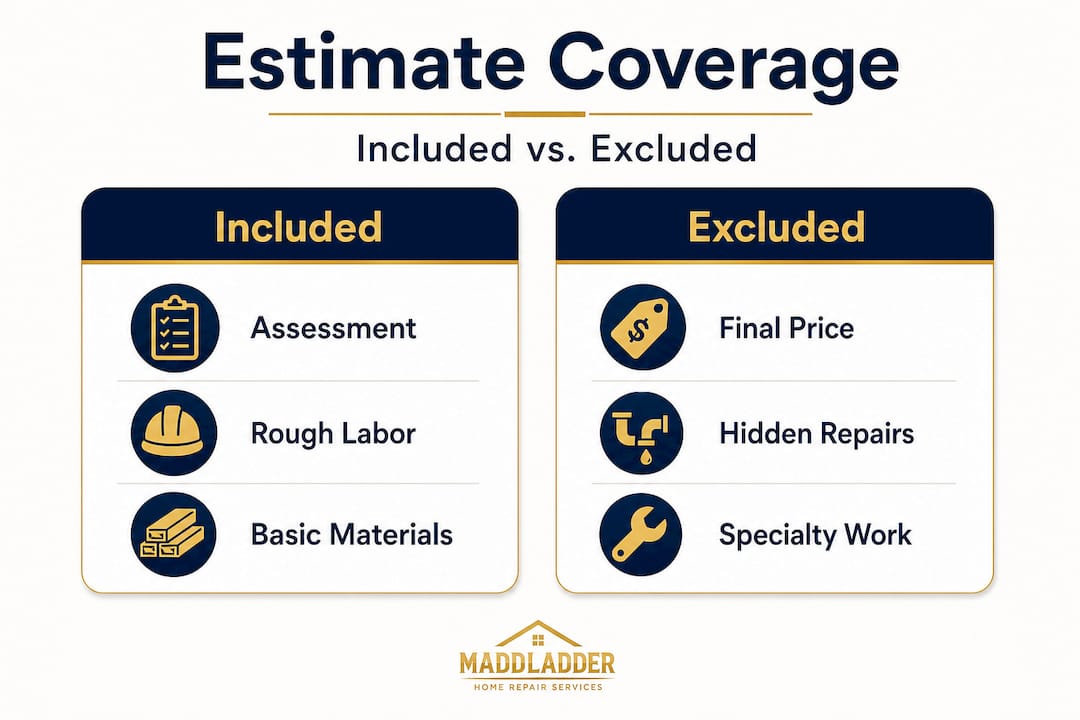
Most free estimates include three core components:
- An onsite or virtual assessment of the work needing attention
- A rough cost breakdown covering labor, approximate materials, and time
- Recommended actions, sometimes ranked by urgency and sometimes not
What they typically exclude is just as important. A free estimate is usually not a final, binding quote. It won't always include a precise materials list, a written report, or any guarantee that the work can be completed at the stated price once the contractor opens a wall or pulls a fixture. Understanding what home repairs include helps set a realistic starting point before you even pick up the phone.
Estimates also come in two formats: verbal and written. A verbal quote is faster but harder to compare later. A written estimate gives you something concrete to reference, review, and hold a contractor accountable to. Some inspection partners provide repair estimate reports derived directly from inspection findings, delivered within 24 hours, complete with prioritized repair lists and estimated costs. That's a meaningful step above a back-of-the-napkin number.
Pro Tip: Always request a written estimate with repairs listed in priority order. If a contractor won't provide one, that tells you something important about how they operate.
Here's a quick comparison of what free estimates typically do and don't cover:
| What's usually included | What's usually excluded |
|---|---|
| Onsite assessment | Binding final price |
| Rough labor and material costs | Precise materials list |
| Recommended repairs | Hidden or structural issues |
| General timeline | Post-inspection repairs |
| Verbal or basic written quote | Priority ranking (unless requested) |
For a closer look at free repair estimate breakdowns, it helps to understand how local services structure their pricing before you start comparing bids.
The value and limitations of free estimates

Free estimates offer real advantages, especially when you're managing a property or planning a repair budget. But they also come with blind spots that can cost you if you treat them as gospel.
The genuine benefits:
- You gather competitive pricing without spending a dime upfront
- You can compare service quality and communication style across multiple contractors
- A well-structured estimate helps you spot the real scope of a project before committing
- Some estimates include prioritized repair lists that guide your decision-making even if you delay certain fixes
The flip side is that free estimates have built-in limitations. A contractor spending 20 minutes in your home isn't going to catch everything. Hidden moisture damage, outdated wiring behind walls, or deteriorating subflooring often don't appear until work actually begins. That's when the "estimate" gets revised, sometimes significantly. Following an efficient home repair process from the start helps you anticipate these scenarios rather than react to them.
Estimates are also not legally binding contracts. If a contractor gives you a number verbally and the project cost grows, you have limited recourse without a signed agreement. Some services, particularly those tied to property inspections, deliver repair estimate reports within 24 hours, organizing repairs by price and priority ranking. That level of organization transforms a casual estimate into a working budget document.
Here's how the estimate process typically unfolds:
- You contact the contractor and describe the work needed
- An onsite (or virtual) assessment is scheduled
- The contractor reviews the scope of repairs during the visit
- A verbal or written estimate is delivered, sometimes on the spot, sometimes within a day or two
- You review, compare, and follow up with questions
- If satisfied, you move to a formal work agreement and scheduled start date
Staying current with home repair trends also helps you understand what repairs are driving up costs right now and where you have room to negotiate.
Pro Tip: Treat a free estimate as a starting point for budgeting and negotiation, not a final price. Build in a 10–15% buffer for unexpected discoveries during the actual repair work.
How prioritized repair estimate reports work
Not all estimates are created equal. Standard estimates tell you roughly what repairs will cost. Prioritized estimate reports tell you what matters most and why, which is an entirely different level of useful.
These reports typically divide repairs into three actionable tiers:
- Urgent: Safety concerns or damage that will worsen quickly without attention (leaking pipes, exposed wiring, structural compromise)
- Important: Repairs that affect function or value but aren't immediately dangerous (damaged trim, failing caulk, non-functioning fixtures)
- Defer: Cosmetic or low-risk items that can reasonably wait six to twelve months
This structure gives homeowners and landlords a roadmap for spending, not just a price tag. A prioritized report is especially useful before a property sale or lease renewal. For landlords managing multiple units, landlord repair best practices often start with exactly this kind of triage: knowing which repairs protect the asset and which ones can wait.
Decisions that become easier with a prioritized report include:
- Negotiating a lower purchase price on a home based on documented repair costs
- Deciding which repairs to complete before listing a rental unit
- Communicating clearly with tenants about repair timelines
- Allocating a maintenance budget across multiple quarters
- Avoiding reactive, emergency-rate repairs by addressing urgent items first
"For landlord/tenant or pre-close scenarios, prioritize repair estimate reports that derive from inspection findings and provide prioritized cost breakdowns. This reduces negotiation ambiguity."
That reduced ambiguity is worth more than people realize. When you walk into a repair negotiation with a documented, prioritized cost breakdown, you're not guessing. The numbers are in writing, organized by severity, and backed by an onsite assessment. Contractors and sellers both respond differently when you have that kind of paperwork in hand. Building a reliable repair scheduling system around prioritized estimates keeps your property in better shape year after year.
What to look for in a free repair estimate: Homeowner checklist
You know what a quality estimate looks like in theory. Now let's make it practical. Use this checklist every time you receive a free repair estimate in Kansas City.
Must-have items in any written estimate:
- Scope of repairs clearly described, not just a category label like "plumbing"
- Breakdown by priority so you know what's urgent versus what can wait
- Cost breakdown separating labor from estimated materials when possible
- Project timeline with a realistic start and completion window
- Exclusions explicitly stated, such as "estimate does not include inside-wall pipe replacement"
- Who performs the work — is it the person you met, or a subcontractor?
- Validity period for the estimate, since material costs change
Questions worth asking every contractor:
- What happens if hidden damage increases the scope during the job?
- Will you provide a written change order before proceeding with additional work?
- Is this estimate based on visible damage only, or did you account for likely hidden issues?
- Can you provide references from similar Kansas City repair jobs?
Red flags to watch for:
- Vague language like "approximately" without any range or explanation
- Refusal to provide a written estimate or itemized breakdown
- Pressure to sign same-day without time to compare
- No mention of licensing, insurance, or permits where applicable
- One-line estimates with no detail behind the number
Some services provide detailed reports quickly; as noted, certain inspection-linked report providers deliver prioritized repair estimates within 24 hours of an inspection upload. That speed combined with detail is a benchmark worth expecting from any reputable service.
When you decide between handling a repair yourself or calling a pro, it changes how you read an estimate entirely. Understanding the real cost difference in DIY vs. professional repair decisions helps you know when a "simple" estimate hides labor value you'd lose by going solo.
For straightforward comparison shopping, line up your estimates side by side. Match the scope of work first, then compare costs. An estimate missing several line items will look cheaper on paper but may actually cost more once the overlooked work surfaces. Truly transparent repair pricing shows all the cards upfront.
The real key to avoiding surprises: It's not just about the price
Here's something most advice on home repairs gets wrong: people tell you to get three estimates and pick the middle one. That's not bad advice, exactly, but it's incomplete in a way that regularly costs Kansas City homeowners thousands of dollars.
The most valuable estimate isn't the cheapest or the most detailed. It's the one where every step of the process is made clear before you ever sign anything. Transparency about process matters more than the number itself.
Think about what a low one-line estimate actually signals. It usually means the contractor hasn't thought through the full scope, hasn't accounted for what might be hiding behind the wall or under the floor, and hasn't built in any buffer for real-world complications. That low bid becomes a moving target the moment work starts. By the third change order, you're spending more than the highest estimate you originally received.
Ambiguous quotes also shift accountability. When the scope isn't documented, disputes about what was "included" are resolved in the contractor's favor almost every time. A single vague sentence doesn't protect you. A three-page prioritized report with exclusions, timelines, and change-order procedures does.
What most Kansas City homeowners miss is that transparent pricing practices signal something bigger than just good accounting. They signal a contractor who has done this enough times to know where surprises hide, and who respects your right to know what you're buying before you buy it.
A contractor who takes 48 hours to provide a detailed written estimate is not slow. They are thorough. A contractor who produces a verbal number in five minutes and asks for a deposit immediately is not efficient. They are avoiding the accountability that written documentation creates.
Pro Tip: Always prioritize clarity, prioritization, and contractor accountability over the lowest up-front price. The most expensive repair is the one you have to redo.
Get your next repair estimate—fast, clear, and locally trusted
If everything above resonates, you're already thinking like someone who won't get burned by a vague quote or a ballooning repair bill.

At MaddLadder, we serve homeowners and landlords across the Kansas City metro with exactly the kind of transparent, prioritized estimates this article describes. No runaround, no one-line bids, and no surprise charges after we start. Our repair and replacement services are clearly scoped before any work begins, so you know what you're paying for and why. Whether you need a single repair handled or want to browse all the home services we offer, we make it easy to compare and decide. Reach out to the trusted local team Kansas City homeowners count on, and get your free estimate scheduled today.
Frequently asked questions
How fast can I expect a free repair estimate after my home inspection?
Many providers deliver prioritized repair estimate reports within 24 hours of inspection report upload, according to National Property Inspections. Response time varies by provider, so always ask upfront.
Are all repairs included in a free estimate?
Free estimates often exclude specialty, hidden, or structural repairs unless specifically stated. Always ask for a detailed written scope and a list of exclusions before agreeing to anything.
What makes a detailed estimate report better than a verbal quote?
A detailed report organizes repairs by urgency and cost, giving you negotiation leverage and a clear budget roadmap. Verbal quotes, as noted in prioritized cost breakdowns, leave too much room for disputes about scope and price.
How can I compare multiple free repair estimates?
Line up estimates by matching scope of work first, then compare costs line by line. Check for exclusions, note who performs the work, and prioritize clarity and documentation over the lowest number.