
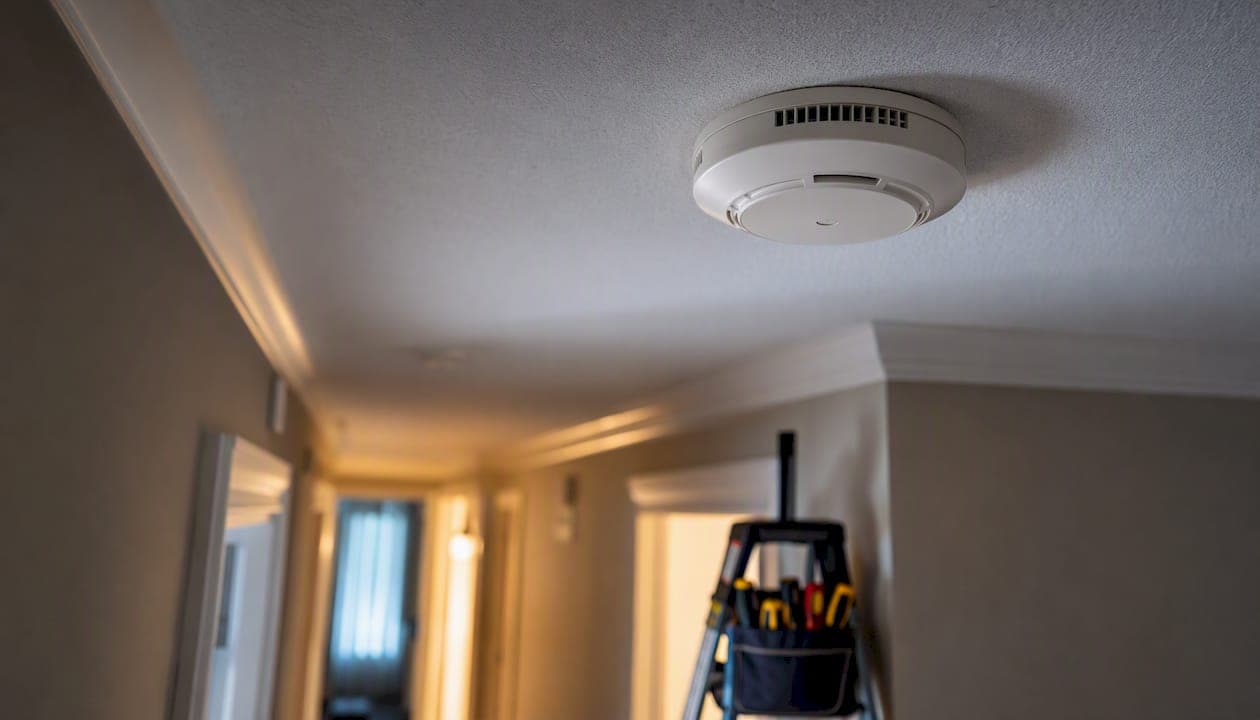
Replacing a smoke detector yourself costs a modest amount in parts if you're swapping a sealed 10-year battery unit. Hire a pro to handle an existing hardwired location and expect $105 to $210 per unit once you factor in the service call. A full single-family home refresh runs a few hundred dollars for DIY or several hundred to a low thousand for a professional whole-house job. The decision rule that cuts through most of the confusion: if fixing an old unit would cost more than half of what a new one costs, just replace it.
TL;DR:
- Replacing a single smoke detector with a pro generally costs between $105 and $210, depending on wiring and location complexities.
- Installing a new hardwired detector in a finished ceiling can cost $200 to $600 per location, with added costs for drywall patching.
- Costs for labor include an $80 to $150 service call fee, with hourly rates from $50 to $100 for electricians and lower for straightforward jobs.
- Choosing dual-sensor, photoelectric, or ionization detectors depends on the area, with prices ranging from $10 to $150, and combo units cost about $30 to $80.
- Whole-house upgrades with multiple detectors typically cost $700 to $900 for existing wiring or up to $1,200 for new wiring runs, optimized by bundling multiple jobs.
Table of Contents
- What does smoke detector replacement cost by scenario?
- How much does each type of smoke detector cost?
- What do electricians and handymen charge for detector work?
- Should you DIY it or hire a licensed pro?
- What's a realistic whole-house budget?
- Maddladder field notes: what actually slows down a service visit
- Our take on the smartest default for most homes
- Ready to book your smoke detector replacement?
- Where these cost figures come from
- Sources
What does smoke detector replacement cost by scenario?
The total you pay depends less on the detector itself and more on who's doing the work and what's already in the wall. A $12 photoelectric unit and a $12 dual-sensor unit both cost about the same to buy, but the labor bill around them can swing by hundreds of dollars depending on the scenario.
DIY swap, existing location. If you're replacing a battery unit or popping a hardwired detector off its existing bracket and snapping a new one on, you're buying parts only. Budget a modest amount per sealed 10-year unit, or a similar modest amount for a basic photoelectric or ionization model. No labor, no service call, no permit.
Professional swap, wiring already in place. This is the most common paid job. A licensed electrician or handyman shows up, confirms the existing junction box and wiring are code-compliant, and swaps the old unit for a new one. Pricing typically breaks down like this:
- Service-call minimum: $80 to $150, often waived or credited if you book actual work
- Labor per device: $30 to $80 depending on ceiling height and access
- Parts: $10 to $150+ depending on device type
Add those up and a single-unit installed replacement lands around $105 to $210 per location, which lines up closely with Angi's reported national average near $115 per unit for straightforward jobs.
New hardwired location. This is where costs jump. Adding a detector where none existed means fishing cable through a finished ceiling, cutting in a new junction box, and patching drywall afterward. Expect $200 to $600 per new location, with the top of that range reserved for finished basements, plaster ceilings, or homes with no attic access to run cable.
Here's the rough math a technician uses to price a new location:
- Base labor for cutting, fishing wire, and mounting a box: 1 to 2 hours
- Drywall patch and texture matching: 30 minutes to 1 hour, sometimes billed separately
- Circuit tie-in to an existing smoke alarm loop, if interconnection is required
- Parts for the box, cable, and detector itself
Permits and inspections. Most straightforward swaps don't need a permit. New circuits, panel work, or adding detectors as part of a larger remodel sometimes do, depending on your city's building department. If your project touches the electrical panel or adds new circuits rather than tapping an existing smoke alarm loop, ask your contractor whether your municipality requires a permit before work starts.
How much does each type of smoke detector cost?
Not every detector does the same job, and the price differences track real functional gaps, not just marketing. Ionization detectors react fast to flaming fires but lag on smoldering ones. Photoelectric units are the reverse. That's why the NFPA recommends either dual-sensor units or a mix of both technologies throughout a home rather than betting on one type everywhere.
| Detector type | Typical price range | Best suited for |
|---|---|---|
| Ionization | $10–$150 | Kitchens, garages (fast-flame detection) |
| Photoelectric | $10–$30 | Bedrooms, living rooms (smoldering-fire detection) |
| Dual-sensor | $40–$150+ | Whole-home consistency, hallways near kitchens |
| Combo smoke/CO | $30–$80 | Near bedrooms, furnace rooms, attached garages |
| Smart/connected | $50–$150+ | Homes wanting app alerts or voice notification |
Combo smoke and carbon monoxide units make sense near sleeping areas and anywhere a fuel-burning appliance sits nearby, since they cover both hazards without doubling your mounting points. Smart detectors add real convenience, voice alerts naming the room, phone notifications when you're not home, but that premium often comes with a companion monitoring app and occasionally a subscription fee for extended features.
For most bedrooms and hallways, a sealed 10-year photoelectric or dual-sensor unit hits the sweet spot: no yearly battery swap, no chirping at 2 a.m., and a price that stays reasonable even if you're outfitting six or seven rooms.
What do electricians and handymen charge for detector work?
Labor pricing on this job comes down to two numbers: the hourly rate and the trip fee. Electricians in most U.S. markets charge $50 to $100 per hour, with licensed handymen sometimes running slightly lower for straightforward swaps that don't touch the panel. On top of that hourly rate sits a service-call minimum, typically $80 to $150, which covers the trip out to your house regardless of how long the actual job takes.
That trip fee is often the biggest line item on a small job. Swap one detector and you might pay $150 total, with $100 of that being the visit itself rather than the 20 minutes of actual labor. This is exactly why bundling multiple small jobs into one visit changes your math so much. Replace five detectors in one visit and that same $100 trip fee gets spread across five units instead of one.
A few situations push costs higher than the baseline:
- Aluminum wiring from 1960s and 1970s homes requires special connectors and added labor time
- Detectors sharing a circuit with other fixtures can complicate troubleshooting if one unit fails
- Detectors wired into a whole-home interconnect system need careful testing after any single unit is swapped
Pro Tip: Ask any contractor for a quote broken into four parts before they start: the trip fee, the hourly or per-device labor rate, the parts cost, and any drywall patch allowance. A vague lump-sum quote is where surprise upsells hide.
Should you DIY it or hire a licensed pro?
Battery-only detectors and like-for-like hardwired swaps are reasonable DIY projects for most homeowners. New wiring, panel work, or interconnected systems are not.
- Safe DIY territory: Cutting power at the breaker before removing a hardwired unit, confirming voltage is dead with a non-contact tester, and matching the new unit's mounting bracket to the old wiring harness. Battery swaps require nothing more than a step stool and the right battery type.
- Call a licensed electrician when: you're adding a detector where no wiring exists, your home has aluminum wiring, the job involves the breaker panel, or you're tying multiple detectors into a single interconnected alarm loop. Licensed installation ensures proper grounding and code-compliant interconnection across the whole system, not just the one unit you're touching.
- Run the numbers before deciding: a $20 sealed 10-year unit you install yourself costs $20. The same unit installed by a pro at an existing location costs $105 to $210 once labor and the trip fee are added. For one unit, DIY wins easily on pure math. For six units needing new wiring runs, that math flips, because a licensed electrician handling code compliance across an entire interconnected system is worth the premium.
The NFPA's guidance to replace every smoke alarm at the 10-year mark applies regardless of who does the swap. Check the manufacture date stamped on the back of each unit; if you can't find one or it's been more than a decade, that's your answer.
What's a realistic whole-house budget?
House size drives detector count, and detector count drives your total more than any other single variable. NFPA guidance calls for a smoke alarm in every bedroom, outside each sleeping area, and on every level of the home, which means a typical 3-bedroom house needs 5 to 6 units and a 5-bedroom house often needs 8 to 10.
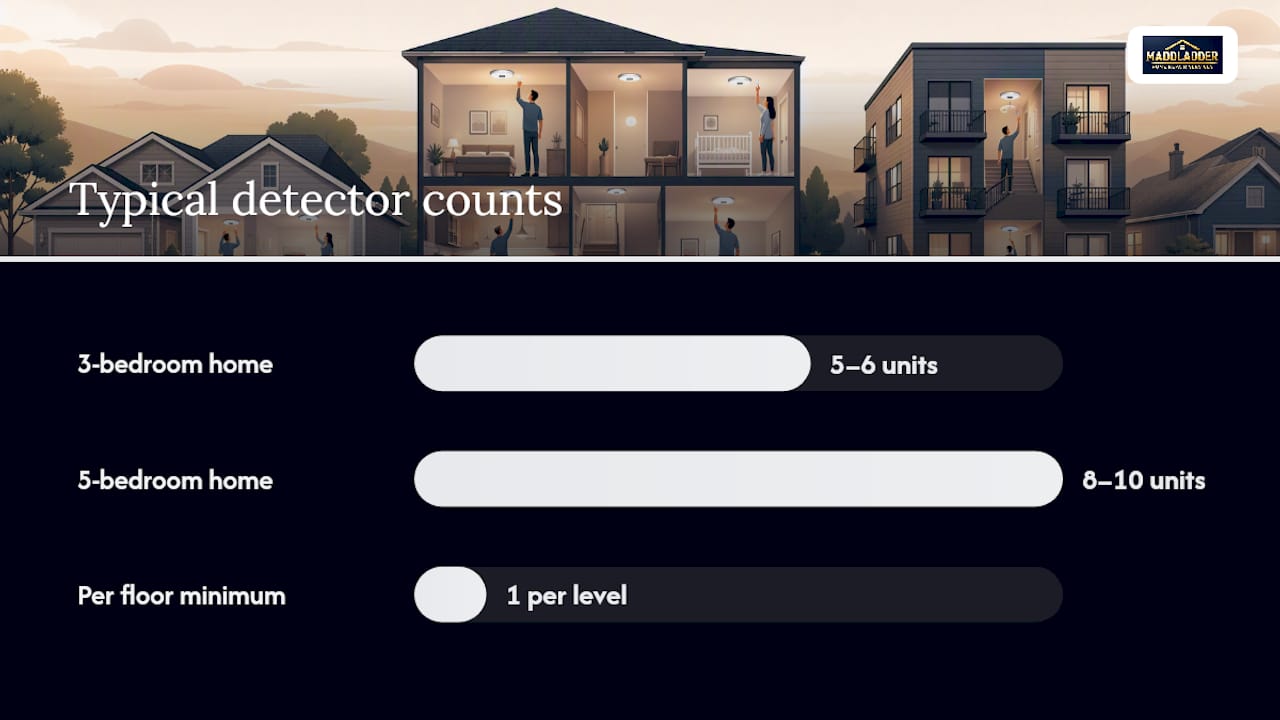
Those pro-installed totals already account for amortizing one service-call fee across every unit in the house rather than paying it per device, which is why the whole-house rate per unit comes in lower than the single-swap rate from earlier.
A few common project shapes to map against those numbers:
- Battery-only refresh: Swapping standalone battery units for sealed 10-year models across a 3-bedroom home, DIY, usually lands near $80 to $180.
- Hardwired same-location swap: Replacing aging hardwired units on existing brackets, professionally, across a 5-bedroom home typically runs $700 to $900.
- Adding two new hardwired locations: Tack on $400 to $1,200 to your base swap cost, since each new location runs $200 to $600 on its own.
- Wireless-interconnect upgrade: Swapping standalone units for models that talk to each other wirelessly, without new wiring, adds $10 to $40 per unit over standard sealed models but skips the fishing-cable labor entirely.
To turn these ranges into your own number, count your bedrooms and hallways, note which detectors are hardwired versus battery, and flag any location where you'd want to add a detector that isn't there today. That's the information any contractor needs to quote your specific house.
Maddladder field notes: what actually slows down a service visit
Every job looks simple until the technician is standing on the ladder. A few things consistently add time and cost that homeowners don't expect: bases painted over during a remodel, corroded wire connectors on older units, and mounting brackets in spots barely reachable without specialty equipment. None of these are deal breakers, but they do change the labor estimate once discovered on-site.
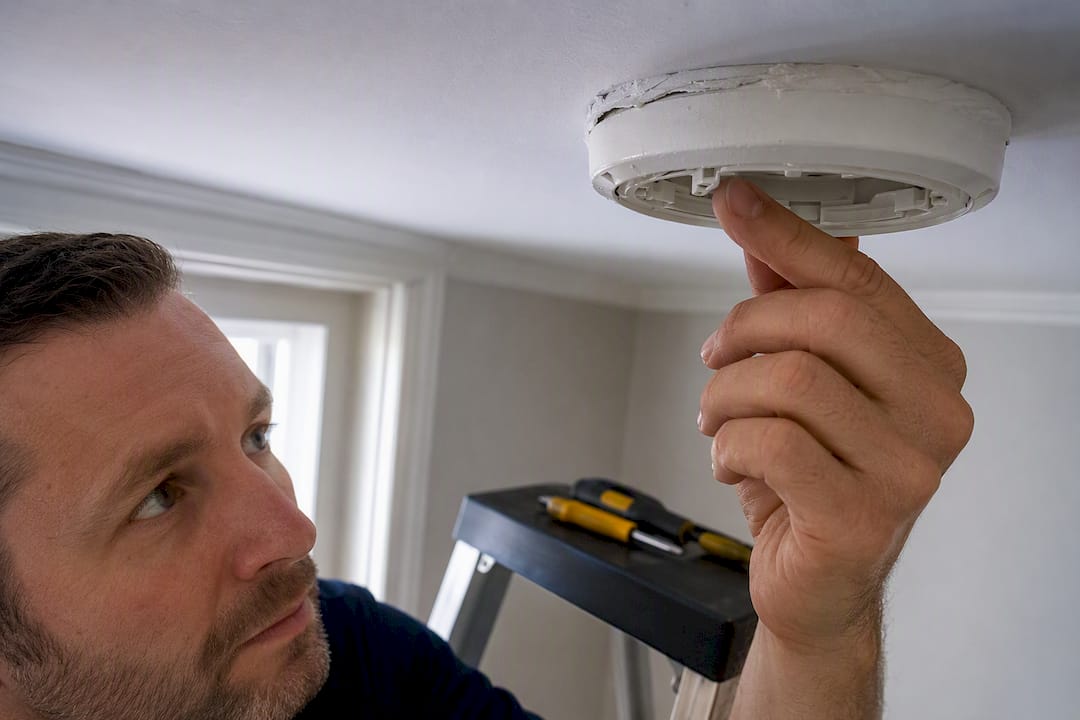
Maddladder bundles smoke detector work with other small electrical tasks whenever it makes sense, since combining jobs on one visit spreads the trip fee across more work instead of charging it twice. If you've also got a loose outlet or a dead light switch, mention it when booking.
A short prep list makes visits faster and cheaper: snap a photo of each detector's location beforehand, make sure the technician has clear access to every ceiling in question, and write down which units are chirping, discolored, or older than 10 years. That five-minute prep step routinely saves 20 to 30 minutes of on-site diagnosis time, which is time you're not paying for.
Our take on the smartest default for most homes
Most homeowners overthink detector type and underthink replacement timing. If your units are past their 10-year mark, replace them, full stop, and lean toward sealed 10-year battery models for anywhere you're not hardwiring anyway. They cost a little more upfront but save you a decade of battery swaps and false alarms from dying batteries.
Where I'd spend the professional labor money is on anything touching a junction box or a new wiring run. That's not a place to save $80 by guessing at code compliance. Check the manufacture date on every unit in your house this weekend. If you find one older than 10 years, that's the one to move on first.
— Jennifer
Ready to book your smoke detector replacement?
Maddladder is the straightforward alternative to juggling separate electrician quotes for a job this size. We replace smoke detectors, handle the minor electrical work that often comes with it (a dead switch, a loose outlet, a new hardwired location), and bundle everything into one visit so you're not paying multiple trip fees for work that could've happened in one trip.

One-time services start at $75 per hour, and we provide free estimates before any work begins, so you know your total before we're on the ladder. If your home needs detectors swapped, added, or brought up to a full interconnected system, our repair and replace services cover exactly this kind of work, alongside the broader electrical service offerings for anything else on your list. Reach out through our site to get a free quote scheduled, and mention any other small jobs you've been putting off. Bundling them now is the easiest way to make one trip fee cover a lot more ground.
Where these cost figures come from
The ranges in this guide draw from the NFPA's smoke alarm safety guidance, installed-cost data from Angi and HomeAdvisor, and whole-house worked examples from FixItReal. For anything involving new circuits or panel work, confirm requirements with your local municipal building department before scheduling.
Sources
- NFPA — Smoke alarms
- How Much Does It Cost to Install a Smoke Detector? 2026 Data | Angi
- HomeAdvisor — Smoke & CO detector prices
- What It Actually Costs — Smoke detector installation cost
- FixItReal — Smoke detector replacement cost: 2026 ranges