

TL;DR:
- Outsourcing property maintenance in Kansas City can significantly lower costs, improve quality, and boost tenant satisfaction. It involves hiring vetted vendors for routine, emergency, and specialized repairs, often through flexible plans and SLAs. Most property owners find that structured outsourcing outperforms in-house efforts, especially amid labor shortages and scalability challenges.
Most Kansas City property owners assume that keeping maintenance in-house saves money. It feels logical: no middleman, no markups, full control. But the numbers tell a different story. Outsourcing property maintenance can reduce long-term costs by eliminating training expenses, equipment purchases, and emergency repair overruns through access to specialized professionals and bulk vendor discounts. For homeowners and property managers juggling multiple responsibilities, outsourcing isn't just a convenience. It's often the financially smarter move that also leads to happier tenants and fewer headaches.
Table of Contents
- What does outsourcing property maintenance really mean?
- Major benefits of outsourcing: Cost savings, quality, and tenant retention
- In-house vs. outsourced: Comparing workflows and results
- Potential drawbacks and how to avoid them
- How Kansas City property owners can get started
- The uncomfortable truth: Why outsourcing wins for most Kansas City properties
- Discover reliable outsourcing solutions for Kansas City properties
- Frequently asked questions
Key Takeaways
| Point | Details |
|---|---|
| Outsourcing cuts costs | Owners and managers can reduce long-term maintenance expenses by 30-45% by outsourcing specialized and emergency tasks. |
| Service quality improves | Expert vendors provide faster, better compliance-focused repairs that boost tenant confidence and property value. |
| Tenant retention rises | Happier tenants and fewer emergencies lower turnover and drive renewals, protecting your bottom line. |
| Hybrid models add flexibility | Blending in-house staff for simple tasks with expert outsourcing for complex jobs optimizes efficiency and control. |
| Vetting prevents pitfalls | Thorough selection and service agreements are essential to avoid service inconsistencies and maintain trust. |
What does outsourcing property maintenance really mean?
Now that we've questioned assumptions about in-house savings, let's clarify what outsourcing property maintenance actually involves.
Outsourcing property maintenance means hiring outside vendors or service firms to handle repairs, routine upkeep, and emergency responses instead of relying on your own staff or doing the work yourself. In practical terms, it might mean contracting a licensed handyman service to handle monthly inspections, calling in a plumber when a tenant reports a leak, or setting up a scheduled preventive maintenance program to keep systems running before they fail.
What makes outsourcing different from just calling a repair person occasionally is the structure behind it. Good outsourcing involves vetted vendors, service-level agreements (SLAs), and consistent workflows. You know who's showing up, what they're qualified to do, and how fast they'll respond.
Kansas City outsourcing specifically addresses local challenges like 24/7 emergency coverage, vendor vetting, and preventive maintenance through established local firms who already understand the region's housing stock, weather patterns, and code requirements.
Here's what a solid outsourced property maintenance setup typically includes:
- Routine inspections and scheduled upkeep (quarterly HVAC checks, gutter clearing, caulking)
- On-call emergency repairs for nights, weekends, and holidays
- Specialized work like plumbing, electrical, drywall, and fixture replacement
- Preventive maintenance programs tied to seasonal Kansas City conditions
- Compliance monitoring to make sure repairs meet local building codes
Many Kansas City owners are now pairing outsourced vendors with KC maintenance subscriptions to get predictable costs and priority scheduling built into a single monthly plan.
Major benefits of outsourcing: Cost savings, quality, and tenant retention
With a clear definition, it's time to see why more Kansas City property owners are making the switch and what results they're seeing.
Cost reduction is the first and most compelling reason. When you factor in wages, benefits, equipment, insurance, and training for in-house staff, the numbers often exceed what a professional outsourced vendor charges. Properties that shift to outsourced maintenance models typically see meaningful reductions in both routine operating costs and emergency repair expenses.
The following table compares key performance indicators for properties that maintain in-house teams versus those using outsourced vendors:
| Metric | In-house | Outsourced |
|---|---|---|
| Average monthly maintenance cost | $1,800+ | $950 to $1,200 |
| Emergency callout frequency | 8 to 12 per year | 2 to 4 per year |
| Average tenant satisfaction score | 2.8 out of 5 | 4.6 out of 5 |
| Annual turnover cost per unit | $2,500+ | $800 to $1,100 |
| Response time for urgent repairs | 12 to 24 hours | 2 to 6 hours |
Those numbers aren't small differences. The gap in tenant satisfaction alone justifies a serious look at outsourcing.
Quality improves across the board. Expert technicians for HVAC, plumbing, and electrical work resolve issues faster, meet code compliance requirements, and prevent small problems from escalating into expensive replacements. An outsourced vendor who handles 50 plumbing calls a month is simply more efficient than an in-house handyman who sees that job twice a year.
Tenant retention follows naturally when quality improves. Faster resolutions and proactive communication reduce the frustration tenants feel when maintenance requests drag on. When a tenant sees a problem fixed within hours instead of days, they renew their lease. That directly cuts your turnover costs, which in Kansas City can run thousands of dollars per unit when you add up cleaning, marketing, and lost rent.
Pro Tip: Set up a preventive maintenance schedule with your outsourced vendor before problems start. Quarterly walkthroughs and seasonal checks are far cheaper than emergency repairs, and they signal to tenants that you run a well-managed property.
Exploring flexible pricing for KC repairs can help you find options that match your budget while still delivering the quality tenants expect. And if you own rentals specifically, investing in professional repairs for rentals protects your property value while keeping tenants satisfied long-term.
In-house vs. outsourced: Comparing workflows and results
Understanding the advantages is useful, but comparing side by side with in-house options reveals where outsourcing truly stands out.
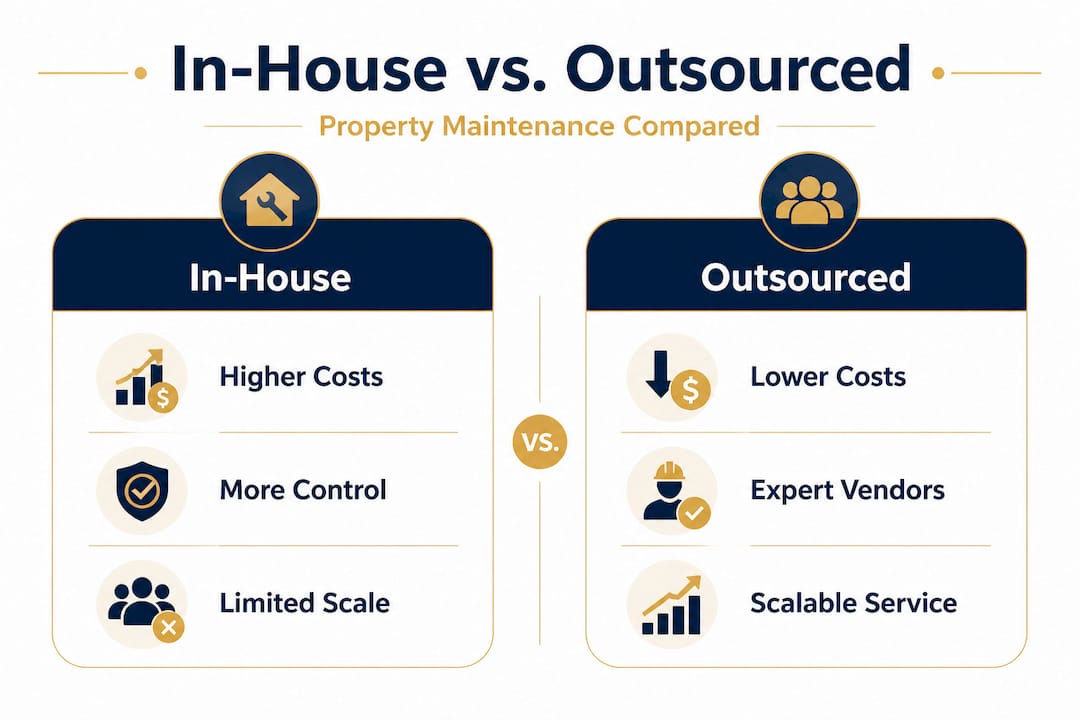
In-house maintenance gives you direct control and can be fast for small recurring tasks at a single property. If you have a super on site who handles light bulb changes and minor fixes, that works fine for those specific jobs. But when labor shortages hit, when a specialized repair comes up, or when you're managing properties across multiple locations, in-house models buckle fast.
Outsourced models scale efficiently. A vendor network can dispatch the right person for the right job within hours, without you needing to recruit, train, or manage that person directly. For remote landlords or multisite managers in Kansas City, that scalability is invaluable.
Hybrid models balance routine tasks done in-house (like landscaping and light bulbs) with outsourced specialized and emergency work for the best overall efficiency. This is the model most experienced Kansas City property owners quietly settle on after trying both extremes.
| Attribute | In-house | Outsourced | Hybrid |
|---|---|---|---|
| Cost control | Moderate | High | High |
| Direct control | High | Lower | Moderate |
| Response time | Variable | Consistent | Good |
| Specialized skills | Limited | Extensive | Extensive |
| Scalability | Poor | Excellent | Good |
| Risk of labor shortage | High | Low | Low |
The statistics back up the shift toward outsourcing. Roughly 58% of facility managers now outsource at least part of their maintenance operations, and benchmark studies show that hybrid models have saved organizations more than $200 million over five-year periods by reducing labor overhead and emergency costs.
Here's a quick breakdown of which tasks belong where in a typical Kansas City hybrid model:
- In-house: Light cleaning, landscaping, replacing light bulbs, trash management, tenant communication
- Outsourced: Plumbing, electrical, HVAC, drywall, structural repairs, after-hours emergencies
- Either: Painting, appliance troubleshooting, seasonal maintenance checks
Working with licensed handymen in Kansas City for the outsourced portion gives you both professional credentials and local knowledge, which matters when dealing with city permits and inspections.
Potential drawbacks and how to avoid them
While the advantages are clear, it's smart to be aware of potential challenges and how to sidestep them.
Outsourcing isn't perfect. Potential drawbacks include reduced direct control, inconsistent service quality if you choose the wrong vendor, and time spent on onboarding. These are real risks, but every single one is preventable with the right approach.
"Quality varies by provider. Use SLAs for guarantees."
That quote should be your guiding principle before signing any vendor contract. An SLA specifies response times, quality standards, and remedies if a vendor falls short. Without it, you're trusting a handshake agreement.
Here are three concrete steps to vet a vendor and establish a strong SLA:
- Check credentials and insurance. Verify that the vendor is licensed in Missouri, carries general liability insurance, and has workers' compensation coverage. Ask for certificates, not just verbal confirmation.
- Review references and past performance. Speak directly with two or three current clients in Kansas City who have properties similar to yours. Ask specifically about emergency response times and how the vendor handles disputes or call-backs.
- Define SLA terms in writing before work starts. Your SLA should specify: maximum response times for urgent and non-urgent requests, quality standards for completed work, communication protocols, and what happens if those standards aren't met.
Pro Tip: Before you sign any vendor contract, ask for their average emergency response benchmark in Kansas City. A vendor confident in their performance will answer immediately. One who hesitates or deflects is telling you something important.
Onboarding delays are the other common complaint. Give yourself four to six weeks when transitioning to a new outsourced vendor. Use that time to document your current maintenance needs, transfer records, and run parallel workflows if possible. Rushing this step leads to gaps in coverage.
Need to start scheduling KC repairs before your outsourced setup is fully in place? Having a reliable local service ready to step in keeps your tenants covered during any transition period.
How Kansas City property owners can get started
Now that the roadblocks are addressed, here's how to confidently make the move toward outsourced property maintenance in Kansas City.
Getting started doesn't require a dramatic overnight switch. Most successful Kansas City owners start by outsourcing one or two categories, measuring results, and expanding from there. The key is going in with a clear plan rather than just calling whoever answers the phone.
Start with this checklist:
- Audit your current maintenance load. List every task you handle each month. Separate them into routine (predictable, low skill) and specialized (technical, code-sensitive, or unpredictable). This tells you immediately where to start outsourcing.
- Research Kansas City vendors with local experience. Look specifically for providers who know the metro, understand city permit requirements, and have references from properties similar to yours in terms of size and age.
- Interview at least three vendors before deciding. Ask about their response time guarantees, how they handle after-hours calls, and whether they offer preventive maintenance programs.
- Insist on proof of insurance and licensing. Missouri requires licensing for electrical and plumbing work. Don't assume, verify.
- Negotiate SLA terms before you start. Get response time benchmarks, quality standards, and escalation procedures in writing.
- Set up KPIs to track results after switching. Measure response times, tenant satisfaction, and emergency repair frequency before and after the switch. Give it 90 days for a fair comparison.
Outsourcing also addresses local Kansas City challenges like 24/7 emergency coverage and access to vetted vendor networks that know the city's housing stock. That local expertise is worth paying for. And as your property portfolio grows, investing in safety upgrades for KC rentals through your outsourced vendor adds long-term value while keeping tenants and insurance carriers happy.
The uncomfortable truth: Why outsourcing wins for most Kansas City properties
Having covered the how-to, here's a candid take on why outsourcing is where the smart money is moving in Kansas City real estate management.
In conversations with long-tenured Kansas City property managers, one admission comes up again and again: they held onto in-house models longer than they should have because of pride, habit, or fear of losing control. When they finally made the switch, the results surprised them.
In-house maintenance offers control for clustered properties but faces serious labor shortages. Outsourcing scales better, especially for multisite owners and remote landlords who can't be on-site for every repair. The post-2022 labor crunch made this impossible to ignore. Qualified in-house maintenance workers became harder to find, more expensive to retain, and quick to leave for better offers. Vendors who specialize in property maintenance, on the other hand, already have those workers on staff and manage their own turnover issues independently.
Here's the part most articles won't tell you: outsourcing doesn't mean losing control. It means redirecting your control toward vendor accountability instead of day-to-day task management. The best-run properties in Kansas City don't just outsource and walk away. They use detailed SLAs, regular performance reviews, and tenant feedback loops to hold vendors rigorously accountable.
The bottom line is that for most Kansas City homeowners and property managers, a well-structured outsourcing arrangement with vetted, local vendors will outperform in-house operations on cost, quality, and tenant satisfaction. Not occasionally. Consistently.
Discover reliable outsourcing solutions for Kansas City properties
Ready to experience the advantages of trusted outsourcing? Here's how MaddLadder can help you simplify property maintenance and improve outcomes.
If you're a Kansas City homeowner or property manager looking to put these outsourcing benefits to work, MaddLadder brings licensed, dependable service directly to your properties. From plumbing and electrical specialists to full repair and replacement services, MaddLadder's local teams handle the jobs that protect your investment and keep tenants satisfied.

Need to modernize your rentals while you're at it? MaddLadder also offers smart home upgrades like thermostats and security cameras that add value, reduce energy costs, and appeal to today's tenants. With flexible pricing starting at $75/hour and subscription-based maintenance plans designed specifically for property managers, getting professional outsourced support has never been more straightforward in Kansas City. Contact MaddLadder today for a free estimate.
Frequently asked questions
What property maintenance tasks are best outsourced?
Specialized work such as HVAC, plumbing, electrical, large repairs, and emergency response are ideal for outsourcing because expert technicians ensure compliance and prevent small issues from escalating into costly problems.
How much can outsourcing property maintenance save homeowners?
Property owners can realistically save 30 to 45% on maintenance costs, and preventive outsourcing programs typically reduce emergency callouts by 60 to 75% compared to reactive in-house models.
What are the main risks of outsourcing?
Risks include reduced direct control and possible inconsistency if you choose a poor vendor, but SLAs and thorough vetting address both issues before they become problems.
How do hybrid models work in Kansas City?
Hybrid models pair in-house staff with outsourced specialists, keeping simple routine tasks internal while sending technical, emergency, and code-sensitive work to vetted local vendors.
Does outsourcing property maintenance really improve tenant satisfaction?
Absolutely. Tenant satisfaction scores rise sharply and turnover drops significantly when faster, more reliable service replaces slow in-house response times. Tenants who get quick fixes stay longer.