
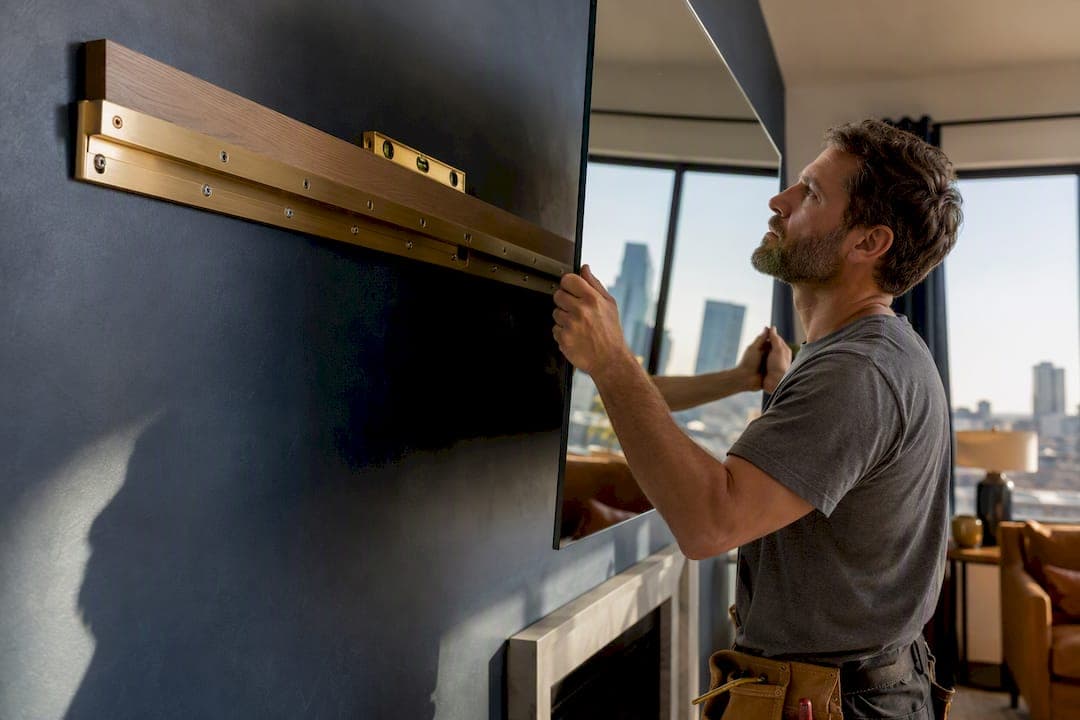
The safest method for heavy mirror hanging is anchoring into wall studs, and for anything wide or over 100 pounds, a French cleat spread across at least two studs beats every other option. For anchors without studs, always pick hardware rated at twice the mirror's actual weight, known as the 2x safety rule. Get a second person to help with anything over 50 pounds.
TL;DR:
- For mirrors over 100 pounds, mounting with a French cleat anchored into multiple wall studs offers the most reliable, weight-spreading support.
- Snap toggles and metal toggle bolts rated at 100 pounds or more are recommended for heavy mirrors on drywall, following the 2x safety rule, especially in older or thinner walls.
- Using a longer French cleat, at least 30 inches, increases the likelihood of crossing multiple studs and preventing load concentration on a single point.
- Always confirm wall condition and drywall thickness, as they significantly reduce anchor holding capacity compared to manufacturer ratings.
- Consider professional installation when dealing with extremely heavy or delicate mirrors, or if wall conditions or mounting locations complicate safe support.
Table of Contents
- Tools and Materials You Need for Heavy Mirror Hanging
- How Do You Choose Between Studs, Anchors, or a Cleat?
- Step-by-Step Installation Into Wall Studs
- What If You Can't Hit a Stud?
- How Do You Test the Install and Catch a Failing Anchor?
- Why Trust This Guide, and When Should You Call a Pro?
- Considerations for Preventing and Repairing Wall Damage
- Maintenance Tips to Keep Your Mirror Secure Long-Term
- Lessons From Real Installs
- Hire Maddladder for Heavy or Risky Mirror Installs
- Sources
- FAQ
Tools and Materials You Need for Heavy Mirror Hanging
Before touching a drill, lay out everything on a table. Half the mistakes in heavy mirror hanging happen because someone runs out mid-job to buy a longer screw.
You'll want a stud finder, a level, a drill/driver, and a full bit set, including a 1/2 inch bit for snap toggles. Add a tape measure, pencil, painter's tape, safety glasses, and work gloves. For anything over 50 pounds, bring a helper or a set of lifting jacks.
For hardware, stock these:
- 3-inch wood screws for anchoring into studs
- A French cleat between 18 and 30 inches long
- Snap toggles or metal toggle bolts for no-stud spots
- Molly bolts for lighter loads
- D-rings and heavy-duty picture wire
- Adhesive bumpers for the bottom edge
Pro Tip: Buy one size up on your toggles. A snap toggle rated for 85 pounds in perfect drywall performs worse in real walls, especially older ones.
Most American homes use either 1/2 inch or 5/8 inch drywall, and the thinner sheet noticeably reduces how much weight an anchor actually holds compared to the number printed on the package. Older or water-damaged drywall performs worse still, which matters more than people expect when they're trusting a single toggle bolt with a 40-pound mirror.
How Do You Choose Between Studs, Anchors, or a Cleat?
Weight decides almost everything. Here's how the choices break down:
- Under 20 lbs: plastic anchors or basic D-rings on wire are fine
- 20 to 50 lbs: snap toggles are the safer, more reliable pick
- 50 to 100 lbs: aim for at least one stud, or step up to a French cleat
- 100+ lbs: a French cleat anchored to multiple studs, or plywood backing, is the only method worth trusting
Drywall alone reliably supports around 20 pounds with typical hardware. Past that, you're relying on the anchor's engineering, not the wall's.
A French cleat works because it spreads weight across the entire length of the mounting bracket instead of concentrating it on two or three screw points. That's why a 30 inch cleat is worth the extra few dollars over an 18 inch one: longer cleats have a better shot at crossing multiple studs, which removes the single point of failure that sinks so many DIY hangs.
One more distinction that trips people up: pull-out strength versus shear strength. Shear is the anchor resisting downward weight. Pull-out is what happens when the mirror gets bumped and yanks outward, away from the wall. Package ratings usually reflect shear numbers, not the weaker pull-out figure, which is exactly the force a mirror sees every time someone brushes past it.
Step-by-Step Installation Into Wall Studs
This is the sequence to follow when you can anchor into framing, whether you're using D-rings or building a full French cleat setup.
- Weigh the mirror and find its balance point. Lean it against a wall and check whether the weight sits center or leans toward the top, which changes where your hardware needs to go.
- Measure and mark. Note the mirror's width, height, and the distance from the top edge down to the wire or D-rings.
- Find your studs. Run a stud finder across the wall, mark the center of each one, and confirm with a small test hole if you're unsure.
- Transfer your measurements. Use painter's tape and a level to mark exactly where the top of the mirror and the hanger points will land on the wall.
- Prep the mirror. Attach D-rings, or screw the mirror-side half of the cleat to the frame. Drill pilot holes first to keep the wood from splitting.
- Mount the wall-side cleat. Drive 3-inch wood screws directly into the studs, using two offset rows per stud for wide mirrors so the load doesn't twist on a single line of screws.
- Lift and seat the mirror. Engage the cleat, or hook the wire over your hangers, checking that it drops fully into place.
- Level it and add bumpers. Adjust for level, then stick adhesive bumpers on the bottom corners to stop swinging and wall contact.
- Test it. Give it a gentle pull and inspect for movement before you walk away.
Pro Tip: For anything over 75 pounds, borrow or rent a lifting jack. Trying to hold a mirror steady with one hand while you thread it onto a cleat with the other is how frames get cracked and backs get hurt.
What If You Can't Hit a Stud?
Sometimes the studs just aren't where you need them, and that's when anchor choice matters most.
Snap toggles are the strongest no-stud option on the market. In testing, a single 1/8 inch snap toggle in 1/2 inch drywall held around 85 pounds, and metal toggle bolts came close behind at roughly 100 pounds under good conditions. Molly bolts and self-drilling zinc anchors handle lighter loads, usually in the 20 to 30 pound range, and shouldn't be trusted much past that regardless of the box's claims.
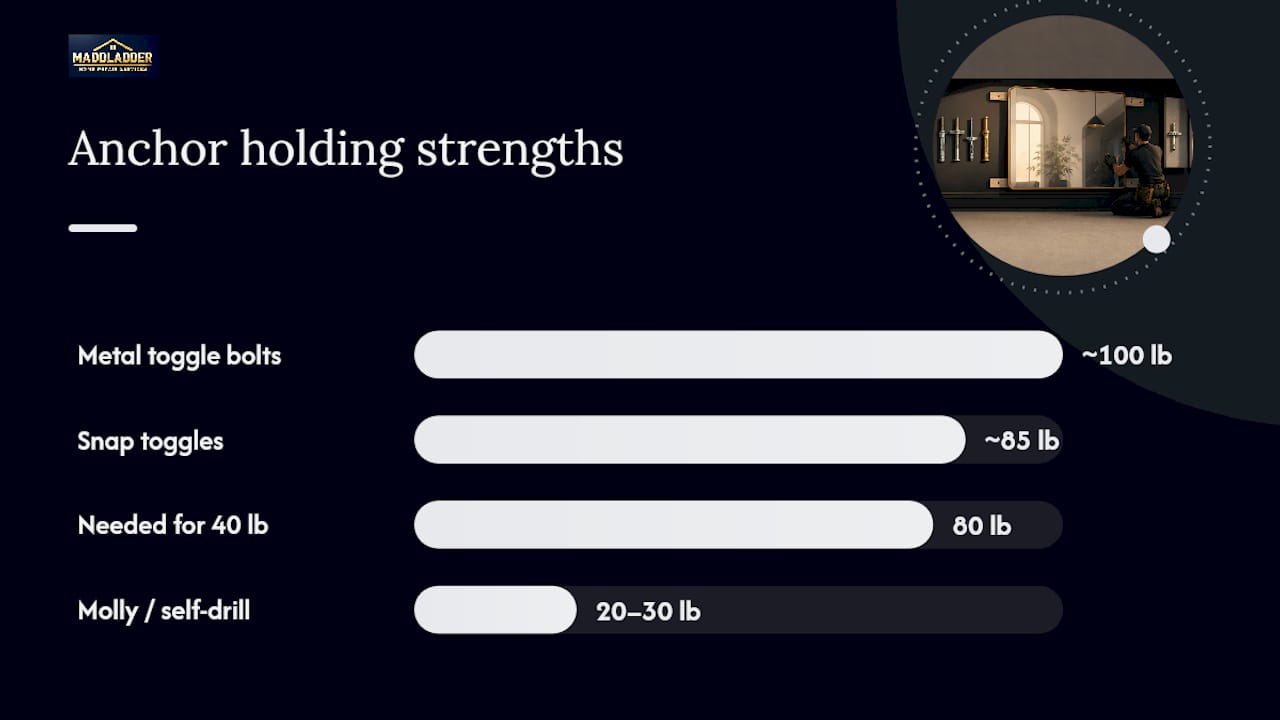
Apply the 2x rule here without exception: if your mirror weighs 40 pounds, the anchor needs a rating of at least 80. Drywall condition changes the math, too. A toggle that performs fine in fresh 5/8 inch drywall can underperform in older or thinner walls.
Renters have options too. Heavy-duty no-drill strips can work for lighter mirrors, but they're not a substitute for studs or a cleat once you're above 20 or 30 pounds. If neither anchors nor studs line up right, cutting in a section of plywood backing between studs gives you a solid surface to screw into. Our guide to installing grab bars covers similar load-transfer techniques if you want to see the concept applied elsewhere.
How Do You Test the Install and Catch a Failing Anchor?
Once the mirror is up, don't just walk away and hope. Grip the frame near the top and pull outward gently for 10 to 15 seconds, watching the wall around the anchor points the whole time.
Warning signs to watch for:
- Any creeping or shifting downward, even a fraction of an inch
- Cracking or popping sounds from inside the wall
- Visible dimpling, bulging, or cracks in the drywall surface
- The mirror tilting slightly forward at the top
If you catch any of these, take the mirror down immediately rather than hoping it settles. Move to a stud, upgrade to a larger toggle, or add plywood backing behind the drywall. If you damaged the wall pulling an anchor, our wall patching guide walks through the repair.
Why Trust This Guide, and When Should You Call a Pro?
This guide draws on hands-on fixture installation and safety-upgrade work, the kind of jobs where a missed stud or an undersized anchor turns into a real hazard, not just a cosmetic problem. Licensed handyman services offer heavy mirror installs, which are a common task for professional crews in the Kansas City metro area.
Call a pro when your mirror weighs over 100 pounds, it's an antique or irreplaceable piece, you're mounting into plaster or masonry instead of drywall, you can't locate usable studs, or you simply don't have a second set of hands available — for more on this, see Avoiding Common Pitfalls: The Challenges of DIY Door Replacement.
Considerations for Preventing and Repairing Wall Damage
The biggest damage risk isn't the install, it's the removal. Pulling a toggle bolt or molly bolt out of drywall almost always leaves a hole bigger than the one you started with, since the mechanism expands behind the wall surface.
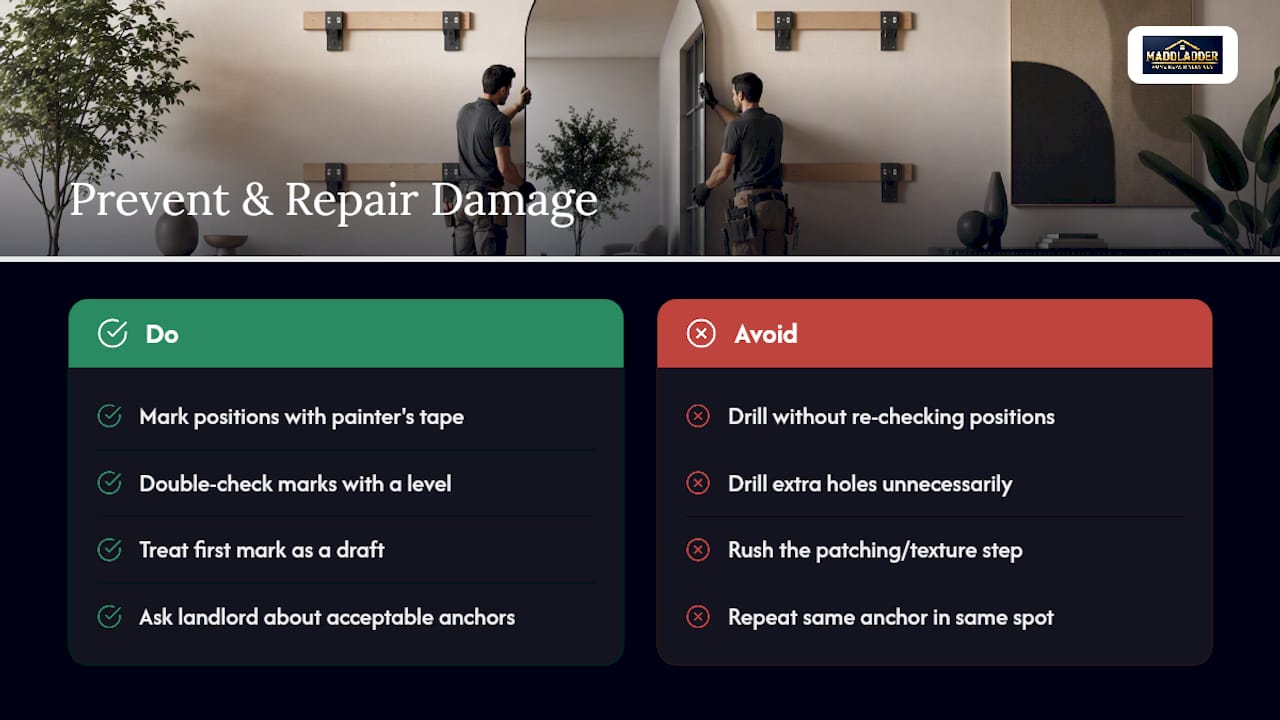
Plan for this before you drill. Mark your positions with painter's tape and double check them against a level before committing to a pilot hole. Drilling one hole too many, or in the wrong spot, is common enough that it's worth treating your first mark as a draft, not a final answer.
If you're renting, ask your landlord about acceptable anchor types before hanging anything heavy. Some property managers have preferences, and knowing them upfront avoids an awkward conversation at move-out.
When damage happens anyway, small anchor holes patch easily with spackle and a putty knife. Larger holes from a failed toggle bolt or a cleat that needed repositioning usually need a proper patch kit with mesh backing, sanding, and a matching texture pass before paint. Rushing this step is how patch jobs end up more visible than the original hole. If the damage happened because an anchor pulled loose under load, patch the hole but also rethink the hardware before rehanging. Repeating the same anchor choice in the same spot just sets up round two.
Maintenance Tips to Keep Your Mirror Secure Long-Term
A mirror that's hung correctly still needs a checkup now and then. Wood-frame houses shift with the seasons, and screws can work loose over a year or two, especially in homes with noticeable humidity swings.
Twice a year, give the mirror a gentle pull test the same way you did during installation. If it's on a French cleat, check that the wall-side screws haven't backed out even slightly, since a loosened screw on one stud shifts the entire load onto the others.
Wipe down adhesive bumpers periodically. They lose grip over time, especially in warm rooms, and a mirror that's begun swinging slightly at the bottom is often just telling you the bumpers need replacing, not that the whole install has failed.
If you ever add or remove wall art nearby and end up bumping the mirror during that work, treat it as a reason to retest, not just resettle it visually. A mirror that looks straight can still have a compromised anchor behind it.
Keep a note of what hardware you used and where the studs are located, especially if you rearrange furniture in that room later. Future you, or whoever lives there next, will appreciate not having to hunt for studs all over again.
Lessons From Real Installs
Buy the longer cleat every time. The extra few inches of a 30 inch French cleat over an 18 inch one is what lets you land on two studs instead of gambling on one, and that difference shows up the first time someone leans on the wall nearby.
Lifting jacks aren't overkill, they're what keeps a 90 pound mirror from becoming a two person injury. And snap toggles are worth the extra cost over cheaper anchors almost every single time you can't hit a stud. None of this is complicated. It just rewards patience over speed.
— Jennifer
Hire Maddladder for Heavy or Risky Mirror Installs
If your mirror is pushing past 75 pounds, your walls are plaster instead of drywall, or you simply don't want to be the one balancing a French cleat solo on a ladder, that's exactly the gap Maddladder fills. Rather than buying tools you'll use once or guessing at anchor ratings, you get a licensed handyman who's done this install before and brings the right hardware the first trip.

Professional handyman services are available in the Kansas City metro area, providing installation work including fixture mounting, wall reinforcement, and repair jobs related to failed DIY anchors. If your situation calls for plywood backing or a full wall repair before the mirror can safely go up, our repair and replace services cover that groundwork too. For the mirror hang itself, our installation and assembly service is built for exactly this kind of job, heavy, awkward, and not worth risking on a ladder alone. Request a free estimate through Maddladder and get the mirror up right the first time.
Sources
For deeper specs beyond this guide, HGTV's French cleat walkthrough covers cleat construction in detail. Home Depot's mirror guide explains stud-anchoring basics. The Decor Advisor breaks down pull-out versus shear testing. Walabot explains how drywall thickness changes anchor math.
- How to Hang a Heavy Mirror With a French Cleat | HGTV
- Hanging a wall mirror on drywall: Complete guide | The Decor Advisor
- How to Hang a Heavy Mirror | The Home Depot
- How much weight can drywall hold? | Walabot
FAQ
What Is the Best Way to Hang a Very Heavy Mirror?
For mirrors over 100 pounds, a French cleat anchored into at least two wall studs is the safest method, since it spreads the load across the full length of the bracket instead of a few screw points.
Can I Hang a 50 lb Mirror on Drywall?
Yes, but not with basic plastic anchors. A 50 pound mirror needs a snap toggle or metal toggle bolt rated at 100 pounds or more, following the 2x safety rule, or better yet, at least one screw anchored into a stud.
How Do I Hang a 100 lb Mirror on Drywall?
Drywall alone shouldn't carry 100 pounds. Locate studs and use a French cleat spanning at least two of them, or cut in plywood backing between the studs if the mirror's position doesn't line up with usable framing.
Are There Heavy-Duty Mirror Hangers That Can Support 100 Pounds?
Metal toggle bolts have held close to 100 pounds in real-world testing, but that's near their ceiling, and results depend heavily on drywall thickness and condition. For loads at or above 100 pounds, studs or a French cleat are the more reliable choice, and Professional installers can safely mount studs or French cleats if you'd rather not test the limits yourself.