
TL;DR:
- Wall hole patching involves filling damaged drywall with appropriate materials to create a smooth, paint-ready surface. Properly matching techniques, tools, and textures according to hole size ensures seamless repairs that blend into the wall. For complex textures or large damage, professional assistance may provide the best long-lasting, invisible results.
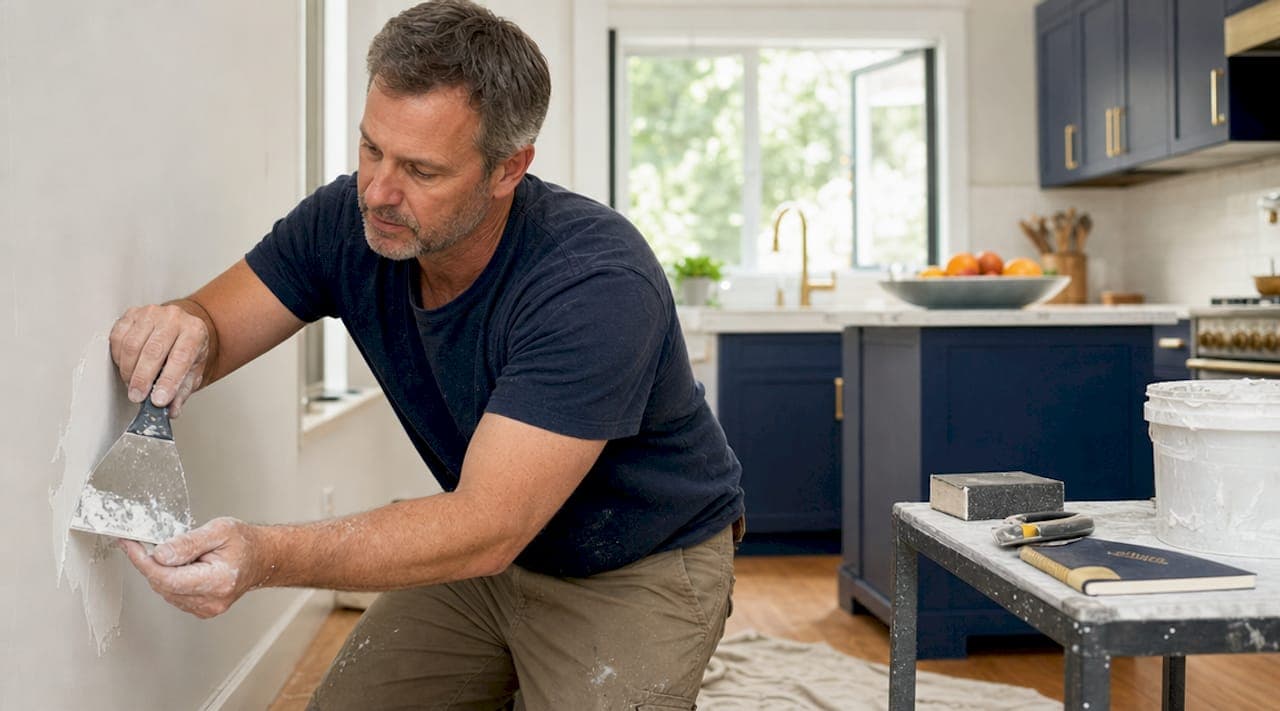
Wall hole patching is the process of filling and finishing damaged drywall or plaster to restore a smooth, paint-ready surface. Whether you're dealing with a nail hole the size of a pencil eraser or a fist-sized gap left by a doorknob, knowing how to patch holes in walls saves you money and keeps your home looking sharp. This guide covers every repair size, from tiny dents fixed with lightweight spackle to large openings requiring the California patch technique. You'll also learn how to match wall textures and finish repairs so cleanly that no one will know the hole was ever there.
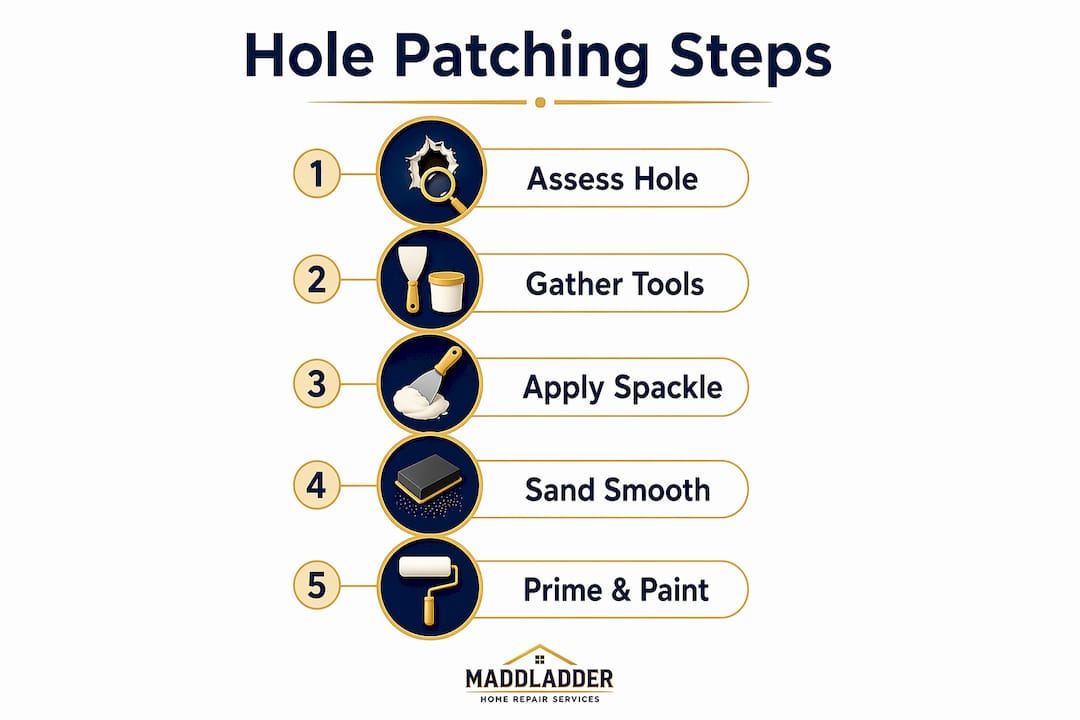
What tools and materials do you need to patch holes in walls?
Gathering the right supplies before you start is the single step most DIYers skip, and it's the one that causes the most trips back to the hardware store. The tools you need depend directly on the size of the hole you're fixing.
Lightweight spackle is ideal for small holes and dents, while joint compound is the better choice for larger repairs involving tape and mesh patches because of its superior bonding strength. Using the wrong filler for the job is one of the most common reasons patches crack or shrink after drying.
Here's what to have on hand before you start any wall repair:
- Putty knife (3-inch and 6-inch sizes cover most jobs)
- Sanding block or sandpaper (150-grit for smoothing, 220-grit for final passes)
- Self-adhesive mesh patch (for holes between 1/2 inch and 4 inches)
- Utility knife (for cutting drywall and trimming patches)
- Drywall saw (for cutting clean edges on large holes)
- Pre-mixed joint compound (also called "mud," sold in buckets at Home Depot or Lowe's)
- Lightweight spackle (for nail holes and small dents)
- Primer and paint (matched to your wall color)
- Aerosol texture spray (for orange peel or knockdown finishes)
| Tool or Material | Best Use | Hole Size |
|---|---|---|
| Lightweight spackle | Nail holes, small dents | Up to 1/2 inch |
| Self-adhesive mesh patch | Medium holes | 1/2 inch to 4 inches |
| Pre-mixed joint compound | All patch sizes, skim coats | Any size |
| California patch (drywall piece) | Large holes | Over 4 inches |
| Aerosol texture spray | Texture matching after repair | Any size |
Pro Tip: Buy a small tub of pre-mixed joint compound even for tiny repairs. It stays workable longer than spackle and sands more smoothly, which matters when you're trying to blend a patch into an older wall.
How to patch small holes and dents in drywall
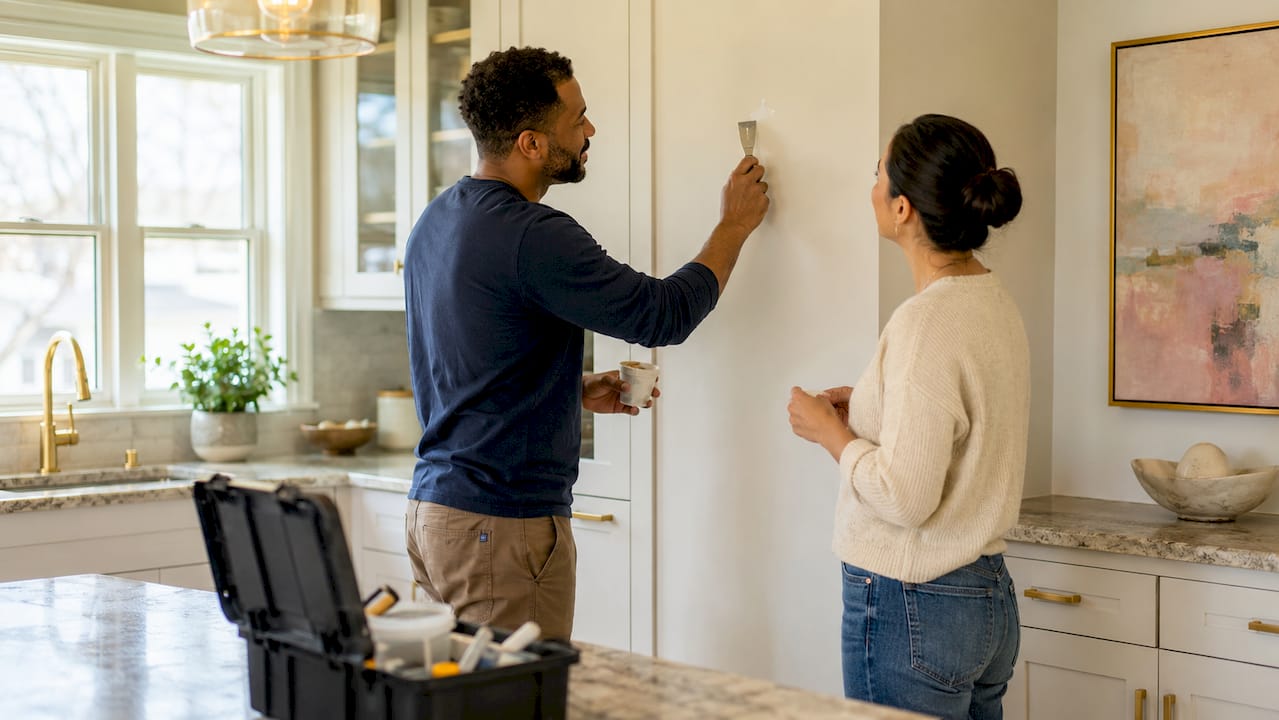
Small holes, defined as anything up to about 1/2 inch in diameter, are the most common type of wall damage in any home. Nail holes, picture-hanger anchors, and minor dents all fall into this category. Spackle drying time for small holes runs 30 to 60 minutes, after which you sand with 150-grit sandpaper for a flush finish.
One preparation detail most guides skip: if you've removed a wall anchor, the drywall around the hole often pooches outward. Press the edges inward with the handle of a hammer instead of sanding them flat. This creates a slightly concave surface so your compound sits flush rather than creating a bump.
Follow these steps for holes up to 1/2 inch:
- Clean the hole. Remove any loose paper, dust, or debris with your finger or a dry brush. For wall cracks, widen into a V-shaped groove before filling so the compound bonds to the edges rather than just capping the surface.
- Apply spackle or compound. Use your finger or a 3-inch putty knife to press lightweight spackle firmly into the hole. Overfill slightly.
- Scrape flush. Drag the putty knife flat across the surface to remove excess. The goal is a slight overfill, not a mound.
- Let it dry. Wait 30 to 60 minutes. The compound turns from gray to white when fully dry.
- Sand smooth. Use 150-grit sandpaper on a sanding block. Sand in circular motions until the patch is flush with the surrounding wall.
- Prime and paint. Apply primer first, then touch up with your wall color. Skipping primer causes the paint to absorb unevenly, leaving a dull spot called "flashing."
Pro Tip: For nail pops, don't just cover the popped nail with compound. Drive a new drywall screw about two inches away from the pop, then patch both spots. Covering the pop without securing the panel causes the repair to fail within months.
How do you patch medium holes with mesh and joint compound?
Holes between 1/2 inch and 4 inches in diameter need more structural support than spackle alone can provide. A self-adhesive mesh patch gives the joint compound something to grip, turning what would be a spanning failure into a solid, lasting repair.
The key to an invisible result at this size is feathering. Each coat of compound should extend 2 to 8 inches beyond the previous layer, blending the patch gradually into the surrounding wall. Skipping this step is the most common reason medium patches look like obvious circles on the wall.
Here's the full process:
- Prepare the area. Clean loose debris from the hole and wipe the surrounding wall with a damp cloth to remove dust and grease.
- Apply the mesh patch. Center a self-adhesive mesh patch over the hole and press firmly. The mesh should overlap the hole by at least an inch on all sides.
- Apply the first coat of compound. Use a 6-inch putty knife to spread pre-mixed joint compound over the mesh, pressing it into the mesh openings. Feather the edges outward 2 to 3 inches beyond the patch.
- Let it dry. Wait at least 2 hours, or overnight if your space is humid. Rushing this step causes the next coat to crack.
- Sand lightly. Use 150-grit sandpaper to knock down any ridges. Don't sand through to the mesh.
- Apply a second coat. Spread a thinner layer of compound, feathering it 4 to 6 inches beyond the patch edges.
- Repeat and finish. A third thin coat, feathered even wider, produces a surface that's nearly impossible to detect. Sand with 220-grit for the final pass.
Pro Tip: Press a strip of drywall tape into the wet compound on the first coat for holes near the upper end of this size range. It adds stability and prevents the mesh from flexing as the compound dries.
What is the California patch method for large holes?
Holes larger than 4 inches require a real piece of drywall, not just mesh and compound. The California patch is the professional standard for this job because it creates a seamless repair without wood backing, which means no hunting for studs and no furring strips to install.
The technique works by scoring and snapping the gypsum core of a slightly oversized drywall piece while leaving the paper facing intact on all sides. Those paper flanges embed directly into the joint compound, locking the patch in place. Here's how to execute it:
- Cut the hole into a clean rectangle. Use a drywall saw and a straightedge to cut the damaged area into a neat square or rectangle. Clean edges make fitting the patch far easier.
- Cut your patch piece. Cut a piece of drywall about 4 inches larger than the hole on all sides. Score the back of the gypsum about 2 inches in from each edge, then snap the gypsum core away, leaving the paper facing attached.
- Test the fit. Hold the patch over the hole and confirm the gypsum plug fits snugly inside while the paper flanges lie flat against the surrounding wall.
- Apply compound to the flanges. Spread a thin layer of joint compound around the perimeter of the hole, then press the patch into place. The paper wings embed into the wet compound.
- Smooth and feather. Use a 10-inch or 12-inch drywall knife to smooth the compound over the flanges and feather outward 6 to 8 inches.
- Apply 2 to 3 skim coats. Each coat should be thinner and wider than the last. Drying times between coats range from 2 hours to overnight depending on humidity and temperature.
- Sand, prime, and paint. Sand with 150-grit after each coat and finish with 220-grit. Prime before painting.
| Step | Tool | Key Detail |
|---|---|---|
| Cut clean rectangle | Drywall saw | Straight edges make patch fitting accurate |
| Score and snap patch | Utility knife | Keep paper flanges intact on all sides |
| Embed flanges | 6-inch putty knife | Press into wet compound firmly |
| Skim coats | 10-12 inch drywall knife | Feather each coat wider than the last |
| Final sand | 220-grit sandpaper | Sand after every coat, not just the last |
Pro Tip: For a Kansas City rental property or any home where you need a fast, clean result, the California patch beats every other large-hole method because it requires zero additional hardware. The paper flanges do all the structural work.
How to match wall textures and finish your repair like a pro
A perfectly smooth patch on a textured wall stands out just as much as the original hole did. Texture matching is often harder than patching itself, and it's the step where most DIY repairs fall apart visually. The three textures you'll encounter most often in Kansas City homes are smooth, orange peel, and knockdown.
Getting the finish right comes down to using the correct tools and practicing on cardboard before touching the wall:
- Smooth walls: Apply a final skim coat of joint compound with a wide drywall knife, then sand with 220-grit until the surface feels like glass. Any ridges will show under paint.
- Orange peel texture: Use an aerosol orange peel texture spray, available at Home Depot or Lowe's. Hold the can 18 to 24 inches from the wall and apply in short bursts. Practice on cardboard to match the droplet size of your existing wall.
- Knockdown texture: Apply joint compound with a roller, let it partially set for 5 to 10 minutes, then flatten the peaks with a knockdown knife held at a low angle. Timing is everything here. Too wet and the texture smears; too dry and the knife tears.
Priming correctly is just as critical as the texture itself. Apply primer with a roller rather than a brush for the most even coverage. Brush strokes leave texture marks that show through paint, especially in raking light. Use two thin coats of paint rather than one thick coat to better match the sheen and depth of the surrounding wall.
Pro Tip: Paint sheen matters more than color when blending a patch. A flat paint patch on a satin wall will look like a dull spot even if the color matches perfectly. Always check the sheen of your existing paint before buying touch-up paint.
Key takeaways
Successful wall repair depends on matching your method to the hole size, feathering compound properly, and replicating the wall's original texture before painting.
| Point | Details |
|---|---|
| Match method to hole size | Use spackle for holes under 1/2 inch, mesh patches for up to 4 inches, and the California patch for larger holes. |
| Feather every coat | Extend each layer of compound 2 to 8 inches beyond the previous one to avoid visible edges. |
| Prepare before you fill | Press pooched edges inward and widen cracks into a V-groove so compound bonds properly. |
| Texture matching is the hardest step | Use aerosol spray for orange peel and a knockdown knife for knockdown textures; practice on cardboard first. |
| Prime before painting | Skipping primer causes uneven paint absorption and leaves a visible dull spot over the patch. |
What I've learned after watching hundreds of wall repairs go wrong
The repair itself is rarely where people struggle. The struggle is almost always in the finishing. I've seen patches that were structurally perfect, smooth to the touch, and completely invisible until the painter rolled over them without priming. That one skipped step turned a solid repair into a glaring circle on the wall.
The other thing I'd push back on is the idea that more coats of compound are always better. Three thin, well-feathered coats beat five thick ones every time. Thick coats shrink as they dry, which creates low spots that require more sanding and more compound. You end up in a loop. Thin coats dry faster, shrink less, and sand more easily.
Texture matching is where I'd honestly recommend most homeowners draw the line on DIY. Smooth and orange peel are manageable with practice. Knockdown is genuinely difficult to replicate consistently, and a mismatched knockdown patch on a living room wall is more noticeable than the original hole. If you're dealing with a large area or a complex texture, the cost of a professional repair is almost always worth it. You can check Kansas City repair costs to benchmark what a fair price looks like before you call anyone.
One more thing: patience with drying time is not optional. Rushing a second coat onto a damp first coat is the fastest way to crack your repair. If you're in a hurry, a fan pointed at the wall cuts drying time significantly without the risks of a heat gun.
— Jennifer
When to call Maddladder for wall repairs in Kansas City

Some wall repairs are straightforward enough for a confident DIYer with an afternoon to spare. Others, including large holes in textured walls, water-damaged drywall, or repairs in rental units that need to pass inspection, are worth handing off to a professional. Maddladder's repair and replacement services cover drywall patching, texture matching, and finishing for homeowners and landlords across the Kansas City metro area. The team handles everything from single nail holes to full panel replacements, with free estimates and flexible scheduling. If you want a repair that's invisible and built to last, contact Maddladder and get it done right the first time.
FAQ
How long does it take to patch a small hole in drywall?
Fixing a hole smaller than a pencil eraser takes about 5 minutes of active work, plus 30 to 60 minutes of drying time before sanding and painting. Larger holes with multiple compound coats can take one to two days when you account for drying between coats.
What is the best filler for small wall holes?
Lightweight spackle is the best choice for nail holes and small dents up to 1/2 inch because it dries quickly and sands easily. For anything larger, pre-mixed joint compound provides better strength and adhesion, especially when used with mesh patches or drywall tape.
What is the California patch method?
The California patch is a drywall repair technique for holes larger than 4 inches. It uses an oversized drywall piece with the gypsum core scored and snapped away, leaving paper flanges that embed into joint compound for a secure, backing-free repair.
How do you match wall texture after patching?
Use aerosol texture spray for orange peel finishes and a knockdown knife for knockdown textures. Practice on cardboard first to match the pattern, then apply primer before painting to prevent uneven absorption that reveals the patch.
How much does professional drywall repair cost?
Professional repair costs range from $75 to $150 for holes between 0.5 and 2 inches, $125 to $250 for holes between 2 and 6 inches, and $200 to $400 for holes larger than 6 inches, depending on location and finish complexity.