
Most handrail projects run from a few hundred to over a thousand dollars total, with per-linear-foot pricing varying significantly depending on material and location. Indoor stair rails tend to be on the lower end of per-foot pricing, while outdoor and custom builds generally cost more. Complexity like curves, new posts, or masonry anchoring adds the rest. The sections below break down materials, labor, permits, and how to read a contractor's quote line by line.
TL;DR:
- Material choice can increase per-foot costs by over 300 percent, from $10 for basic wood to more than $150 for glass or custom wrought iron.
- A typical indoor straight handrail costs about $50 to $60 per foot, while outdoor railings often range from $50 to $230 per foot, depending on complexity and material.
- Site conditions like curved stairs, newel posts, and anchoring into concrete can significantly raise costs beyond the baseline per-foot rate.
- Complete quotes should itemize material, hardware, removal, permits, and labor, with no omitted line items, to avoid unexpected expenses.
- Regional differences can add 10 to 30 percent to project costs, with costs higher on the West Coast and Northeast compared to the Midwest or South.
Table of Contents
- Handrail Installation Cost Breakdown: Per-Project and Per-Foot Examples
- What Does Handrail Cost by Material?
- What's Included in a Handrail Installation Quote?
- What Makes a Handrail Installation More Expensive?
- DIY Handrail Installation vs Hiring a Professional
- How Do You Get an Accurate Handrail Quote?
- When Do You Need a Permit for a Handrail?
- How Much Do Handrails Cost by Region?
- Why Trust Maddladder on Handrail Costs?
- The Real Lesson in Handrail Pricing
- Get a Local Handrail Quote from Maddladder
- Where to Verify Handrail Pricing and Code Details
- Sources
Handrail Installation Cost Breakdown: Per-Project and Per-Foot Examples
A handrail quote usually comes down to one simple equation: linear feet multiplied by a per-foot rate, plus whatever the site throws at the installer. Get the math right and you can sanity-check any bid that lands in your inbox.
Start with the national baseline. Homewyse puts indoor stairway handrail installation at roughly $40.15 to $60.18 per linear foot. Outdoor work runs higher, with HomeGuide reporting $50 to $230 per foot and a typical 5-foot section landing between $275 and $1,150, averaging near $700. For a full staircase, HomeAdvisor lists a common range of $500 to $1,300, averaging around $900.
Here's how that plays out on three common jobs:
- A 5-foot outdoor porch rail at a mid-range $60 per foot lands around $300 in materials and labor combined, though wrought iron or custom mounting can push a small section past $1,000.
- An 8 to 12 foot indoor straight run at $50 per foot averages $400 to $600, assuming no new posts or wall patching.
- A full staircase replacement, often 14 to 18 linear feet including newel posts and turns, typically lands in that $900 to $1,300 average, sometimes higher with hardwood or wrought iron.
To measure your own project, run a tape measure along the slope of the stairs (not the floor) for stair rails, and straight-line for landings or porch runs. Add extra footage for each corner post or wall return, since installers often price those as separate labor items rather than folding them into the linear-foot rate. Regional labor costs shift these numbers by 10 to 30 percent between high and low-cost metros, so a Kansas City quote sitting near the national average is normal, not a red flag.
What Does Handrail Cost by Material?
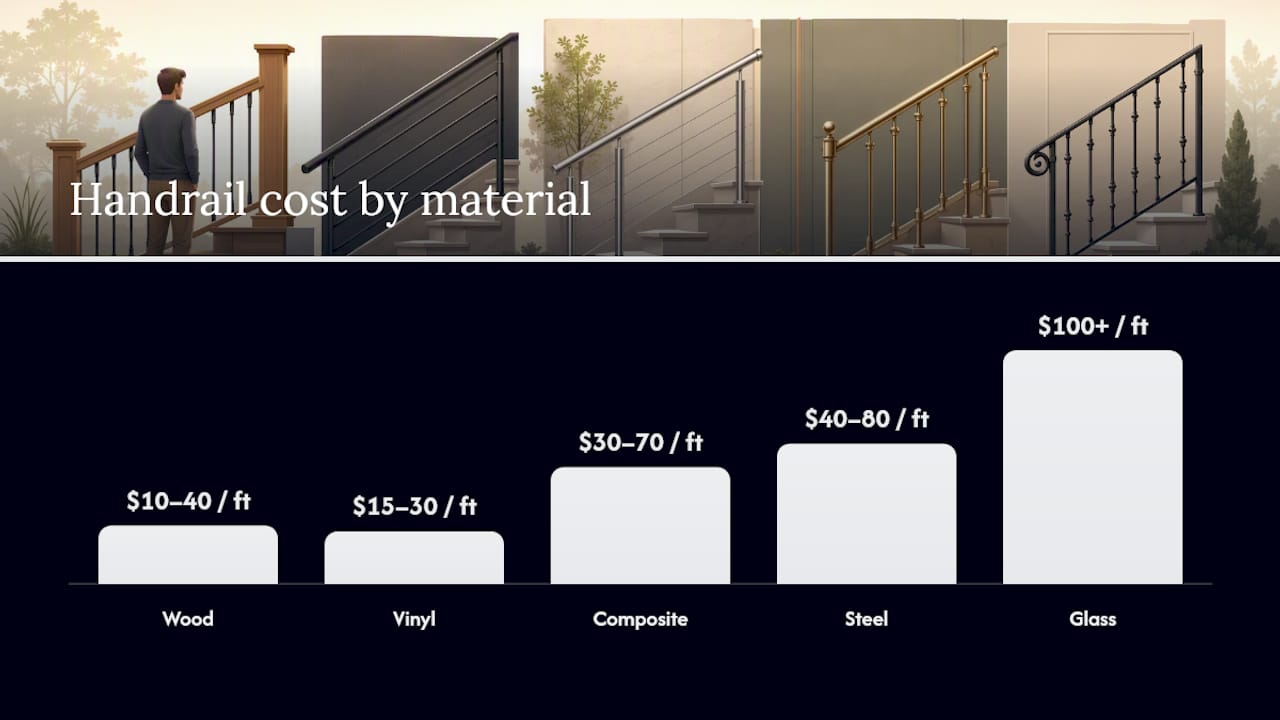
Material is the single biggest lever on price, and it also shapes how long the rail lasts before it needs attention again. One and Done Prep confirms wood and vinyl sit at the affordable end, while wrought iron, cable, and glass carry a real premium.
- Wood: Roughly $10 to $40 per linear foot for pine or basic hardwood; needs periodic refinishing, especially outdoors where sun and moisture take a toll.
- Vinyl: Around $15 to $30 per foot; low maintenance and a common pick for budget-conscious porch and deck rails.
- Aluminum: About $30 to $60 per foot; resists rust well and handles weather better than steel without the upkeep.
- Composite: Typically $30 to $70 per foot; blends wood-like looks with far less maintenance, a strong outdoor value pick.
- Steel: Roughly $40 to $80 per foot; strong and code-friendly but needs rust protection outdoors.
- Wrought iron: Often $50 to $150 per foot, frequently custom-fabricated, which adds both cost and lead time.
- Cable: Around $60 to $150 per foot; popular for modern looks but tensioning and post spacing require skilled labor.
- Fiberglass: About $40 to $90 per foot; weather-resistant and lighter than steel, though less common regionally.
- Glass: Frequently $100 or more per foot, making it the priciest common option on the market.
Statistic: Material choice alone can swing your per-foot price by more than 300 percent, from roughly $10 for basic wood to $150-plus for glass or custom wrought iron, according to pricing data compiled by One and Done Prep.
Outdoor installs generally call for weather-rated hardware and often a step up in material grade, since a rail exposed to rain and freeze-thaw cycles fails faster than one indoors. Mid-range aluminum or composite tends to offer the best balance of upfront cost and low upkeep for porches, decks, and exterior stairs. Custom metalwork, curved wood, or glass panel systems almost always require specialty fabrication, which adds both dollars and days to the timeline.
What's Included in a Handrail Installation Quote?
A handrail bid isn't just "material plus labor." Understanding the line items helps you spot a bid that's missing something, or one padded with vague fees.
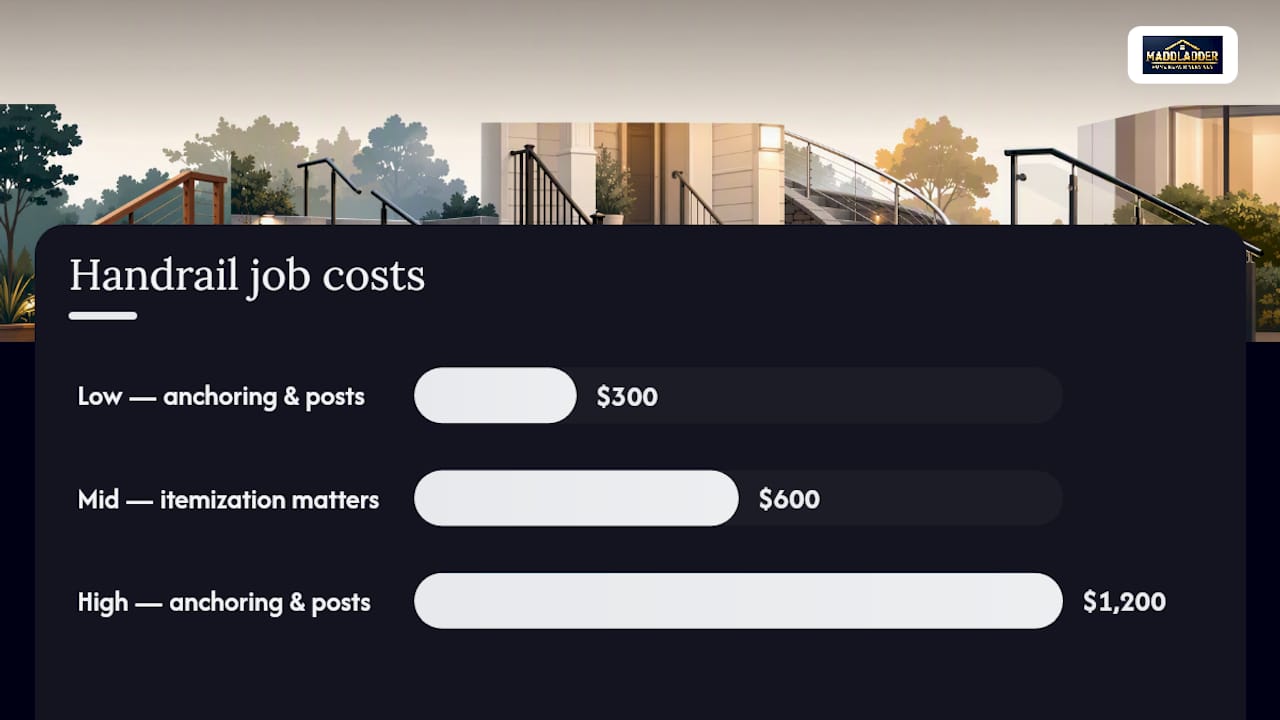
Labor typically makes up 30 to 50 percent of total project cost, with the material grade you choose shifting that ratio. A $300 vinyl job might be mostly labor; a $1,200 wrought iron job skews back toward materials.
Expect these components on a complete quote:
- Materials: rail stock, balusters or cable, newel posts, brackets.
- Hardware and fasteners: lag bolts, anchors, mounting brackets rated for the surface (wood stud, concrete, brick).
- Removal and disposal: demo of the old rail and hauling debris, sometimes billed as a flat fee of $50 to $150.
- Permit fees: passed through at cost by most installers, not marked up.
- Labor hours: billed either as a flat project rate or an hourly rate, commonly $50 to $100 an hour for skilled trim carpentry work.
- Contractor markup: general contractors subcontracting the work often add 10 to 20 percent on top of the installer's price, while specialty handrail or handyman companies typically build their margin directly into the quoted rate.
If a bid skips removal, hardware, or permit costs entirely, ask why. Those omissions usually mean a change order lands on your invoice later.
What Makes a Handrail Installation More Expensive?
A handful of site conditions push jobs well past the baseline per-foot pricing, and they're worth flagging before you request quotes.
- Curved stairs: Custom-bent wood or metal rails require specialty fabrication, and curved runs are often best left to specialists since the labor time can multiply cost fast compared to a straight run.
- Newel posts, landings, and turns: Each corner or post adds separate labor, not just extra linear footage.
- Anchoring into concrete or masonry: Drilling and epoxy-setting posts into a concrete porch or brick stoop takes longer and often needs specialized bits and hardware.
- Weatherproofing for outdoor installs: Sealants, rust-resistant fasteners, and UV-stable coatings add material cost that indoor jobs skip entirely.
- Hidden structural issues: Rotted framing under a porch rail or water damage behind a stair stringer can add repair costs that weren't in the original estimate.
Pro Tip: Ask your installer to physically test the anchor points during the estimate visit, not just eyeball them. A rail that looks solid on a rotted ledger board is a liability waiting to happen, and catching it before installation is far cheaper than after.
DIY Handrail Installation vs Hiring a Professional
DIY kits from home improvement stores run roughly $50 to $300 in materials for a simple straight run, which looks appealing next to a $700 professional installation. But that comparison only holds up for the simplest jobs.
- DIY makes sense for a short, straight indoor rail on an existing wall with solid stud backing and no code-triggered height requirements.
- Hire a licensed installer when the porch or deck sits more than 30 inches above grade, the stairs curve, you're anchoring into concrete or masonry, or the job involves removing an existing rail tied into structural framing.
- Factor in the real DIY cost, which includes tools you may not own (stud finders, masonry bits, levels), the time investment, and the risk of a failed inspection if your project needed a permit you skipped.
A rail that's improperly anchored is a fall hazard, not just a cosmetic problem, and most homeowner insurance and resale inspections will flag it. Kansas City homeowners weighing this exact tradeoff can find more on when DIY makes sense versus calling a pro. For a broader look at where DIY commonly goes wrong on home projects, this breakdown of common DIY pitfalls is worth a read before you commit to doing it yourself.
How Do You Get an Accurate Handrail Quote?
Getting quotes that you can actually compare side by side starts with showing up prepared, not just calling around and asking "how much for a handrail?"
Before you contact anyone, measure the linear footage along the slope of the stairs or the straight run of the porch, take photos of the mounting surface (drywall, concrete, brick), and note how many posts, corners, or landings are involved.
When you get a written quote, it should itemize:
- Material type and grade, not just "handrail included."
- Labor hours or a flat labor rate.
- Demo and disposal of the old rail, if applicable.
- Permit costs, if the project requires one.
- Estimated start and completion timeline.
Ask directly: Are you licensed and insured? Who pulls the permit, you or me? What's covered under warranty, and for how long? What happens if you find rotted framing once the old rail comes off? Requesting three written bids with the same line items commonly reveals 20 to 30 percent price variance among contractors, which is real money for a five-minute ask.
When Do You Need a Permit for a Handrail?
Permit requirements vary by city, but a few triggers show up in most residential codes across the country. If your porch, deck, or patio sits more than 30 inches above grade, most jurisdictions require a guard rail, and that usually means a permit and an inspection.
Common residential code benchmarks (always confirm locally):
- Guard height typically 36 to 42 inches for open sides of a walking surface.
- Baluster or infill spacing generally kept under 4 inches to prevent a small child from slipping through.
- Stair handrail height commonly 34 to 38 inches measured from the tread nosing.
Statistic: Residential permit fees for railing work commonly range from $50 to $200 depending on the city, a small line item compared to what a failed inspection or a code violation notice costs later.
Bring your contractor's proposed measurements to your local building department before work starts, and make sure any quote you accept includes the permit fee as its own line, not buried into "miscellaneous."
How Much Do Handrails Cost by Region?
Where you live changes the math more than most homeowners expect. Northeast and West Coast metros tend to run above the national average because of higher labor rates and stricter permitting, while Midwest and Southern markets, including Kansas City, typically land closer to or below the national baseline.
Three quick scenarios using mid-range materials (aluminum or composite):
- Lower-cost metro (Midwest/South): An 8-foot indoor stair rail might run $350 to $550 total.
- High-cost metro (Northeast/West Coast): The same 8-foot job could reach $600 to $900 due to labor rates alone.
- Mid-cost example (Kansas City metro): Expect somewhere in between, typically $400 to $650 for that same indoor run.
To trim cost regardless of region, schedule non-urgent handrail work in slower seasons (late fall through winter, when many exterior contractors have lighter calendars), ask about prefabricated rail sections instead of full custom builds, and bundle the handrail with other planned repairs to spread a single trip charge across more work.
Why Trust Maddladder on Handrail Costs?
This guide was put together by Jennifer, a content contributor who researches home repair pricing and building code basics for Kansas City area homeowners. Maddladder's crews handle handrail repair and replacement, aging-in-place and ADA and safety mobility upgrades, and general handyman installs across the metro every week, which grounds this pricing in what actually shows up on local job sites, not just national averages.
If you're weighing a rail alongside other accessibility work, Maddladder's guide on installing grab bars safely covers a closely related project with the same anchoring concerns. Customer testimonials on the Maddladder site consistently point to clear, itemized estimates as the reason homeowners keep calling back for the next project.
The Real Lesson in Handrail Pricing
Most of the guidance floating around treats handrail cost like a single number you can Google and walk away with. It isn't. The research here points to something more useful: the per-linear-foot rate is a starting point, not a promise, and the gap between a $300 job and a $1,200 job almost always comes down to two things people underestimate, anchoring conditions and post count, not the material label on the quote.
Conventional advice tells you to "get three quotes." Fine, but the quotes only help if they're itemized the same way. A homeowner comparing a $600 flat-rate bid against a $600 itemized bid with labor, hardware, and permit fees broken out is comparing two different things, not two prices.
If you take one thing from this guide, prioritize the line items over the headline number. A contractor who breaks down materials, labor, and permits separately is telling you more about the actual job than one who quotes a single round figure.
— Jennifer
Get a Local Handrail Quote from Maddladder
Maddladder handles handrail repair and replacement across the Kansas City metro, and the advantage over piecing a project together yourself is simple: one licensed crew handles the measuring, the material sourcing, the permit paperwork if your porch or deck triggers one, and the final anchoring, so you're not managing three separate vendors for a job that should take a day or two.

Maddladder's repair and replacement services cover indoor stair rails, outdoor porch and deck railings, and safety upgrades like grab bars and ADA-friendly modifications, often bundled into the same visit if you've got more than one project on the list. Because pricing includes permit costs where required and hardware rated for your specific mounting surface, you get a quote that matches what actually shows up on the invoice, not a lowball number that grows once work begins.
Ready to find out what your specific project costs? Request a free estimate and get a written, line-item quote before any work starts.
Where to Verify Handrail Pricing and Code Details
Cross-check any quote against Homewyse's per-foot averages and BLS wage data for regional labor context. Always confirm final height and permit rules with your local building department, since cost calculators help you budget but don't replace a local inspector's answer.
Sources
- Cost to Install Stairway Handrail - Homewyse
- How Much Does It Cost to Install Outdoor Handrails? - HomeGuide
- What Do Stair Railings Cost to Install? - HomeAdvisor
- Cost of Handrails for Stairs 2026 – One and Done Prep