
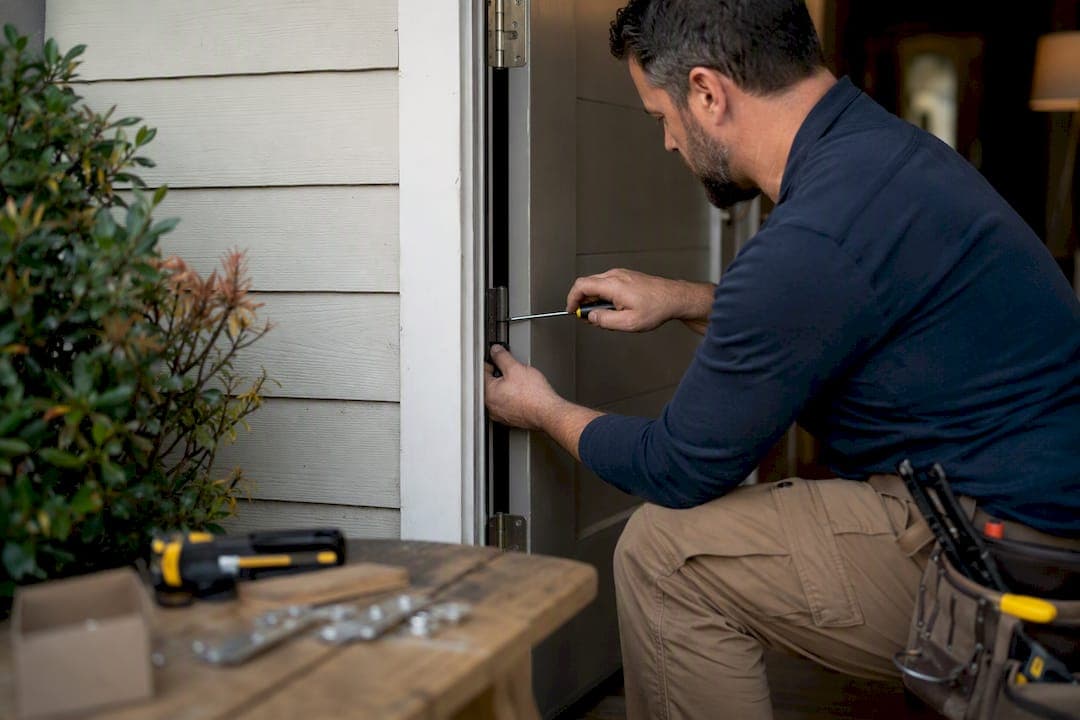
Most door repairs in the United States run $132 to $372, with a national average close to $239, according to Angi's cost data. The rule of thumb: repair the door if the fix costs less than half of what a full replacement would run, and the frame and slab are still structurally sound. This guide breaks down pricing for interior doors, exterior entry doors, sliding and patio doors, and garage doors, then walks through exactly what drives the number up or down.
Quick fact: Labor typically constitutes the majority share of a small door repair bill, indicating that the amount of technician time on-site drives costs more than job size.
Key Takeaways
Door repair costs in the U.S.
| Point | Details |
|---|---|
| National cost range | Most repairs run $132 to $372, averaging near $239 nationally. |
| Labor drives the bill | Labor typically constitutes the majority share of a small door repair bill, more than materials. |
| Apply the 50% rule | Repair if cost stays under half of replacement price and the frame is structurally sound. |
| Ask about minimum fees | Mobilization or minimum service fees ($75 to $150) can make tiny jobs feel expensive. |
| Confirm disposal and permits | Ask whether haul-away, drywall patching, or permits are included before signing a quote. |
| Maddladder offers itemized estimates | Kansas City homeowners get free written estimates with hourly pricing starting at $75/hour. |
Table of Contents
- Door Repair Cost by Door Type
- What Does Each Type of Door Repair Cost?
- What Drives Door Repair Pricing Up or Down?
- Should You Repair or Replace the Door?
- How Do You Get an Accurate Door Repair Estimate?
- How a Licensed Handyman Scopes a Door Repair
- Are There Extra Fees Beyond the Repair Itself?
- Materials vs. Labor: Where Your Money Actually Goes
- Does Door Material Change the Repair Cost?
- What Warranty Should You Expect on a Repair?
- How Do You Compare Repair Cost Against Replacement Cost?
- The Real Number That Matters Isn't the Average
- Get a Free Door Repair Estimate From Maddladder
- Frequently Asked Questions
- Sources
Door Repair Cost by Door Type
Not all doors cost the same to fix, and the gap between a sticky bedroom door and a bowed steel entry door can be $300 or more. Here's what to expect for each category.
- Interior doors: $75 to $250 for most jobs. Hinges, latches, and minor warping dominate this category, and Yelp's cost data confirms interior repairs consistently price below exterior work because there's less weatherproofing and hardware complexity involved.
- Exterior/entry doors: $150 to $600. These jobs often involve heavier hardware, weatherstripping, and sometimes structural framing, which pushes costs well above interior work.
- Sliding and patio doors: Costs vary from relatively inexpensive fixes like roller replacement and track cleaning to higher-cost repairs such as bent frames or glass panel replacements.
- Garage doors: Repair costs span a broad range depending on the issue, with some panel dents and sensor repairs at the lower end, and major components like spring replacements or significant damage raising costs higher.
- Specialty doors: Repairs costing significantly more often involve custom materials or hardware such as beveled glass inserts, wrought iron security doors, or matching multi-door sets.
Metro labor markets change these numbers meaningfully. A repair that costs $180 in a smaller Midwest town might run $280 to $320 in a coastal metro simply because hourly labor rates are higher there.
What Does Each Type of Door Repair Cost?
Breaking a job down by the actual task, rather than the door itself, gives you a clearer read on where your money goes. Here's how the most common repair categories typically price out.
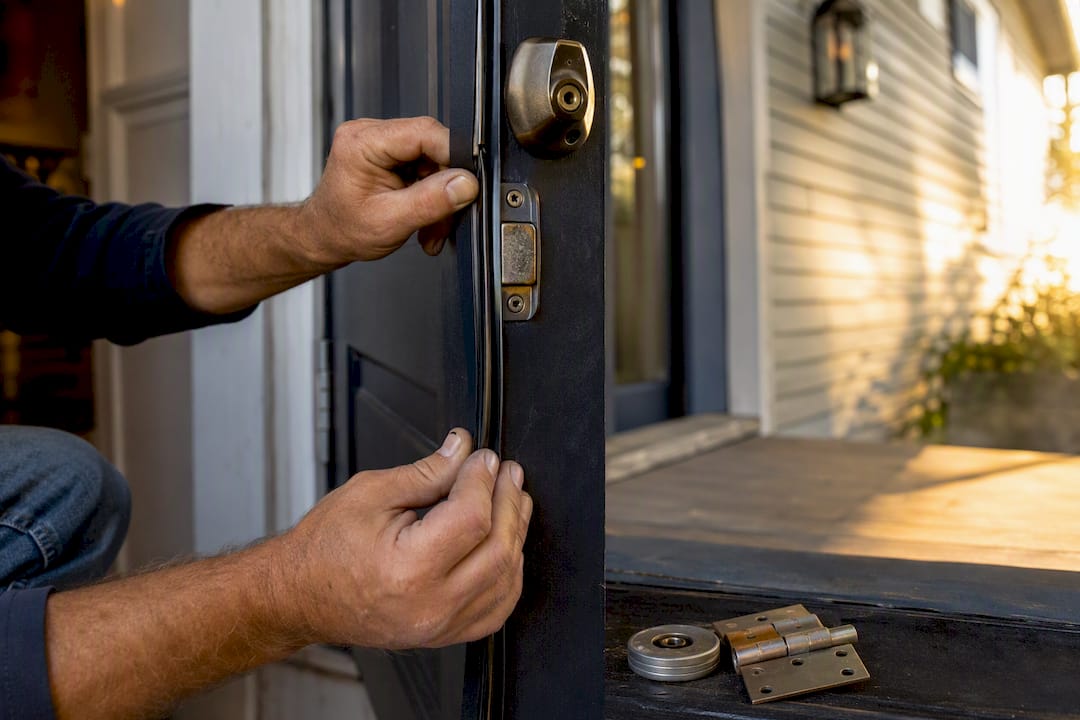
- Hinge rehanging or replacement: $75 to $150. Usually a 30 to 60 minute job unless the jamb has stripped screw holes that need reinforcement.
- Hardware replacement (locks, handles, deadbolts): $100 to $300, with cost climbing based on smart lock or high-security hardware.
- Jamb and frame repair: $250 to $600. HomeAdvisor's data shows frame work regularly lands in the several-hundred-dollar range because it often requires carpentry, filler or new wood sections, and repainting.
- Glass panel or insert replacement: $150 to $500 depending on glass type, with decorative or beveled panels at the top end.
- Roller and track replacement (sliding doors): $100 to $250, a relatively quick fix that rarely requires more than an hour of labor.
- Weatherstripping and seal replacement: $50 to $150, one of the cheapest fixes on this list and one Energy for cutting drafts before winter.
Quick jobs like hinge tightening or weatherstripping often wrap in under an hour. Frame repairs, glass replacement, or anything requiring paint touch-up frequently stretch into multi-hour or multi-visit territory, especially if a carpenter has to let wood filler cure before finishing.
A realistic combined scenario: rehang a sagging exterior door with new hinges, add a deadbolt, and replace worn weatherstripping. That job commonly totals $250 to $450 once labor, hardware, and materials are combined. A second scenario, a rotted lower jamb section plus new interior trim, tends to land between $400 and $700 once carpentry, materials, and finish work are added in.
What Drives Door Repair Pricing Up or Down?
Labor is the number that moves your bill more than anything else. National wage data from the Bureau of Labor Statistics shows carpentry and general repair trades carry meaningfully different hourly rates depending on region and specialty, and that variation shows up directly in your quote.
Most handyman and repair companies charge a minimum service fee, sometimes called a mobilization or trip charge, because sending a technician out costs money regardless of job size. A five-minute hinge tightening might still carry a $75 to $150 minimum. If you've got two or three small door issues piling up, batching them into one visit is almost always cheaper than calling separately for each.
Scope changes hit the bottom line fast. Hard-to-reach hardware, rotted wood hidden behind trim, or a job that suddenly needs a painter after the carpenter finishes can turn a $200 estimate into a $500 invoice.
Pro Tip: Ask your contractor upfront whether their quote includes a minimum service fee, and whether that fee gets waived or reduced if you add a second small task to the same visit.
Should You Repair or Replace the Door?
That threshold works well for hardware issues, minor warping, and cosmetic damage. It breaks down fast when structural problems are involved.
- If the frame shows rot, water staining, or soft wood at the base, replacement usually wins even when a patch repair looks cheaper on paper.
- If energy loss is the core complaint, weatherstripping and seal replacement are often enough. Energy treats weatherproofing as a legitimate lower-cost alternative to full replacement in many cases.
- If security is the concern, a old, thin, or damaged door frequently isn't worth reinforcing when a new door with modern hardware solves the problem outright.
Scenario one: A homeowner has a sticking interior door with one bent hinge. Repair cost: about $100. Replacement cost: roughly $300 to $500 installed. Repair wins easily.
Scenario two: An exterior entry door has a warped slab, a cracked frame, and failing weatherstripping. Combined repairs quote near $650. A comparable new door with installation runs $700 to $900. At that point, replacement often makes more sense because you get a warranty and better energy performance for a small premium. Our interior door replacement guide walks through this math in more detail for interior-specific scenarios.
How Do You Get an Accurate Door Repair Estimate?
A vague verbal quote is the single biggest reason homeowners get surprised by a final bill that's $150 or $200 higher than expected. Before you agree to anything, ask these questions.
- Does the quote separate labor hours from material and hardware costs?
- Is there a minimum service fee, and does it apply if I book multiple small repairs together?
- What's the warranty on parts and on labor?
- Does the price include disposal of the old door, frame material, or hardware?
- Will the same technician handle carpentry, glazing, and painting, or will you need to schedule multiple visits?
Quotes typically come in three formats: flat per-door pricing, hourly rates plus materials, or per-project bids that bundle everything. Flat pricing is easiest to compare across contractors. Hourly pricing rewards efficient crews but punishes you if the job runs long. Per-project bids are best for larger, multi-repair jobs where scope is already well defined.
Red flags worth walking away from: a contractor who won't itemize parts versus labor, anyone offering only a verbal quote with nothing in writing, and claims of licensing or insurance that can't be verified. Our guide on DIY versus pro repairs covers how to tell when a job is simple enough to handle yourself versus when it genuinely needs a licensed pro.
Pro Tip: Get at least two written quotes for any repair over $300. The spread between bids on frame or multi-trade work can be $150 or more.
How a Licensed Handyman Scopes a Door Repair
When Maddladder scopes a typical door repair in the Kansas City metro, the estimate starts with the same logic outlined above: separate labor hours from materials, flag whether a minimum service call applies, and note any additional trade work the job might need.
- Standard one-time service starts at $75/hour, with a free estimate provided before any work begins.
- A common job, rehanging a door and replacing worn weatherstripping, typically breaks down into 45 to 90 minutes of labor plus $20 to $60 in hardware and sealant.
- Homeowners with recurring maintenance needs can enroll in a subscription plan (Essential, Home Care, or Property Manager tier) instead of paying per visit.
- Response times run fast for standard repair requests, and every estimate is provided before work starts, not after.
For landlords managing several rental units, the subscription approach often beats calling a new contractor for every sticking door or worn hinge.
Are There Extra Fees Beyond the Repair Itself?
Most straightforward door repairs, hinge swaps, hardware replacement, weatherstripping, don't trigger permits or disposal charges. Where extra fees show up is almost always tied to structural or full-unit replacement work rather than a simple fix.
Permit requirements vary by city and generally apply when you're altering a structural opening, such as widening a doorway or replacing an exterior entry door that affects the building envelope. Most municipalities don't require a permit for swapping hardware or repairing an existing frame in place, but replacing an entire exterior door assembly sometimes does, depending on local code. Check with your city's building department before assuming either way, since rules differ by jurisdiction and even between counties in the same metro area.
Disposal charges are more common than permit fees. If a job involves removing an old door slab, frame sections, or damaged hardware, some contractors fold a small disposal or haul-away fee into the quote, typically $20 to $75, while others itemize it separately. This is exactly the kind of line item the deep knowledge on frame repair quotes flags as a common source of mid-job surprises: a quote that looks complete on paper but quietly excludes haul-away costs, drywall patching around the frame, or paint touch-up.
Ask directly whether disposal, drywall repair, and paint are included before you sign off on any estimate. It's a two-minute question that prevents a change order later.
Materials vs. Labor: Where Your Money Actually Goes
Materials rarely drive the bill on a door repair. Labor does. Angi's data puts labor at the majority share of most repair invoices, and that split holds fairly consistent across repair types, with some variation.
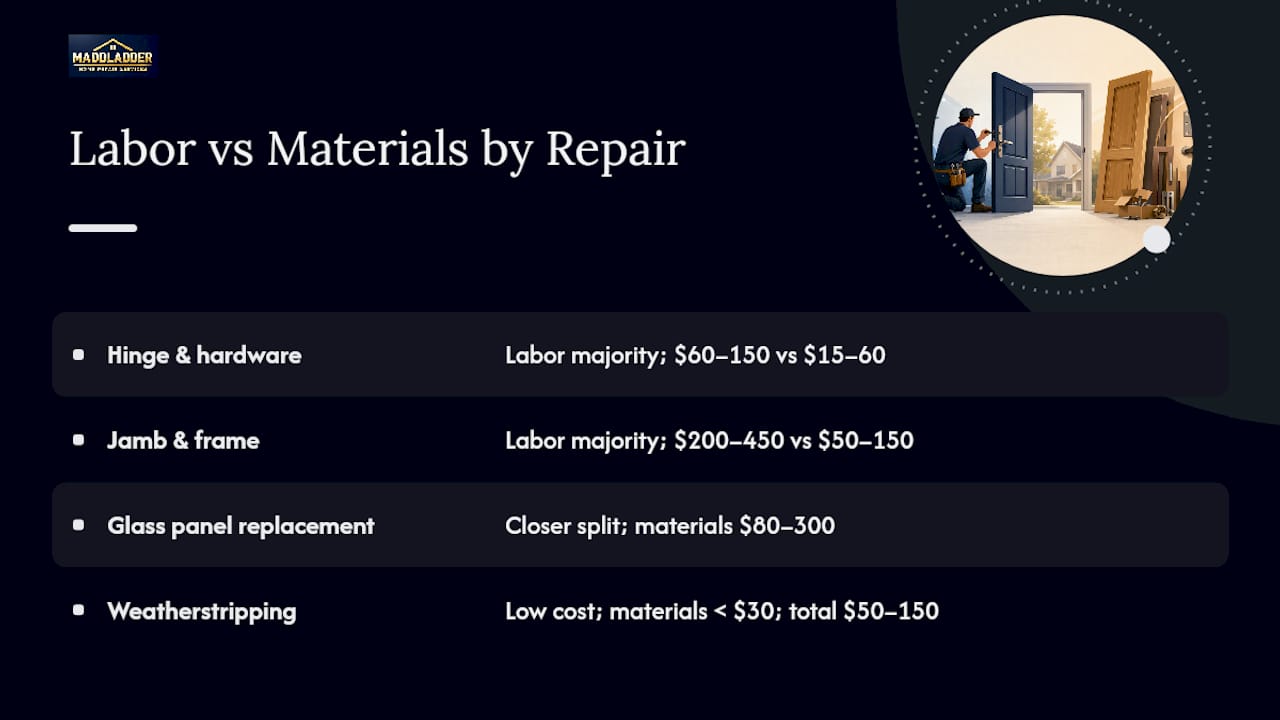
For hinge and hardware work, materials might run $15 to $60 (hinges, screws, a new handle set), while labor accounts for $60 to $150 of a typical job. The labor share here is high because diagnosing a misaligned hinge or worn strike plate takes longer than the parts swap itself.
For jamb and frame repair, materials climb, sometimes $50 to $150 for lumber, filler, and primer, but labor still dominates at $200 to $450 because carpentry work requires precise fitting, curing time for wood filler, and often a repaint.
For glass panel replacement, the ratio flips somewhat. Glass itself can run $80 to $300 depending on type, narrowing the gap between material and labor cost compared to other repair categories.
For weatherstripping, materials are cheap, often under $30, and labor is minimal too, which is why this repair stays in the $50 to $150 range overall. It's the best return on investment in the entire repair category.
Does Door Material Change the Repair Cost?
Yes, significantly. The material your door is made from affects both what can go wrong and how much fixing it costs.
Wood doors are the most repairable of the three common materials. Rot, dents, and warping can often be sanded, filled, and refinished rather than replaced outright, but wood is also the most vulnerable to moisture damage, which is why frame rot shows up disproportionately in wood door complaints, per HUD's technical guidance on door assemblies.
Steel doors resist warping and rot but dent easily, and a dented steel panel usually can't be repaired invisibly, it typically needs a filler compound and repaint, or panel replacement if the dent is severe. Steel hardware repairs (hinges, locks) are usually straightforward and inexpensive.
Fiberglass doors split the difference: they resist rot and denting better than wood or steel, but a cracked fiberglass skin is harder to patch cleanly and sometimes calls for a specialized repair kit or full panel replacement rather than a simple fix.
If you're not sure what your door is made of, check the edge where the door meets the frame. Wood shows grain, steel is cool to the touch and slightly magnetic, and fiberglass has a smoother, more uniform texture with no visible wood grain.
What Warranty Should You Expect on a Repair?
A repair and a full replacement carry very different warranty expectations, and knowing the difference protects you from paying twice for the same problem.
Most licensed contractors offer a workmanship warranty on repairs, typically 30 to 90 days, covering the specific fix performed. This is standard for hinge work, hardware swaps, and minor frame patches. It's worth asking whether that warranty covers just labor or labor plus any replaced parts.
Replacement doors carry more layered protection: a manufacturer's warranty on the door slab and hardware (often 1 to 10 years depending on the product line) stacked on top of the installer's workmanship warranty. That's a meaningful advantage of replacement over patch repair when a door is already borderline, you're not just buying a new door, you're buying years of covered protection that an aging, repeatedly-patched door simply can't offer.
Always ask what voids the warranty. Water damage from unrelated roof or gutter issues, for instance, sometimes falls outside a door warranty's coverage even if it eventually affects the frame.
How Do You Compare Repair Cost Against Replacement Cost?
The clearest way to decide is lining up your actual repair quote against a realistic replacement estimate for the same door, side by side.
Start with your repair quote total. Then get a replacement estimate for a comparable door, same size, similar material, standard hardware.
Don't compare in isolation, though. Factor in the warranty gap discussed above, plus any energy savings a new door delivers, since Energy.gov notes that door replacement can meaningfully affect a home's energy performance in ways a patch repair usually can't match. A $700 replacement that comes with a 10-year warranty and better insulation can be a smarter long-term spend than a $500 repair that buys you another two years before the same problem resurfaces. For a broader look at when new construction beats renovation, One Day Doors & Closets has a useful breakdown of this exact tradeoff for interior doors specifically.
The Real Number That Matters Isn't the Average
Everyone quotes the $239 national average because it's the easy headline. It's not the number that should drive your decision. What actually matters is the labor-to-materials ratio on your specific job, because that ratio tells you whether you're paying for genuine skilled work or padding from a multi-trade markup you didn't need.
Conventional advice tells homeowners to "get three quotes and pick the middle one." That's lazy guidance. A better approach: get three quotes, then ask each contractor to break down hours versus materials. If one bid is unusually high but shows more hours at a lower hourly rate, and another is cheap but vague about labor, the cheap one is often the one that surprises you with a change order.
Prioritize the minimum service fee question before anything else. It's the line item homeowners forget to ask about, and it's the one most likely to make a "$100 fix" feel like a $250 bill once the technician actually shows up. A door repair estimate that doesn't mention a minimum fee upfront usually isn't a complete estimate.
Get a Free Door Repair Estimate From Maddladder
Skip the guesswork of comparing three vague verbal quotes. Maddladder is the straightforward alternative for Kansas City homeowners and property managers who want a licensed pro who itemizes labor and materials before touching a single hinge, not after.

One-time repairs start at $75/hour, and every job begins with a free, written estimate so you know the mobilization fee, labor hours, and hardware costs before you commit. Beyond single-visit repairs, Maddladder offers tiered home maintenance subscriptions (Essential, Home Care, and Property Manager) built for homeowners and landlords who'd rather handle sticking doors, worn weatherstripping, and loose hinges on a predictable schedule instead of waiting for something to break. The team also covers related work, trim, hardware installs, and minor carpentry, so a frame repair doesn't turn into three separate contractor calls.
Ready to get a number for your specific door? Visit the door repair and replacement services page to request your free estimate, or explore the full range of handyman services if your door issue is tied to a bigger project.
Frequently Asked Questions
What is the average cost to repair a door? Most homeowners pay between $132 and $372, with a national average around $239, according to Angi's data. The exact price depends on door type, damage severity, and whether the job needs one trade or several.
How much does it cost to repair a door frame? Door frame and jamb repairs typically run $250 to $600, higher than hardware or hinge fixes because they often involve carpentry, wood filler, and repainting. HomeAdvisor's cost data shows frame work regularly landing in the several-hundred-dollar range.
Is it cheaper to repair or replace a door? Once a repair quote climbs above that threshold, or the door needs a second fix within a year, replacement often makes more financial sense.
How much do handyman services charge per hour for door repairs? Hourly rates for door repair generally run $50 to $125 depending on region and complexity, based on wage data from the Bureau of Labor Statistics. Maddladder's one-time services start at $75/hour with a free estimate provided upfront.
Do I need a permit to repair a door? Most standard repairs, hinges, hardware, weatherstripping, don't require a permit. Permits typically apply only when you're altering a structural opening or replacing an entire exterior door assembly, and requirements vary by city, so check with your local building department.
What's included in a typical door repair quote? A complete quote should itemize labor hours, material and hardware costs, any minimum service fee, warranty terms, and whether disposal of old materials is included. Missing any of these is a common cause of surprise costs mid-job.
Sources
- How Much Does Door Repair Cost? 2026 Data | Angi
- How Much Does Door Repair Cost? | HomeAdvisor
- Occupational Employment and Wage Statistics | Bureau of Labor Statistics