

TL;DR:
- Home repair time investment includes both active labor hours and the total calendar span affected by waiting and scheduling. It often exceeds initial estimates because repairs involve delivery delays, drying periods, inspections, and personal scheduling gaps. Carefully estimating all aspects helps homeowners choose when to DIY or hire professionals, saving time and reducing stress.
A home repair time investment is defined as the total time and effort you commit to a repair, covering hands-on labor, waiting periods, setup, cleanup, and the opportunity cost of your personal time. Most homeowners track only the hours they spend working with tools. The real cost includes every hour a project occupies your calendar, from the moment you start planning to the moment you put the last tool away. Understanding what is a home repair time investment gives you a clear framework for deciding when to do a job yourself and when to call a professional.
The distinction matters because DIY projects frequently take 2–3 times longer than instructions or online videos suggest. First-timers face learning curves, mistakes, and interruptions that inflate the true time cost well beyond the estimate. A repair that looks like a two-hour Saturday job can easily consume an entire weekend once you account for a hardware store run, a drying period, and a redo on a crooked patch.
What is a home repair time investment and why does it matter?
A home repair time investment has two distinct components: committed labor time and calendar disruption. Committed labor time is the hours you actively work. Calendar disruption is the total span of days the project affects your schedule, including waiting for parts, drying, curing, inspections, and rescheduling around your life.
Calendar disruption often outweighs committed labor hours in the total time cost of a repair. A bathroom faucet replacement may take two hours of actual work but require three days if a part ships from a supplier. Drywall patching takes 30 minutes of labor per coat but needs 24 hours of drying between coats, stretching a simple fix across several days. Tracking both numbers separately gives you a realistic picture of what a project actually demands.
Opportunity cost is the third layer. Every hour you spend on a repair is an hour you cannot spend on work, family, or rest. If a DIY job takes 8 hours but a professional can finish it in 2, the 6-hour gap is a real cost, even if no money changes hands. Financial advisors and home maintenance professionals use this framework to help homeowners make smarter repair decisions.

How do you accurately estimate labor time versus total project duration?
Separating labor hours from total project duration is the single most common mistake homeowners make when planning repairs. The two numbers are almost never the same, and confusing them leads to missed deadlines, frustrated schedules, and half-finished projects.
A repair may take 2–3 hours of hands-on work but span several days due to non-labor components. Those components include:
- Part delivery: Online orders for specialty fixtures, valves, or trim pieces can add 2–5 business days to any project.
- Drying and curing: Paint, caulk, grout, and adhesives all require waiting time before the next step.
- Inspections: Permitted electrical or plumbing work may require a scheduled inspection before walls close.
- Scheduling gaps: Your own availability, a helper's schedule, or a rental tool window all add calendar days.
Write down both estimates before you start any project. Record the expected labor hours and the expected calendar duration as two separate figures. Comparing them forces you to plan around the waiting periods rather than being surprised by them.
Pro Tip: Keep a simple repair log with two columns: "hours worked" and "days elapsed." After three or four projects, you will see your personal pattern for underestimating, and you can build a correction factor into every future estimate.
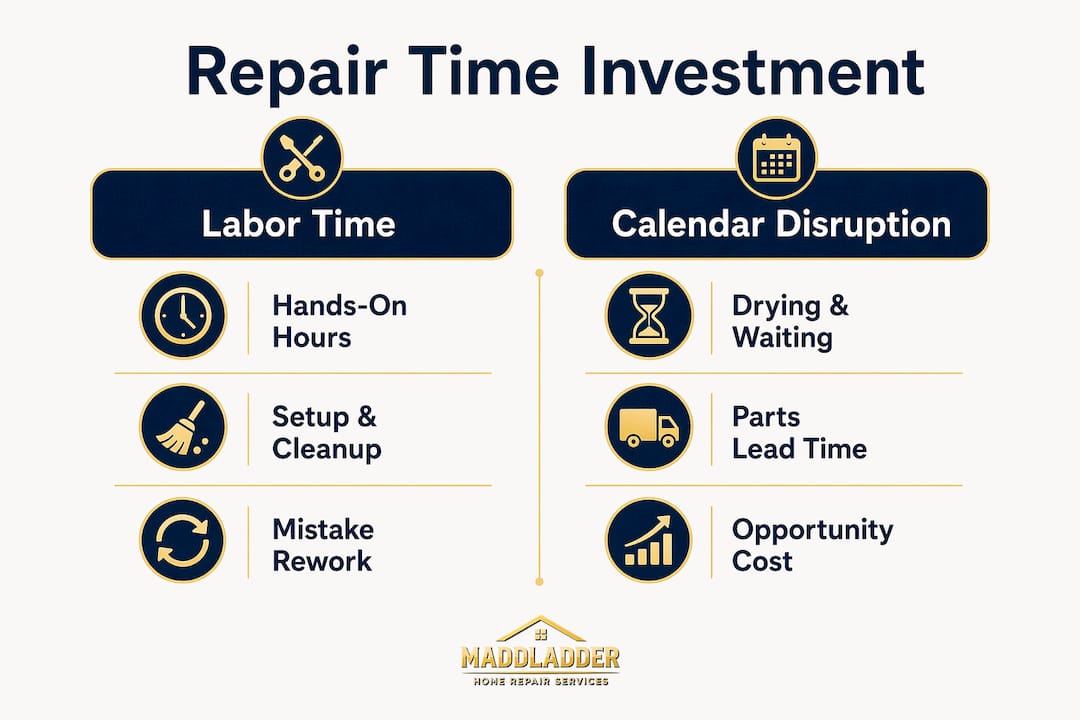
Accurate calendar time estimation is critical because drying, scheduling, and parts lead time drive project length far more than the labor itself. Homeowners who plan only for labor hours consistently find themselves living with an unfinished repair longer than expected.
How do you calculate the true cost of DIY versus hiring a professional?
The true cost of a DIY repair is not just the price of materials. It includes the monetary value of your time, the cost of any tools you rent or buy, and the risk of a mistake that requires a redo or a professional fix anyway.
The calculation follows a straightforward method:
- Estimate your hourly value. Use your after-tax hourly wage, or use a figure that reflects what your free time is worth to you personally.
- Multiply by expected DIY hours. If a job takes 16 hours and you value your time at $30 per hour, the time cost alone is $480.
- Add material and tool costs. Include every item you buy or rent, including items you may not use again.
- Compare to a professional quote. A pro might finish the same job in 6 hours, saving you significant personal time and eliminating tool and mistake costs.
Hidden DIY costs catch most homeowners off guard. Mistakes on drywall, tile, or plumbing often require purchasing additional materials. Tool rentals for a single job can cost $50–$150 per day. Waste from cutting errors adds up fast on flooring or trim projects. A professional quote that looks expensive at first glance frequently becomes the lower-cost option once you add up all the real numbers.
Pro Tip: Get at least one professional quote before starting any project that will take you more than four hours. The quote is free and gives you a concrete number to compare against your all-in DIY cost.
Using all-in cost comparisons, including tools, permits, and the cost of mistakes, produces a far more accurate decision than comparing labor hours alone. Kansas City homeowners weighing these tradeoffs can find a detailed local breakdown in this guide on DIY vs. pro repairs.
When does repair cost more time than replacement is worth?
The repair-versus-replace heuristic gives homeowners a fast filter for avoiding poor time investments. The standard guideline used by maintenance professionals is the 50%/30% rule.
If a repair costs more than 50% of the replacement cost and less than 30% of the component's lifespan remains, replacement is usually the more time-efficient and cost-efficient choice. This rule prevents you from pouring hours into a near-end-of-life appliance or system that will fail again within a year or two.
Apply the rule by asking three questions before committing to a repair:
- What does a full replacement cost for this component?
- What will the repair cost in money and time?
- How many years of useful life remain if the repair succeeds?
A water heater with two years of expected life left and a $400 repair bill on a $900 unit fails both thresholds. The repair costs 44% of replacement, and the remaining lifespan is well under 30%. Replacing it now saves you the repair time, the disruption, and the near-certain repeat failure within two years.
The heuristic has exceptions. A repair on a high-quality fixture with strong sentimental or architectural value may be worth exceeding the 50% threshold. Custom millwork, vintage hardware, and structural elements often justify higher repair investment because replacement costs are disproportionately high. Use the rule as a starting point, not a rigid formula.
What are typical time ranges for common home repairs?
Handyman tasks typically require 1–4 hours of labor, but bundling multiple small repairs into a single visit raises total service time to 2–6 or more hours. That bundling effect is one of the most underused time-saving strategies available to homeowners.
| Task | Estimated labor time | Notes |
|---|---|---|
| Faucet replacement | 1–2 hours | Add time if shutoff valves are corroded |
| Drywall patch (small) | 1–3 hours active, 2–3 days total | Drying between coats extends calendar time |
| Grab bar installation | 1–2 hours | Locating studs adds time on tile walls |
| Ceiling fan swap | 1–2 hours | Wiring complexity can extend this |
| Furniture assembly | 1–4 hours | Depends on piece complexity |
| Smart thermostat install | 1–2 hours | Compatibility check adds planning time |
Bundling tasks into a single professional visit reduces repeated travel and setup time. One visit handling three small jobs typically completes within 2–6 hours, which is far more efficient than three separate visits across three separate days. The calendar disruption drops from three disrupted days to one.
Practical bundling examples include:
- Scheduling a grab bar installation, a leaky faucet fix, and a ceiling fan swap in the same appointment.
- Grouping all drywall patches in a home so they dry and get painted in one sequence.
- Combining a smart thermostat install with a camera setup during a single smart home upgrade visit.
For a full breakdown of which fixes are worth tackling yourself, this guide on common handyman fixes covers the most frequent tasks Kansas City homeowners face.
How do you manage and reduce your home repair time commitment?
Reducing the time you spend on repairs starts before you pick up a single tool. Preparation, prioritization, and knowing when to delegate are the three levers that cut time waste the most.
Prioritize repairs by urgency and consequence. A slow leak under a sink causes water damage that compounds daily. A loose cabinet handle does not. Fast repairs prevent costly home damage by stopping small problems before they require major time and money to fix.
Prepare materials and tools before the project starts. A mid-project hardware store run adds 45–90 minutes to any job and breaks your momentum. Read the full instructions, make a complete shopping list, and gather every item before you begin.
- Set a realistic schedule that includes drying, curing, and inspection windows, not just labor hours.
- Identify which tasks require a second person and arrange that help in advance.
- Know your skill ceiling. Electrical panel work, gas line repairs, and structural changes carry real safety risk for untrained homeowners.
- Hire a professional when the risk of a mistake exceeds the cost of the service call.
Pro Tip: Write a one-page project brief for any repair that will take more than half a day. List the goal, the materials, the steps, the drying windows, and the finish criteria. Homeowners who plan on paper finish faster and redo less.
Speed and certainty from professionals add value beyond price by saving weekends and lowering rework risk. For complex plumbing or electrical repairs, the time saved and the risk eliminated often justify the professional fee without any further calculation.
Key Takeaways
Accurately measuring your home repair time investment, including labor, waiting periods, and opportunity cost, is the most reliable way to decide between DIY and professional service.
| Point | Details |
|---|---|
| Define total time investment | Count labor hours, calendar disruption, and opportunity cost, not just hands-on work. |
| Separate labor from calendar time | A 2-hour repair can span several days due to drying, parts delivery, and scheduling. |
| Calculate all-in DIY cost | Multiply your hourly value by DIY hours, then add materials, tools, and mistake risk. |
| Apply the 50%/30% rule | Replace when repair exceeds 50% of replacement cost and under 30% of lifespan remains. |
| Bundle tasks to save time | Grouping small repairs into one professional visit cuts calendar disruption significantly. |
What I've learned from watching homeowners underestimate repairs
The most consistent mistake I see is treating a repair estimate as a labor estimate. Homeowners budget two hours on a Saturday and end up with an open wall for a week because a part is backordered. That gap between expectation and reality is where frustration lives, and it is entirely preventable.
The homeowners who manage their time best are the ones who think like project managers. They write down two timelines: the hours they will work and the days the project will occupy. They get a professional quote before committing to a big DIY job. They know which tasks are worth their weekend and which ones are worth a phone call.
The blended approach works best in practice. Do the painting, the assembly, and the simple swaps yourself. Call a professional for anything that involves water, electricity, or structural integrity. That split is not about skill. It is about risk-adjusted time value. A plumbing mistake that floods a bathroom costs far more in time and money than the service call you avoided.
Sewer and plumbing repairs are a good example of where the time math shifts fast. The cost factors for sewer repair alone can make a DIY attempt far more expensive than a professional fix once you account for equipment, permits, and the real possibility of making the problem worse.
Time awareness does not just save money. It reduces stress. When you know what a project actually requires, you can plan around it, communicate with your household, and finish without the creeping dread of a job that keeps growing.
— Jennifer
Maddladder handles the repairs that cost you the most time
Maddladder serves Kansas City homeowners and renters with dependable handyman and repair services that cut the time you spend managing home maintenance. Whether you need a single fix or a bundled visit covering several tasks, Maddladder's licensed team arrives prepared, works efficiently, and finishes the job without the calendar disruption that DIY projects create.

From drywall and fixture replacements to minor plumbing and electrical repairs, Maddladder's repair and replacement services are built for homeowners who value their time. Flexible pricing starts at $75 per hour for one-time visits, and subscription maintenance plans keep your home in shape year-round. Request a free estimate and get a clear timeline before any work begins.
FAQ
What does home repair time investment include?
A home repair time investment includes hands-on labor hours, waiting periods for drying or parts, setup and cleanup time, and the opportunity cost of your personal time. It is the total time a repair occupies your life, not just the hours you spend working.
How long do common handyman repairs typically take?
Most handyman tasks require 1–4 hours of active labor. Bundling multiple small repairs into one visit extends total service time to 2–6 or more hours but reduces the number of days your schedule is disrupted.
When is it better to hire a professional than to DIY?
Hiring a professional makes sense when the all-in DIY cost, including your time, tools, and mistake risk, exceeds the professional quote. It also makes sense for any repair involving electrical panels, gas lines, or structural work where errors carry safety consequences.
What is the 50%/30% repair-versus-replace rule?
The 50%/30% rule states that if a repair costs more than 50% of the replacement cost and less than 30% of the component's useful life remains, replacement is the more time-efficient and cost-efficient choice.
Why do DIY projects take longer than expected?
DIY projects frequently take 2–3 times longer than instructions estimate because of learning curves, mistakes, mid-project supply runs, and interruptions. First-time repairs on unfamiliar systems almost always exceed the initial time estimate.