
Compare repair cost per added year against the delivered-and-installed replacement cost over that same period. That single calculation is the backbone of every smart appliance decision. If repairing a washer costs $320 and buys you four more years, that's $80 per year. If a new washer costs $900 installed and lasts 10 years, that's $90 per year. Repair wins, barely. Flip those numbers and the answer flips too.
Quick decision checklist:
- Repair when the cost per added year is lower than the replacement cost per year, the unit is reliable, and no safety issue exists.
- Replace when the repair cost is more than 50% of replacement cost, the appliance is near or past its expected lifespan, or the same component has failed more than once.
- **Stop using it immediately if you smell gas, see arcing or sparks, notice smoke, or find water pooling near electrical connections. Call a licensed technician before running the appliance again.
Safety overrides every cost calculation. A $150 repair estimate means nothing if the unit is a fire or gas hazard. When in doubt, unplug it, shut off the gas valve, and get a professional assessment before you do anything else.
Table of Contents
- How do you calculate whether to repair or replace an appliance?
- What costs should you actually include when comparing repair vs replacement?
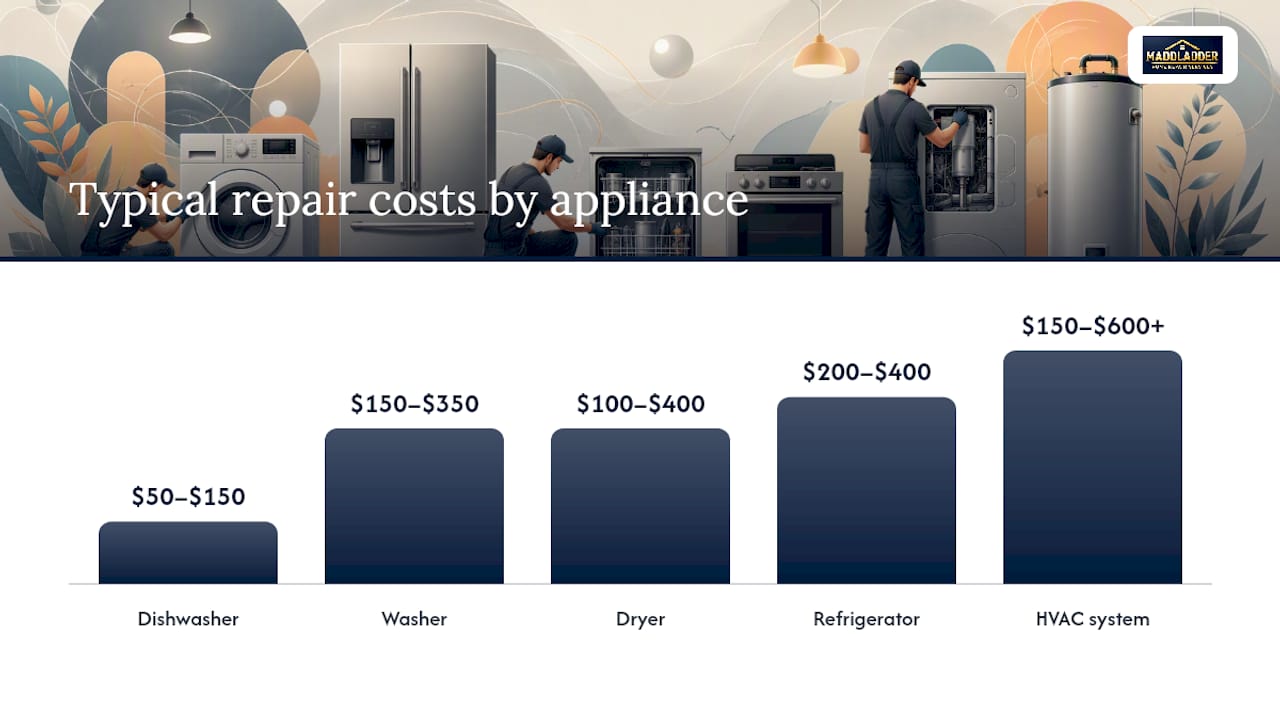
- How long do appliances last, and what do repairs typically cost?
- When do energy savings make replacement the better financial choice?
- What safety red flags mean you should replace or stop using an appliance now?
- How do you get reliable repair and replacement quotes?
- When does repair usually win, and when does replacement make more sense?
- Key Takeaways
- What installers and technicians actually see in the field
- Maddladder helps Kansas City homeowners make the right call
- Useful sources and tools for further research
How do you calculate whether to repair or replace an appliance?
The five-factor comparison method gives you a repeatable framework: immediate repair cost, remaining service life, delivered replacement cost, operating-cost difference, and risk of another failure. Here's how to run it in four steps.
Step 1: Get the full repair cost. Add the diagnostic fee, labor, parts (OEM or aftermarket), taxes, and any dispatch or travel charge. That total is your repair cost.
Step 2: Estimate added useful years conservatively. Ask the technician: "If this repair goes well, how many more years should I realistically expect?" Shave one year off their answer to be safe.
Step 3: Find the true replacement cost. Purchase price plus delivery, installation, required accessories (hoses, filters, power cords), haul-away, and applicable taxes. Never use the sticker price alone.
Step 4: Run the comparison.
- Repair cost per added year = Total repair cost ÷ Estimated added years
- Replacement cost per year = Full replacement cost ÷ Expected total lifespan of new unit
- Subtract any annual operating-cost savings from the replacement-cost-per-year figure before comparing.
Pro Tip: For appliances where failure causes consequential loss (a fridge full of food, a flooded basement), add a risk allowance of $50–$100 per year to the repair side of the equation to account for the chance of another failure.
Worked examples
Refrigerator: A 9-year-old fridge needs a new evaporator fan motor. Full repair cost: $280. Technician estimates 4–5 more reliable years; use 4. Repair cost per year: $70. A comparable new fridge costs $1,100 delivered and installed, expected to last 12 years: $91.67 per year. Repair wins by about $22 per year, assuming no further failures.
Washer: A 10-year-old top-load washer needs a new control board. Full repair cost: $420. Estimated added years: 3. Repair cost per year: $140. A new ENERGY STAR washer costs $850 installed, expected lifespan 10 years: $85 per year, minus roughly $30 per year in water and energy savings = $55 per year. Replace.
Dryer: A 6-year-old dryer needs a new heating element. Full repair cost: $180. Estimated added years: 5. Repair cost per year: $36. New dryer installed: $700 over 10 years = $70 per year. Repair wins clearly.
What costs should you actually include when comparing repair vs replacement?
Most homeowners undercount on both sides. A repair quote that looks cheap and a retail price that looks reasonable can both hide real costs.
Repair side — include all of these:
- Diagnostic fee ($75–$150 is typical, sometimes waived if you proceed with the repair)
- Labor at the technician's hourly rate
- Parts (OEM parts cost more but often carry a warranty; aftermarket parts are cheaper but may void manufacturer coverage)
- Sales tax on parts and labor where applicable
- Dispatch or travel fee for in-home service
- Any follow-up visit if the first repair doesn't hold
Replacement side — the sticker price is never the full number:
- Delivered and installed price (delivery alone can add $50–$100; installation another $100–$200 for appliances requiring water or gas hookups)
- Required accessories: new supply hoses, power cords, dryer venting, or water filters
- Haul-away of the old unit ($25–$75 if not included)
- Disposal fees for refrigerants or hazardous materials
- Permits or electrical/plumbing upgrades if the new unit requires a different circuit or gas line
Hidden costs that rarely appear in any quote:
- Food spoilage during a fridge outage (a full fridge can mean $200–$400 in losses)
- Laundromat trips while a washer or dryer is down
- Delivery lead times of 1–3 weeks for some models, which extend your downtime
- Time and scheduling costs for multiple service visits
Pro Tip: Always ask whether the quoted parts are OEM or aftermarket. OEM parts from the original manufacturer typically carry a 90-day to 1-year warranty and fit precisely. Aftermarket parts may save $30–$80 upfront but can void any remaining manufacturer warranty on the appliance.
How long do appliances last, and what do repairs typically cost?
Typical planning lifespans vary by appliance class. Use these ranges to estimate remaining useful life when you run your calculation.
| Appliance | Typical Lifespan | Typical Repair Cost Range | Notes |
|---|---|---|---|
| Refrigerator | 10–15 years | $200–$400 | Compressor repairs often exceed $500; favor replacement on older units |
| Washer | 8–12 years | $150–$350 | Control board and motor repairs push toward the high end |
| Dryer | 8–12 years | $100–$400 | Heating elements and belts are usually inexpensive fixes |
| Dishwasher | 8–12 years | $50–$150 | Pump and motor repairs can approach replacement cost |
| Oven / Range | 10–15 years | $100–$350 | Gas models tend to cost more to repair than electric equivalents |
| HVAC system | 10–20 years | $150–$600+ | Compressor and heat exchanger failures often favor replacement |
| Microwave | 7–12 years | $50–$150 | Low repair cost, but magnetron failure often exceeds unit value |
Average appliance repair costs typically run $100–$400, with labor at $50–$150 per hour depending on your region and the complexity of the job.
Statistic to know: According to ENERGY STAR data cited by consumer experts, modern certified appliances can use significantly less electricity and water than models that are 10 or more years old, which means operating-cost savings are a real factor in the replacement math, not just a marketing claim.
Some repairs are almost always worth doing: door gaskets, belts, igniters, and thermostats are inexpensive parts that restore full function for well under $200. Others, like compressors, sealed refrigeration systems, and main control boards, are expensive enough that on any appliance past the midpoint of its lifespan, replacement is often the smarter call.
When do energy savings make replacement the better financial choice?
Efficiency gains are real, but they don't always pay back quickly. The key is running the actual numbers rather than assuming a new appliance will pay for itself.
How to estimate annual operating-cost savings:
- Find the new model's estimated annual energy use (kWh/year) on its EnergyGuide label or the ENERGY STAR product finder.
- Find your current appliance's estimated energy use (check the original EnergyGuide or use the ENERGY STAR retirement savings calculator).
- Multiply the difference in kWh by your local electricity rate (the U.S. average is roughly $0.16 per kWh, though Kansas City rates vary).
- For washers and dishwashers, add estimated water savings at your local water rate.
Short example: An older refrigerator uses 800 kWh/year. A new ENERGY STAR model uses 450 kWh/year. At $0.16/kWh, that's $56/year in electricity savings. Over 10 years, that's $560 back against the replacement cost. On a $1,100 installed fridge, efficiency covers about half the cost difference. That's worth including in your math.
Modern ENERGY STAR appliances can use significantly less electricity and water than older models, and the savings are most meaningful for refrigerators, dishwashers, and washing machines because those run continuously or through many cycles per week. For dryers and ranges, the efficiency gap is narrower. Check energy-saving upgrade options if you're weighing a full kitchen refresh.
What safety red flags mean you should replace or stop using an appliance now?
Cost math stops mattering the moment a safety issue enters the picture. Some conditions require you to stop using the appliance immediately, regardless of repair cost or age.
Stop using the appliance right now if you notice:
- A gas smell near a range, dryer, or water heater (leave the house, call your gas utility)
- Sparks, arcing, or scorch marks on or near the unit
- Smoke or a burning smell during normal operation
- Repeated tripping of the circuit breaker when the appliance runs
- Refrigerant leaks (a hissing sound plus warm fridge, or oily residue near coils)
- Water pooling near electrical connections or under a unit with wiring nearby
Reliability signals that point toward replacement even without a safety emergency:
- Two or more repairs within 12–18 months on the same appliance
- Failure of a systemic component: compressor, main control board, sealed refrigeration system, or motor. Repeated failures on these parts signal escalating costs and diminishing returns.
- Discontinued parts or a model no longer supported by the manufacturer
- Visible structural damage: cracked drum, warped door frame, corroded water lines
Regular appliance checks at home catch most of these warning signs before they become emergencies.
How do you get reliable repair and replacement quotes?
Inconsistent quotes are one of the biggest sources of bad appliance decisions. Here's how to gather estimates you can actually compare.
Before you call anyone, document the appliance:
- Record the brand, model number, and serial number (usually on a label inside the door or on the back panel).
- Note the purchase date and approximate age.
- List any prior repairs, including what was fixed and when.
- Take photos of the symptom: error codes, visible damage, water stains, or burn marks.
Questions to ask repair technicians:
- What is the diagnostic fee, and is it applied toward the repair cost if I proceed?
- What parts are needed, and are they OEM or aftermarket?
- What is the labor rate and estimated hours?
- How many additional years of reliable use should I expect after this repair?
- Are these parts still available, or could there be a delay?
- Will you provide a written diagnosis and itemized estimate?
Questions to ask replacement vendors:
- What is the delivered and installed price, including all accessories?
- Does installation include haul-away of the old unit?
- What is the manufacturer warranty, and what does it cover?
- What is the estimated annual energy cost (from the EnergyGuide label)?
- What is the lead time for delivery and installation?
Always request a written diagnosis before authorizing any repair. A verbal estimate is easy to misremember and hard to dispute. The written version also helps you compare the repair quote against replacement on a like-for-like basis. Tools like the Consumer Reports repair-or-replace tool combine age, depreciation, and repair cost to give you a data-backed recommendation once you have your numbers in hand.
For HVAC specifically, the decision framework has some unique wrinkles. The HVAC repair vs replacement guide from Upright covers the cost thresholds and efficiency considerations specific to heating and cooling systems.
When does repair usually win, and when does replacement make more sense?
The 50% rule is the most widely cited guideline: if the repair cost exceeds 50% of the cost of a comparable new appliance, lean toward replacement. It's a useful starting point, but experts caution against treating it as a hard law. A $400 repair on a $900 washer that's only 4 years old and has been flawless is a very different situation from the same repair on a 10-year-old unit with two prior service calls.
Repair usually wins when:
- The appliance is less than halfway through its expected lifespan
- The repair cost per added year is lower than the replacement cost per year
- The unit has a strong reliability history with no prior major repairs
- The failing part is a simple component (belt, gasket, igniter, thermostat)
- A manufacturer or extended warranty covers part or all of the repair cost
Replacement usually wins when:
- The appliance is at or past its expected lifespan
- The repair cost exceeds 50% of a comparable replacement's delivered price
- The same component has failed twice, or a systemic part (compressor, motor, control board) has failed once on an older unit
- Parts are discontinued or backordered with no clear timeline
- A newer model offers meaningful energy savings that change the per-year math
- A safety issue is present
Exceptions that break the rule in either direction:
- An active manufacturer warranty that covers the repair at no cost: always repair, regardless of age.
- A landlord or rental context where replacing aging appliances reduces liability and tenant complaints.
- A rare or vintage appliance where replacement parts are available but new equivalents are not.
- A homeowner scorecard that weighs age, cost share, repeat failures, and efficiency together gives a more complete picture than any single rule.
Key Takeaways
The single most reliable method for deciding whether to repair or replace an appliance is comparing repair cost per added year against the full delivered-and-installed replacement cost per year, adjusted for operating-cost savings.
| Point | Details |
|---|---|
| Use the per-year formula | Divide total repair cost by estimated added years; compare to replacement cost per year minus energy savings. |
| Count all costs on both sides | Include diagnostic fees, installation, haul-away, accessories, and hidden costs like food spoilage or laundromat trips. |
| Safety overrides cost math | Stop using any appliance showing gas smells, arcing, smoke, or repeated breaker trips before running any numbers. |
| The 50% rule is a guideline | Repair history, appliance age, and parts availability all matter as much as the cost percentage alone. |
| Maddladder can help | Maddladder provides on-site diagnosis, written estimates, installation, and haul-away for Kansas City homeowners who want professional guidance on repair-or-replace decisions. |
What installers and technicians actually see in the field
The calculation looks clean on paper. In practice, a few patterns come up repeatedly.
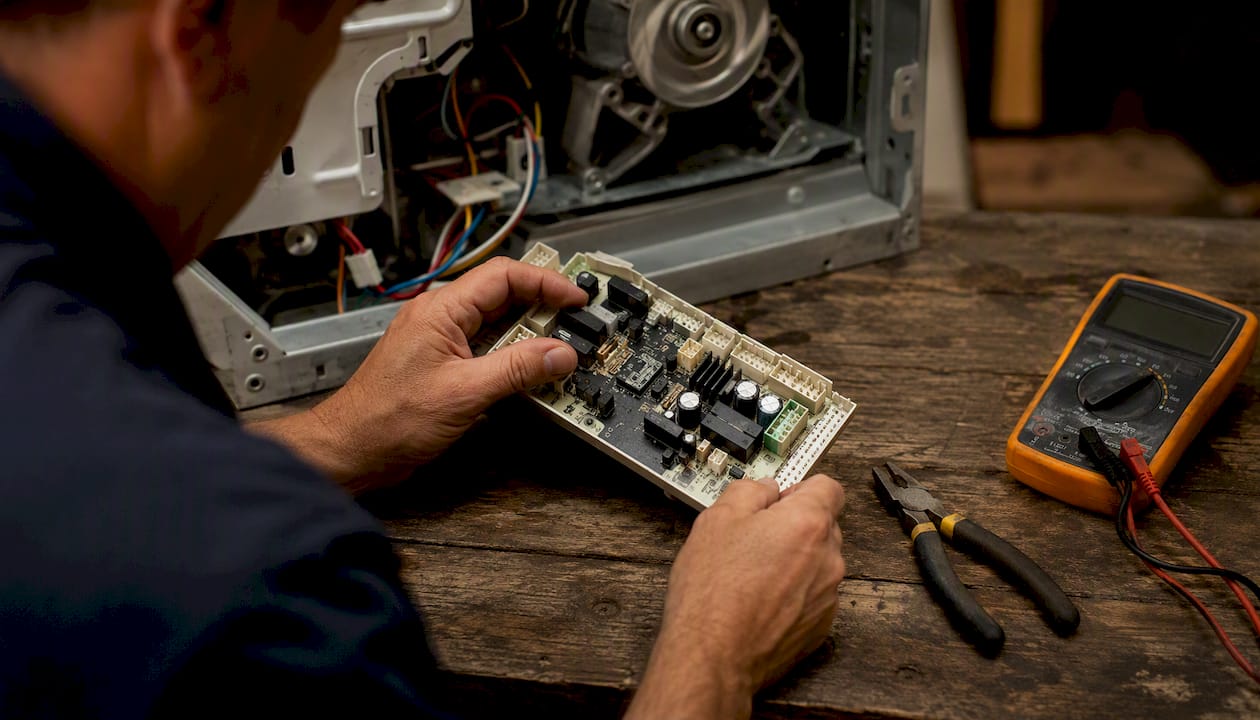
Control board failures are the most common reason a repair quote surprises homeowners. A board for a mid-range dishwasher or washer can run $200–$350 for the part alone, and on a unit that's 9 or 10 years old, that cost almost always tips the math toward replacement. The frustrating part is that a control board failure often looks like a minor symptom at first: the unit won't start, or it stops mid-cycle. Homeowners assume it's a cheap fix. It usually isn't.
Compressor failures on refrigerators are the other common inflection point. A compressor replacement on a fridge that's 11 years old can cost $400–$600 in parts and labor. At that age, with a 10–15 year expected lifespan, you're paying a large fraction of replacement cost for a unit that may have only 2–4 years left. Most technicians will tell you honestly: replace it.
On parts availability, expect 1–2 weeks for special-order components on older or less common models. Some parts simply aren't made anymore, and a technician who can't source the part in a reasonable timeframe should tell you that upfront. If they can't give you a clear timeline, ask for a written diagnosis and get a second opinion before committing to the repair.
One practical note on scheduling: haul-away and installation for a replacement appliance often need to be booked separately from delivery, especially for gas appliances requiring a licensed hookup. Build that into your timeline.
Maddladder helps Kansas City homeowners make the right call
When the numbers are close or the situation is complicated, having a licensed professional on-site makes a real difference. Maddladder serves the Kansas City metro area with on-site repair-and-replace services that cover the full decision process: diagnosis, written estimates, appliance installation, haul-away of old units, and safety checks before and after.

Booking a visit means you get a written diagnosis you can actually use to compare repair against replacement, not a verbal ballpark. Maddladder's technicians will walk you through the full installed cost of a replacement, including any plumbing or electrical changes the new unit requires, so there are no surprises after delivery. For homeowners on a maintenance plan, appliance checks are built into the regular schedule, which means you catch problems before they become emergencies.
Schedule a free estimate and get a clear, written answer on whether your appliance is worth fixing or time to replace.
Useful sources and tools for further research
These are the primary references and decision tools used to build this guide.
- Repair or Replace
- Ask Angi: Should I repair or replace appliances? | The Seattle Times
- Repair or replace? How to decide when a major appliance breaks down — WCVB
- Repair or Replace: Appliance cost, lifespan, efficiency guide
- Repair or Replace Appliance? Decision Helper | Velzany
- How often should you replace household appliances? — Techwalla