
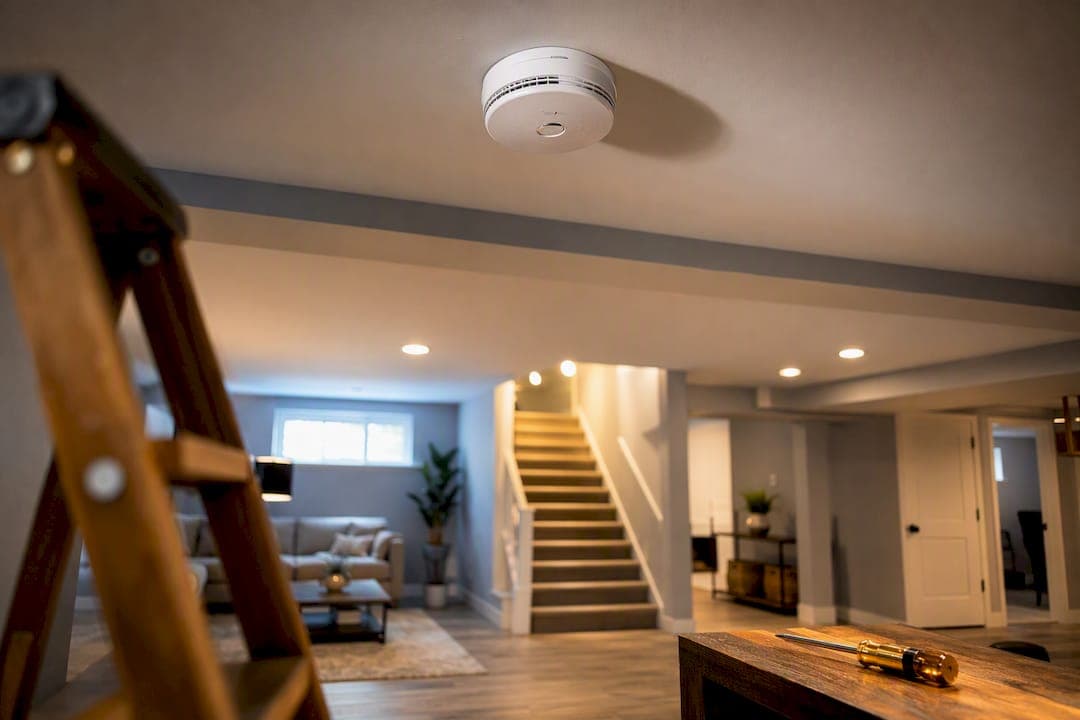
Place a working smoke alarm on every level of your home, inside each bedroom, and outside every sleeping area, mounted on the ceiling or high on a wall away from vents, fans, and cooking appliances, with reliable options available at Home Security - Fire & Smoke Detection. Photoelectric sensors work best near kitchens, and interconnected alarms mean one unit going off sounds every alarm in the house. Get those two things right and you've covered most of what code actually requires.
TL;DR:
- Installing interconnected smoke alarms on every level, inside each bedroom, and outside sleeping areas is essential for comprehensive coverage.
- Mount alarms on the ceiling or high on the wall within 4 to 12 inches from the ceiling to ensure timely smoke detection, adjusting for sloped ceilings.
- Place alarms at least 10 feet from kitchens and 3 feet from bathrooms, HVAC vents, or fans to prevent nuisance triggers and false alarms.
- Use photoelectric sensors near kitchens and living spaces, while ionization or combination units are suitable for bedrooms and hallways.
- Regularly test alarms monthly, replace batteries yearly or switch to sealed 10-year units, and replace all units after 10 years for safety.
Table of Contents
- Smoke Detector Placement Guidelines: How Many Alarms Do You Need?
- How High Should You Mount a Smoke Alarm?
- Where Should You Not Put a Smoke Detector?
- Photoelectric vs. Ionization: Which Sensor Goes Where?
- Smoke Alarm Testing and Maintenance Checklist
- When to Call a Licensed Pro Instead of DIY
- What the Code Guidance Gets Right, and What It Leaves Out
- Get Smoke Alarms Installed and Interconnected the Right Way
- Sources
- FAQ
Smoke Detector Placement Guidelines: How Many Alarms Do You Need?
The baseline rule from the National Fire Protection Association and the International Residential Code is simple to state and easy to underestimate: every level of the home needs its own alarm, including basements and any attic you actually use as living space. That's not one alarm for the whole house. It's one per floor, minimum, plus additional units tied to the bedrooms.
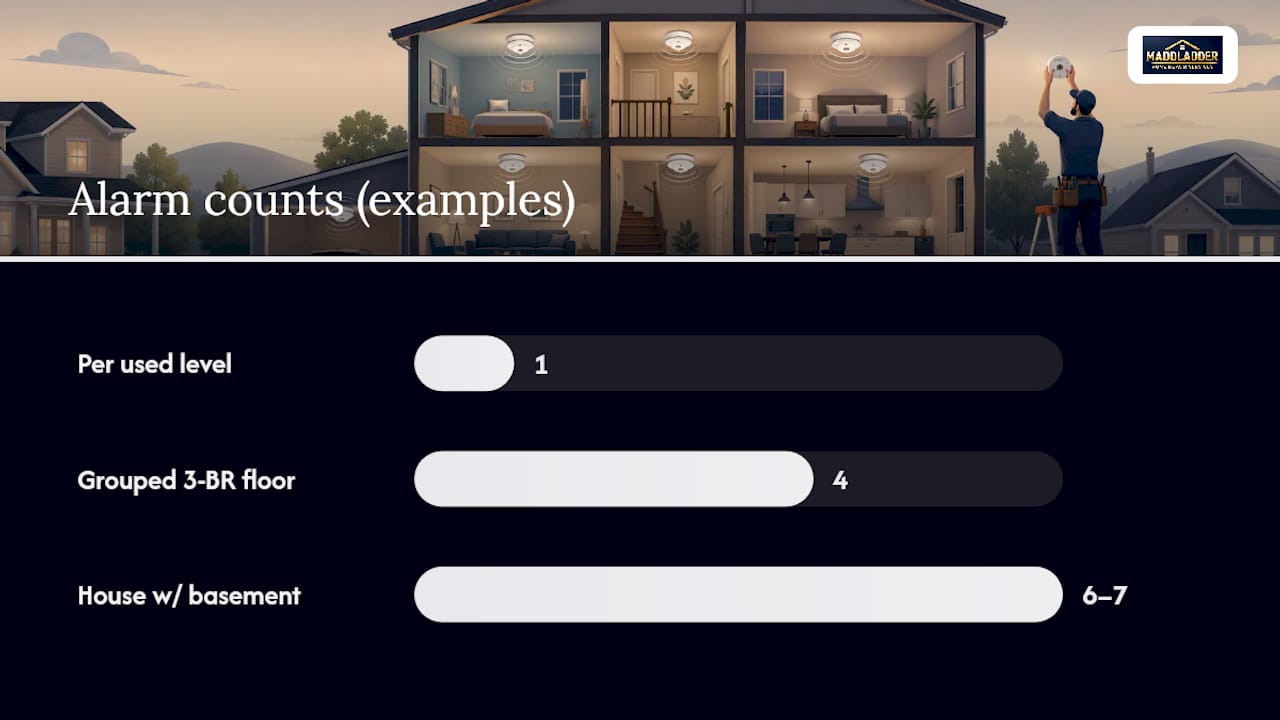
Inside each bedroom gets its own alarm, and another goes in the hallway or common area outside each cluster of bedrooms. A three-bedroom ranch with bedrooms grouped together might need four alarms on that floor alone: one per room, plus one in the hallway. A three-bedroom house with a finished basement and bonus room over the garage could easily need six or seven units total.
Large or spread-out floor plans need more than the minimum. Trade guidance suggests adding a unit for roughly every 500 square feet of open floor area, or making sure no point in the house is farther than about 30 feet of travel distance from the nearest alarm, whichever gives better coverage.
Split-level homes deserve extra attention. Each landing on a staircase counts as part of a level, and a mid-level landing between floors often gets missed. So does the top of an open stairwell, which acts as a chimney for smoke and heat rising from below.
- One alarm on every story, including finished basements and habitable attics
- One inside every bedroom
- One outside each group of bedrooms, in the hallway or common space
- Extra units for large open floor plans or split levels with multiple landings
How High Should You Mount a Smoke Alarm?
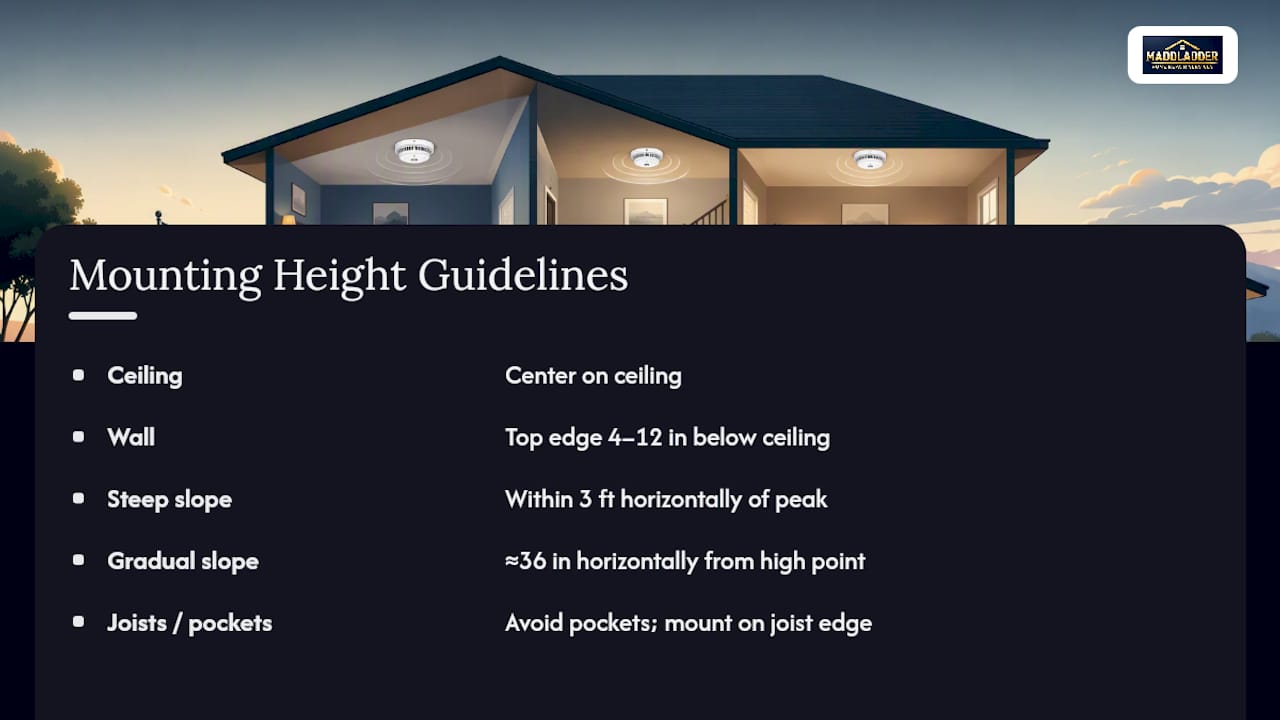
Ceiling mounting is the standard, and for good reason: smoke rises and pools at the highest point in a room first. Center the alarm on the ceiling whenever the room shape allows it.
Wall mounting works too, but the placement window is narrower than most people expect. The top edge of the alarm should sit between 4 and 12 inches down from the ceiling, following the manufacturer's listing instructions for that exact model. Go higher than 4 inches from the ceiling and you land in the "dead air" zone where smoke hasn't started circulating yet, which delays detection.
Sloped or peaked ceilings change the math again. On a steep slope, mount the alarm within 3 feet of the peak, measured horizontally, but not directly at the apex itself. On more gradual slopes, guidance from Kidde points to installing within about 36 inches horizontally from the high point, adjusting down as the ceiling angle relaxes.
Rooms with exposed joists or recessed ceiling pockets create a common installation mistake. Mounting inside a pocket between joists traps smoke above the sensor and delays the alarm. The NFPA recommends mounting on the joist's bottom edge or on a flat section of ceiling instead, so smoke reaches the sensor without an obstruction in the way.
Where Should You Not Put a Smoke Detector?
Nuisance alarms are the single biggest reason smoke detectors get disabled, and disabled alarms are useless alarms. Bad placement is almost always the root cause.
Keep alarms roughly 10 feet from cooking appliances when the kitchen layout allows it. Steam and cooking smoke set off ionization sensors constantly, and a homeowner who's had three false alarms while making dinner will eventually pull the battery and forget to put it back. Where the floor plan genuinely won't allow 10 feet of separation, a photoelectric or hush-button alarm handles kitchen proximity far better than a standard ionization unit.
Bathrooms cause the same problem through steam, so keep a 3-foot horizontal clearance from bathroom doorways. That same 3-foot rule applies to HVAC supply registers and ceiling fan blades, both of which can blow smoke away from the sensor or trigger false readings from moving air, according to USFA placement guidance.
Garages, workshops, and dusty utility areas are generally poor spots for standard smoke alarms. Dust and exhaust fumes cause frequent false triggers there, and a heat alarm is usually the better tool for that specific space.
- Keep about 10 feet from stoves and ovens where the layout permits
- Maintain 3 feet from bathroom doors, supply registers, and ceiling fans
- Skip garages and dusty utility spaces for standard smoke sensors
- Switch to photoelectric, hush-capable, or heat alarms wherever nuisance triggers keep happening
Pro Tip: If an alarm keeps going off during cooking or showers, don't just remove the battery. Move the unit a few feet farther away first, and swap to a photoelectric sensor if repositioning alone doesn't fix it.
Photoelectric vs. Ionization: Which Sensor Goes Where?
Sensor type matters as much as location, and this is where a lot of home installations go wrong with a one-size-fits-all approach. Photoelectric sensors detect smoldering fires, the slow-burning kind that produce a lot of smoke before much heat. That makes them the better choice near kitchens and living rooms, and it's part of why CPSC specifically recommends them for spaces close to cooking activity.
Ionization sensors respond faster to flaming fires, the kind that flare up quickly with less initial smoke. Combination alarms that use both sensor types cover both fire behaviors and are a reasonable default for bedrooms and hallways where you want broad protection without guessing which fire type is more likely.
Interconnection is the upgrade that actually saves lives at 2 a.m. A fire that starts in a basement with only one alarm might not wake anyone on the second floor before conditions turn dangerous. Interconnected alarms, whether hardwired with battery backup or linked through a listed wireless system, mean every alarm in the house sounds together. USFA treats interconnection as standard best practice for exactly this reason.
- Photoelectric: best near kitchens and living areas prone to smoldering-fire triggers
- Ionization: faster response to flaming fires, useful in bedrooms and hallways
- Combination units: a solid default where you don't want to choose one sensor type
- Sealed 10-year battery units: a practical option when hardwiring isn't realistic
Smoke Alarm Testing and Maintenance Checklist
Placement only matters if the alarm actually works when it counts. Test every unit monthly using the test button, and replace batteries once a year unless you've installed sealed 10-year units, which are built to run without a battery swap for their entire service life.
Age matters more than most homeowners realize. Sensors degrade over time, and CPSC recommends replacing any smoke alarm once it passes 10 years old, regardless of whether it still beeps during a test. Check the manufacture date stamped on the back of the unit, since installation date and manufacture date aren't always the same.
Property managers handling multiple units benefit from a simple written log: installation date, model number, and location for every alarm on the property, plus a note confirming interconnection actually works across the whole system.
- Test every alarm monthly and log the result
- Replace batteries yearly, unless the unit uses a sealed 10-year battery
- Replace any alarm once it's past 10 years old, no exceptions for "still working"
- Confirm interconnected units all sound together during a test
- Cut power at the breaker before touching hardwired units, and call a licensed electrician if you're not confident in the wiring
When to Call a Licensed Pro Instead of DIY
Swapping a 9-volt battery or replacing a single battery-only unit is a five-minute job most homeowners can handle without help. Hardwired systems, multi-unit interconnection, and high-ceiling installs are a different story.
A professional visit typically includes a full placement audit against current code, hardwired installation with proper interconnection, mounting at height where a ladder alone isn't safe, and a wiring check to confirm everything is grounded and functioning correctly. Licensed technicians can assist with this kind of work, including documentation of each unit's location and model for your records.
Call a pro when you're dealing with multiple interconnected units, ceilings above standard height, unclear local code requirements, or any wiring you're not confident touching yourself. A free estimate makes it easy to find out what a full-home smoke alarm upgrade actually costs before committing.
What the Code Guidance Gets Right, and What It Leaves Out
Most placement guidance treats compliance as the finish line. Get an alarm on every floor, one in every bedroom, one outside sleeping areas, done. That's the legal minimum, and it's genuinely important. But code compliance and effective fire protection aren't quite the same thing.
The gap shows up in the details nobody enforces: whether alarms are interconnected, whether the sensor type matches the room, whether anyone's replaced a battery since move-in. A technically compliant house with ten-year-old alarms and no interconnection is legal. It's also a lot less safe than it looks on paper.
If you take one thing from this guide, prioritize interconnection over adding extra units. A house with fewer alarms that all sound together beats a house with more alarms that only wake the people in that one room. Nuisance-alarm prevention matters almost as much, because the single biggest threat to a smoke alarm's effectiveness is a homeowner who got tired of false alarms and pulled the battery. Placement rules exist to prevent that outcome as much as to satisfy an inspector.
— Jennifer
Get Smoke Alarms Installed and Interconnected the Right Way
Getting placement, mounting height, and interconnection right on the first try beats troubleshooting nuisance alarms for months afterward. Maddladder handles smoke alarm installation and interconnection wiring for homeowners and property managers across the Kansas City metro, including sealed 10-year unit swaps and full-home placement audits that match current NFPA and CPSC guidance.

To book services, you can call or submit a contact form with the number of levels in your home and photos of your current alarm setup to receive a free estimate before any work starts. Simple battery swaps and single-unit replacements are fine to handle yourself. But if you're dealing with hardwired interconnection, multiple units, or you're just not sure your current setup meets code, see the full range of services and get a technician on the schedule instead of guessing.
Sources
- Installing and maintaining smoke alarms - NFPA
- Smoke Alarm: Why, Where and Which (CPSC Pub 559)
- Placement of Smoke Alarms | Kidde Home Safety
Local jurisdictions can add requirements on top of these federal and national standards, so check your city or county building code before finalizing an installation.
FAQ
Where Should You Not Put a Smoke Detector?
Avoid mounting within about 10 feet of cooking appliances, 3 feet of bathroom doors, HVAC supply registers, or ceiling fans, and skip garages and dusty utility spaces entirely for standard smoke sensors.
Where Should a Smoke Alarm Be Placed?
Put one on every level of the home, one inside each bedroom, and one outside each group of sleeping areas, mounted on the ceiling or high on a wall following standard clearance rules.
How Many Smoke Detectors Do I Need in a Three-Bedroom House?
A typical three-bedroom home with bedrooms grouped together needs at least four alarms on that floor: one per bedroom plus one in the connecting hallway, with additional units for other levels like a basement.
Where Should Smoke Alarms Not Be Installed?
Skip recessed ceiling pockets between joists, spots within the dead-air zone near a ceiling corner, and any location closer than 3 feet to a fan or supply register, since airflow and trapped smoke both delay detection.