

TL;DR:
- Replacing fixtures safely in Kansas City requires understanding permit rules, safety procedures, and proper tools for electrical and plumbing work. Hiring licensed professionals is advisable for complex or risky projects, ensuring code compliance and liability protection. Professional services offer peace of mind, warranty coverage, and proper handling of unanticipated issues in older homes.
Outdated faucets drip. Flickering lights flicker more. And that bathroom fixture your previous tenant installed with duct tape and optimism? It's a problem waiting to get expensive. Knowing how to replace fixtures the right way, whether you tackle it yourself or hand it off to a licensed pro, is one of the most practical skills a Kansas City homeowner can have. This guide walks you through permit rules specific to Kansas City, the tools you actually need, step-by-step processes for both electrical and plumbing fixtures, and the clear signals that tell you when DIY stops being a good idea.
Table of Contents
- Understanding fixture replacement permits and safety in Kansas City
- Preparing tools and materials for replacing light and plumbing fixtures
- Step-by-step process to replace a light fixture safely
- Replacing bathroom and kitchen plumbing fixtures: a step-by-step guide
- Why hiring licensed professionals often makes fixture replacement safer and easier in Kansas City
- Get professional fixture replacement services in Kansas City with MaddLadder
- Frequently asked questions
Key Takeaways
| Point | Details |
|---|---|
| Permits for fixture replacement | In Kansas City, simple fixture swaps usually don’t require permits, but new installations or rerouting do. |
| Safety precautions | Always turn off power or water supplies and use safety tools like voltage testers before work. |
| Essential tools | Having the right tools ready speeds up projects and reduces mistakes for both electrical and plumbing replacements. |
| DIY steps for fixtures | Follow step-by-step instructions carefully to remove old fixtures and install new ones safely and effectively. |
| When to hire pros | Call licensed professionals for outdated wiring, complex installs, or permit-required work to ensure safety and compliance. |
Understanding fixture replacement permits and safety in Kansas City
Before you touch a single wire or shut off a water valve, you need to know what Kansas City actually requires. Getting this wrong doesn't just risk a fine. It can void your homeowner's insurance or create liability issues when you go to sell.
Here's the straightforward breakdown for electrical work: replacing a light fixture in the same location does not require a permit. But if you're adding a new circuit, installing a new outlet, or putting a fixture somewhere that didn't have one before, you need a permit. The same logic applies to plumbing. Replacing a plumbing fixture in its existing location is permit-free, but installing a new fixture or rerouting pipes triggers a permit requirement, with fees typically running $75 to $300.
Understanding your local plumbing permit requirements before you buy materials saves you from an expensive surprise.
Safety essentials before you start any fixture work:
- Shut off the circuit breaker for electrical work, or close the water supply valve for plumbing work
- Use a non-contact voltage tester to confirm the power is actually off, not just assumed off
- Keep a dry towel nearby and wear rubber-soled shoes when working around water and electrical systems
- Never work alone on a ladder; have someone present if you're replacing overhead lighting
"If the wiring in your home is old, brittle, or discolored, stop immediately. You are not looking at a fixture replacement project anymore. You are looking at a potential fire hazard that needs a licensed electrician."
Pro Tip: If your Kansas City home was built before 1980, there's a real chance it has aluminum wiring. Aluminum wiring requires special connectors and handling. If you see silver-colored wires instead of copper-colored ones, call a licensed professional before proceeding.
Preparing tools and materials for replacing light and plumbing fixtures
Showing up to a fixture replacement without the right tools is how a one-hour project becomes a three-hour ordeal with a mid-job hardware store run. Good fixture replacement tools and preparation cut your project time in half.
For electrical fixture work, a DIY light fixture swap requires a non-contact voltage tester, wire nuts, needle-nose pliers, flathead and Phillips screwdrivers, a sturdy ladder, work gloves, and safety glasses. Most homeowners already own half of this list.
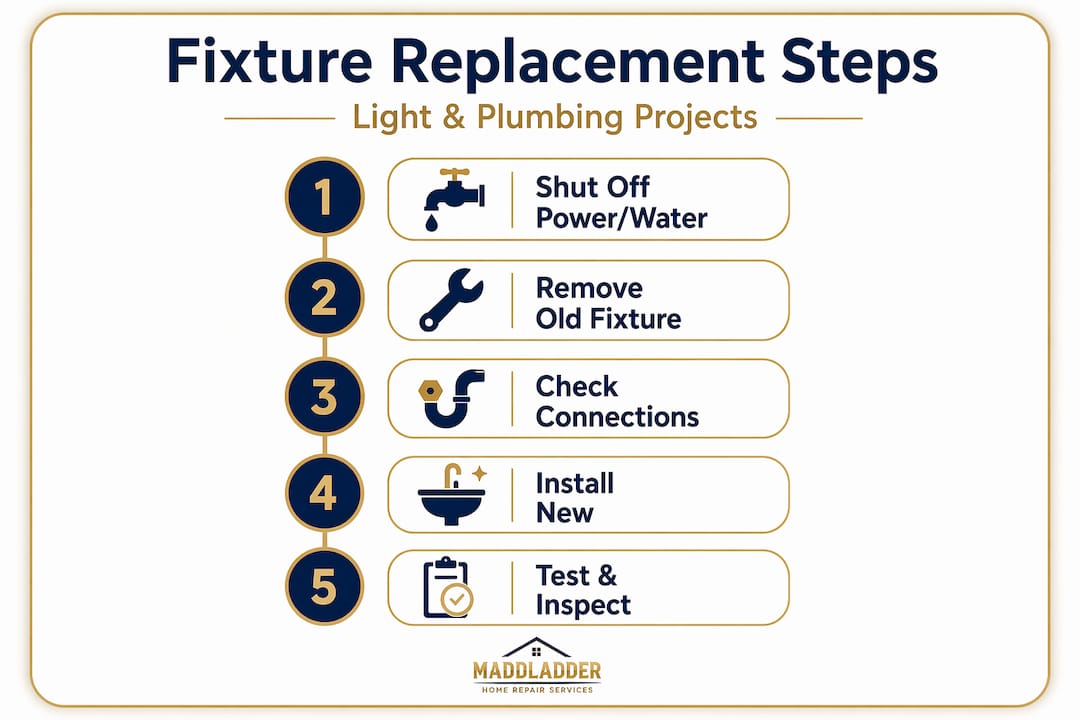
For plumbing, a bathroom faucet replacement adds a few specialized items you might not have on hand.
| Project type | Essential tools | Materials needed |
|---|---|---|
| Light fixture replacement | Non-contact voltage tester, wire nuts, screwdrivers, ladder | Electrical tape, replacement fixture, mounting bracket |
| Faucet replacement | Basin wrench, adjustable wrench, pliers | Plumber's putty or silicone caulk, supply lines, towels |
| Showerhead replacement | Adjustable wrench, pipe tape | Teflon tape, replacement showerhead |
| Ceiling fan swap | Voltage tester, screwdrivers, wire nuts | Mounting brace (if needed), fan downrod |
A basin wrench is the one tool most homeowners don't own but absolutely need for faucet work. It reaches up into tight spaces under the sink to loosen or tighten the mounting nuts that hold the faucet in place. Without it, you'll spend 45 minutes fighting hardware that would take 5 minutes with the right tool.
Quick checklist before starting:
- Tools organized and within reach before you begin
- New fixture unboxed and inspected for missing parts
- Replacement supply lines measured and purchased (many new faucets don't include them)
- Work area cleared and lit properly
Pro Tip: Keep a rag stuffed over the drain opening during any plumbing work. Small screws, rubber washers, and lock nuts have a talent for finding the drain at the worst possible moment.
Step-by-step process to replace a light fixture safely
A standard light fixture replacement takes 30 to 60 minutes when you follow the steps in order. Skipping steps, especially the safety verification steps, is where problems start.
- Turn off the circuit breaker for the room or the specific fixture. Don't rely on the wall switch alone.
- Test with a non-contact voltage tester before touching any wires. Hold it near the fixture wires; a beep or light means power is still present. One in three DIYers encounter live wires even after flipping the breaker.
- Photograph the existing wiring before disconnecting anything. This is your reference if you get confused during installation.
- Remove the old fixture by unscrewing the canopy (the decorative plate at the ceiling) and exposing the electrical box.
- Inspect the electrical box for cracks, corrosion, or loose mounting. A wobbly box needs to be secured or replaced before you hang anything new.
- Disconnect the old wires by unscrewing the wire nuts and separating the connections.
- Check the wiring condition. Older homes often have brittle insulation or aluminum wiring. If the wire coating crumbles when touched, stop and call a professional.
- Attach the new mounting bracket to the electrical box following the manufacturer's instructions.
- Connect the new fixture wires: black to black (hot), white to white (neutral), and bare copper or green to the ground wire. Twist wire nuts clockwise until snug.
- Tuck wires into the box carefully, attach the canopy, and install the bulbs.
- Restore power and test. If the light flickers or doesn't work, shut off power again and check your wire connections.
"If you're unsure at any point, the smartest move is to stop. A $150 service call costs far less than an electrical fire or an ER visit."
Pro Tip: Photograph your old wiring setup before disconnecting a single wire. Three minutes of preparation will save you from a confusing tangle of wires mid-installation.
| Common mistake | What goes wrong | How to avoid it |
|---|---|---|
| Skipping voltage test | Shock or electrocution risk | Always test before touching wires |
| Loose wire nut connections | Flickering light or fire hazard | Tug gently on each wire after capping |
| Overloading the junction box | Box pulls out of ceiling | Check box weight rating before hanging fans |
| Mismatched wire gauges | Overheating | Match wire gauge from old fixture to new |
Replacing bathroom and kitchen plumbing fixtures: a step-by-step guide
A bathroom faucet replacement takes one to two hours for most homeowners and is one of the cleanest, most impactful upgrades you can do. The process translates well to kitchen faucets with minor variations.
- Clear out the cabinet under the sink completely. You'll be working in that space for a while.
- Shut off both hot and cold supply valves under the sink. Turn them clockwise until they stop.
- Turn on the faucet to release pressure and drain any remaining water in the lines.
- Disconnect the supply lines from the faucet using your adjustable wrench.
- Remove the drain linkage (if your faucet has a pop-up stopper mechanism) by unscrewing the pivot rod nut at the back of the drain pipe.
- Use your basin wrench to unscrew the mounting nuts holding the faucet to the sink. This is the step most people struggle with on their first attempt.
- Lift out the old faucet and clean the sink surface thoroughly. Old plumber's putty and mineral deposits need to come off completely before the new faucet goes in.
- Apply a rope of plumber's putty or silicone caulk around the base of the new faucet (check your manufacturer's instructions, as some finishes require caulk instead of putty).
- Drop the new faucet into place, thread the supply lines down through the sink hole, and hand-tighten the mounting nuts. Snug them with your basin wrench without overtightening.
- Reconnect the supply lines and hand-tighten, then give them a quarter turn with a wrench.
- Slowly open the supply valves and let water flow through before turning on the faucet.
Pro Tip: Run both hot and cold water separately for two full minutes post-installation, then check every connection point. Small drips are easier to fix now than after the cabinet is fully packed again.
Things to watch for during installation:
- If the shutoff valves under the sink leak when you close them, replace them before proceeding. A valve that leaks during testing will fail completely later.
- Check the joints and drain connections after the first 24 hours. Thermal expansion sometimes reveals slow leaks that weren't obvious immediately.
- Avoid overtightening plastic supply line connections; they strip easily.
Why hiring licensed professionals often makes fixture replacement safer and easier in Kansas City
Here's the perspective you won't read in most fixture replacement guides: the real risk of DIY fixture work in Kansas City isn't getting the steps wrong. It's not knowing what you don't know yet.
Kansas City has a significant stock of older housing. Many homes built in the 1950s through 1970s were wired or plumbed with materials and methods that don't play nicely with modern fixtures. The homeowner who thinks they're doing a simple faucet swap discovers corroded shutoff valves that snap off. The person replacing a light fixture finds a junction box wired with cloth-insulated cable that crumbles at the touch. These aren't fringe cases.

Licensed plumbers and electricians in Kansas City handle permits, inspections, and code compliance for complex installs, and many offer same-day services with guaranteed safety. That's not just convenience. That's liability protection for your home and your investment.
The DIY-versus-hire decision isn't really about capability. Most homeowners can follow a step-by-step guide. The real question is what happens when something unexpected shows up mid-project. A licensed pro diagnoses it on the spot. A DIYer usually either guesses or stops progress entirely.
There's also a permit compliance angle that homeowners underestimate. If you do unpermitted work that later causes damage, your homeowner's insurance may deny the claim. The cost of that gamble is almost always higher than the cost of hiring someone who does it right the first time.
The professional fixture replacement benefits go beyond convenience. They include code compliance, warranty protection, and the peace of mind that comes from knowing the work was done correctly.
Pro Tip: If you open up a fixture and find brittle wire insulation, aluminum wiring, or a plumbing configuration you don't recognize, close it up and call a licensed handyman. The cost of a professional visit is almost always less than the cost of fixing a problem you made worse.
Get professional fixture replacement services in Kansas City with MaddLadder
Replacing fixtures should make your home better, not create new problems. If what you found in this guide made you realize the job is more involved than expected, that's useful information.

MaddLadder connects Kansas City homeowners and tenants with licensed handyman professionals who handle both simple and complex fixture replacements, from a single bathroom faucet to a full lighting upgrade that requires permits. Our fixture repair and replacement services cover all the scenarios in this guide, and our professional plumbing and electrical services are backed by licensed, insured pros who know Kansas City code requirements. Same-day availability, free estimates, and no guesswork. Visit MaddLadder today to schedule your fixture replacement or request a free estimate.
Frequently asked questions
Do I need a permit to replace a light fixture in Kansas City?
No, replacing a fixture in the same location in Kansas City does not require an electrical permit, but adding new circuits or installing fixtures in new locations does require one.
Can I do plumbing fixture replacement myself without a permit?
Yes, replacing a plumbing fixture in its existing location does not require a permit in Kansas City, but new fixture installations or pipe rerouting do, so verify the scope of your project before starting.
What safety tools should I use to replace a light fixture?
Use a non-contact voltage tester to confirm power is off before touching any wires, and wear safety glasses and gloves throughout the job. Insulated screwdrivers and pliers add another layer of protection.
When should I hire a professional for fixture replacement?
Hire a licensed professional if you encounter brittle or aluminum wiring, corroded plumbing, or any situation that requires permits and inspections. These are not conditions where guessing leads to good outcomes.