
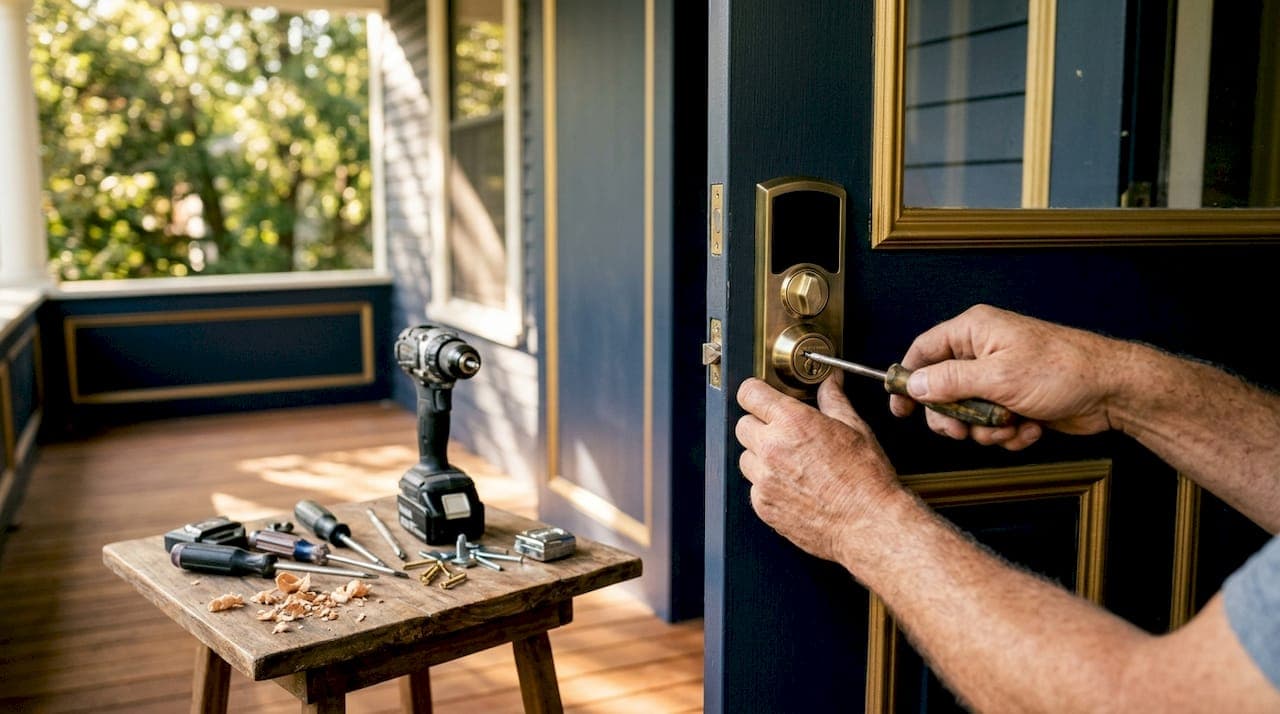
The fastest way to protect a rental investment is to stack five layers at once: the right ownership entity, landlord insurance with an umbrella policy on top, disciplined maintenance and screening, tenant-side insurance requirements, and a cash reserve sized to your rent roll. No single fix carries the whole load. A great lease clause won't stop a burst pipe, and a good insurance policy won't stop a bad tenant from trashing a unit before you can enforce anything.
Do these three things this week if you haven't already:
- Rekey exterior locks and confirm every smart lock or camera still works after the last tenant moved out.
- Pull your current landlord insurance declarations page and check it lists loss-of-rent coverage, then request proof of active renters insurance from every current tenant.
- Open a separate savings account and start funding a repair and vacancy reserve, even if it starts small.
Complex questions about entity structure, title issues, or eviction law vary by state and by property. Talk to a licensed attorney or insurance broker before you make a big structural decision based on a blog post, including this one.
Key Takeaways
Protecting a rental investment requires stacking ownership structure, insurance, tenant controls, maintenance, and cash reserves together, since no single layer covers every risk on its own.
| Point | Details |
|---|---|
| Verify insurance annually | Confirm dwelling limits, loss-of-rent wording, and umbrella coverage every renewal cycle. |
| Require renters insurance | Add it to every lease with a minimum liability limit and verify proof before move-in. |
| Build a cash reserve | Fund three to six months of gross rent per property in a separate account. |
| Match entity to scale | Use an LLC or trust strategically and keep finances and insurance in the entity's name. |
| Use Maddladder for execution | Rely on Maddladder for rekeying, hardware installs, and turnover make-ready across the Kansas City metro. |
This article is general information, not a substitute for advice from a qualified lawyer. Consult a qualified legal professional about your own circumstances before acting on anything here.
Table of Contents
- Why a Layered Protection Strategy Beats Any Single Fix
- Landlord Insurance, Umbrella Policies, and Requiring Renters Insurance
- LLCs, Trusts, and Ownership Design That Actually Holds Up
- Tenant Screening and Lease Clauses That Reduce Disputes
- Inspections, Repairs, and Security That Prevent Loss
- Cash Reserves, Equity Strategies, and Eviction Planning
- Title Insurance and Closing Decisions That Reduce Long-Term Risk
- Your 30, 90, and 365 Day Protection Checklist
- When to Call a Licensed Pro vs. a Handyman
- Fast, Documented Repairs Are the Cheapest Insurance You Own
- How Maddladder Supports Your Protection Plan
- Sources
Why a Layered Protection Strategy Beats Any Single Fix
Rental property protection works the way home security works: one lock helps, but a locked door, a lit porch, a nosy neighbor, and a camera together stop far more break-ins than any one of them alone. The same logic applies to your investment. Ownership design, insurance, day-to-day operations, tenant-side controls, title decisions, and financial reserves each block a different category of loss, and a layered system is what actually holds up when something goes wrong, because a gap in one layer rarely sinks you if the others are solid.
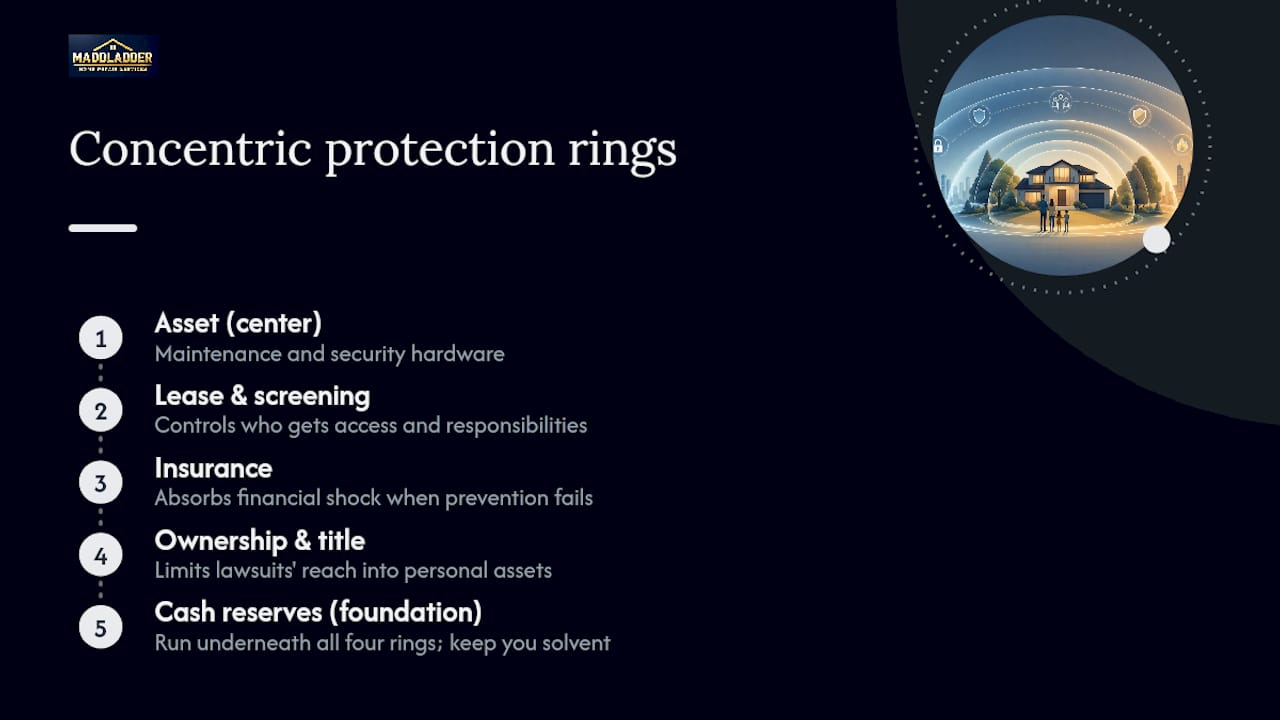
Picture it as concentric rings around the property. At the center sits the asset itself, protected by maintenance and security hardware. The next ring is your lease and tenant screening, which controls who gets access and what they're responsible for. Beyond that sits insurance, which absorbs the financial shock when prevention fails. The outer ring is your ownership structure and title work, which limits how far a lawsuit or ownership dispute can reach into your personal assets. Cash reserves run underneath all four rings, keeping you solvent while a claim, eviction, or repair plays out.
Priorities differ depending on where you are. If you own a single rental, insurance and maintenance come first because you're carrying the operational risk personally and your exposure is concentrated in one property. If you're building a portfolio, ownership structure and standardized lease terms across units matter more, since inconsistent policies across five properties multiply your legal exposure five times over. A landlord-focused operational approach that treats rentals as a business, not a side project, tends to outperform reactive management regardless of portfolio size.
Landlord Insurance, Umbrella Policies, and Requiring Renters Insurance
Buy a landlord (dwelling) policy, add an umbrella policy once your liability exposure justifies it, and require every tenant to carry renters insurance. That combination covers the three places money actually leaks: property damage, lawsuits, and tenant-caused losses you shouldn't be on the hook for.
A standard landlord policy typically covers the structure itself, liability if someone gets hurt on the property, and loss-of-rent coverage if the unit becomes uninhabitable after a covered event like a fire. What it usually doesn't cover: the tenant's personal belongings, flood damage in most standard policies, and normal wear and tear. Landlords often assume their policy protects a tenant's furniture or electronics after a burst pipe. It doesn't, and that gap is exactly why requiring renters insurance matters.
Policy review checklist, once a year:
- Confirm dwelling coverage reflects current rebuild cost, not purchase price, since construction costs shift year to year.
- Check the loss-of-rent wording for how many months it covers and what triggers it.
- Ask your broker whether an umbrella policy or additional liability endorsement makes sense given your portfolio size.
- Review deductibles against your reserve fund. A high deductible only helps if you can actually cover it.
- Confirm any recent upgrades (new roof, security system, updated electrical) are documented and reflected in your premium.
To require and verify renters insurance, put it directly in the lease: tenants must carry a policy with a minimum liability limit (commonly $100,000), name the landlord as an "interested party" for notification purposes, and provide proof before move-in and at each renewal. Renters insurance is widely treated as a non-negotiable requirement among experienced landlords, and enforcement is simple: no certificate, no keys.
- Add the requirement as a lease addendum with a specific coverage minimum.
- Collect a copy of the declarations page at signing.
- Set a calendar reminder to request updated proof at each lease renewal.
Pro Tip: Schedule your insurance review for the same month every year, right before your policy renews, and bring photos of any upgrades. Insurers often apply premium discounts for new roofs, upgraded electrical panels, or monitored security systems, but only if you tell them.
LLCs, Trusts, and Ownership Design That Actually Holds Up
Use an LLC or trust strategically, not automatically. A single-property LLC makes sense for one or two rentals; a portfolio of eight units usually calls for a different structure, like grouping properties under a series LLC or a holding company, depending on your state and how much administrative overhead you can realistically manage.
Each structure offers a different kind of protection. An LLC generally shields your personal assets from liability tied to the property, so a slip-and-fall lawsuit targets the LLC's assets, not your house or savings. A trust is more useful for privacy and estate planning, keeping your name off public property records and simplifying inheritance. Owning a rental in your own name offers no separation at all between the property's risks and your personal finances. One myth worth killing outright: an LLC is not a force field. Courts can and do "pierce the corporate veil" when owners mix personal and business funds or ignore basic formalities.
That's the real catch. Combining an entity with the right insurance and disciplined operations is what actually protects you, and the entity only holds up if you run it like a real business:
- Keep a dedicated bank account for each LLC. Never pay a personal bill from the rental's account.
- Maintain the property's landlord insurance in the LLC's name, not your own.
- Make sure the deed and title match the entity that's supposed to own the property. A surprising number of landlords form an LLC and never actually transfer the deed.
- File your state's annual LLC paperwork on time. Lapsed status can undo the protection when you need it most.
State rules vary widely on LLC formation costs, annual fees, and series LLC availability, so confirm the details with a local attorney before restructuring. Pro Tip: Consolidate properties into fewer entities once the administrative burden of separate LLCs (separate accounting, separate tax filings, separate insurance policies) starts costing more in time than the extra liability separation is worth.
Tenant Screening and Lease Clauses That Reduce Disputes
Thorough screening and specific lease language function as your first operational shield, stopping problems before they ever reach an insurance claim or a courtroom. A tenant who never should have been approved costs far more than the hour it takes to check.
Screening checklist for every applicant:
- Run a credit check and set a minimum score threshold you apply consistently.
- Pull a background check for criminal history, applied under the same standard for every applicant to avoid fair housing violations.
- Verify employment and income, generally requiring gross income at least three times the rent.
- Contact at least two previous landlords, not just the current one, since a current landlord may exaggerate a tenant's reliability to get rid of them faster.
- Check eviction history through a tenant screening service.
Your lease is where screening decisions get backed up in writing. Specific clauses worth including:
- Renters insurance clause: "Tenant shall maintain a renters insurance policy with minimum liability coverage of $100,000 throughout the tenancy and shall provide proof of coverage upon request."
- Maintenance responsibility clause: Spell out exactly what the tenant handles (light bulb replacement, HVAC filter changes) versus what requires landlord notification (any plumbing, electrical, or structural issue).
- Emergency access clause: State the notice period required for non-emergency entry (commonly 24 to 48 hours) and clarify landlord rights to enter without notice in a genuine emergency.
- Insurance notice clause: Require tenants to notify you within a set window (commonly 10 days) if their renters insurance lapses or is canceled.
Deposit, pet, and subletting rules prevent the disputes that eat up the most time. Set the deposit at the maximum your state allows, document unit condition with dated photos at move-in and move-out, and require written approval before any pet or subtenant moves in. Track lease compliance in a simple spreadsheet or property management app so you have a paper trail if enforcement ever becomes necessary. For the actual verification workflow, request the renters insurance certificate at signing, log the expiration date, and send a written notice with a short compliance deadline the moment a policy lapses. If a tenant doesn't respond, most leases allow the landlord to force-place a policy at the tenant's expense, which should also be spelled out in the lease itself.
Inspections, Repairs, and Security That Prevent Loss
Regular maintenance and layered security cut claims and liability more than almost anything else on this list, because most rental losses start as small, preventable problems that got ignored. Here's the non-negotiable operational baseline.
Inspection cadence:
- Full turnover inspection between every tenant, covering plumbing, electrical, HVAC, and structural condition.
- Seasonal check twice a year for HVAC filters, gutters, and weatherproofing before extreme heat or cold hits.
- Safety device testing every six months for smoke detectors, carbon monoxide detectors, and fire extinguishers.
Between-tenant make-ready steps:
- Rekey every exterior lock, no exceptions, even if the last tenant returned their keys.
- Test every smoke and carbon monoxide detector and replace batteries regardless of remaining charge.
- Deep clean and inspect appliances for wear that could become a liability issue later.
- Handle minor repairs (caulking, touch-up paint, loose fixtures) before the next tenant moves in, not after they complain.
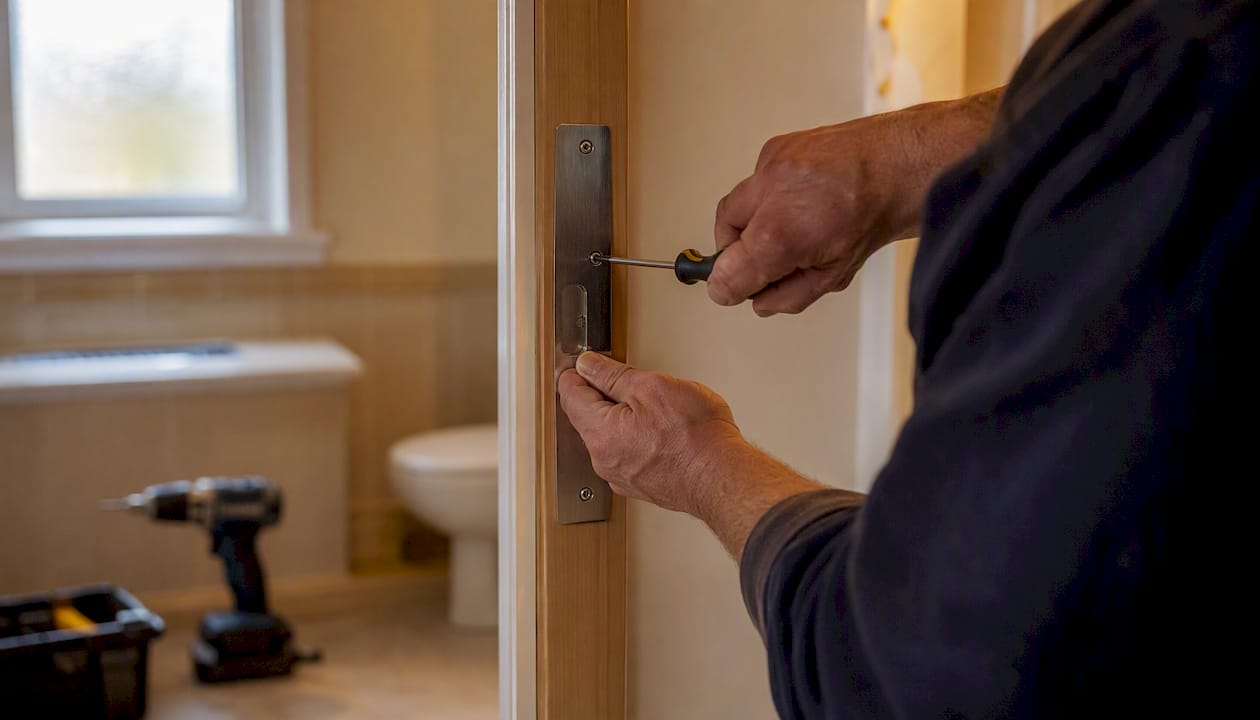
Security hardware pays for itself. A layered security approach combining deadbolts, reinforced strike plates, motion-activated lighting, and cameras in common areas deters far more incidents than any single measure, and visible security signage alone discourages a meaningful share of would-be burglars before they even try a door. If you add smart locks or cameras, stick to common areas and exterior entries only. Cameras inside a unit or pointed into private spaces cross a legal line in most states, so keep the technology focused on shared hallways, parking areas, and entry points.
This is where your maintenance execution plan matters as much as the plan itself. Rekeying, deadbolt upgrades, and entry door reinforcement are straightforward handyman work. Licensed electricians handle anything involving new circuits or panel work, and licensed plumbers handle anything beyond a fixture swap. A local handyman service like Maddladder fills the gap between those two extremes, handling the make-ready checklist, hardware installs, and small repairs fast enough that a vacant unit doesn't sit empty longer than it has to.
Pro Tip: Bundle your turnover repairs into a single scheduled visit instead of calling for one small fix at a time. It's cheaper per job and gets the unit rent-ready faster.
Cash Reserves, Equity Strategies, and Eviction Planning
Maintain a dedicated cash reserve, consider strategies that reduce your exposed equity, and budget for eviction costs before you ever need them. This is the layer that keeps you solvent when the other layers fail, and it's the one landlords underfund most often.
- Reserve size: A common guideline is three to six months of gross rent per property, held separately from your personal accounts and untouched except for property-related emergencies.
- Loss-of-rent endorsement: Confirm your policy's loss-of-rent coverage kicks in fast enough to bridge a gap while repairs happen after a covered event.
- Eviction-cost planning: Budget for legal filing fees, potential lost rent during the process, and possible property damage discovered after the tenant leaves.
- Equity management: Strategic use of debt, sometimes called equity-stripping, reduces the equity a plaintiff could realistically pursue in a lawsuit by keeping a property leveraged rather than paid off outright.
| Liability | Typical Range | Notes |
|---|---|---|
| Eviction filing and court costs | Varies by state and county | Check your local court's fee schedule directly |
| Attorney fees for a contested eviction | Higher for contested cases | Uncontested filings cost meaningfully less |
| Lost rent during eviction process | Depends on how long the process takes | This is where a reserve fund earns its keep |
| Property damage discovered post-eviction | Depends on unit condition | Documented move-in photos help substantiate a deposit claim |
Eviction and legal costs can escalate quickly, and a landlord without a reserve often ends up liquidating other assets or missing a mortgage payment to cover the gap. That's the scenario a reserve fund exists to prevent.
Pro Tip: Size your reserve as a multiple of monthly rent, not a flat dollar figure, so it scales automatically as your rent roll grows. Once your portfolio's total liability exposure outgrows a standard landlord policy's limits, that's your signal to add umbrella coverage.
Title Insurance and Closing Decisions That Reduce Long-Term Risk
Consider upgrading to an Enhanced owner's title policy in most cases, especially on older properties or ones with a complicated ownership history. The trade-off is straightforward: enhanced policies typically cost about 10% more than a standard policy but extend coverage for issues that only surface years after closing, like undisclosed heirs, boundary disputes, or building permit violations from a previous owner.
Closing steps that reduce title risk:
- Order a current survey rather than relying on an old one from a prior sale.
- Run a full lien search, not just the standard title search, to catch contractor or tax liens that might not show up automatically.
- Use the correct deed form for your ownership structure, since a warranty deed and a quitclaim deed offer very different levels of protection.
- Have a title company or attorney handle escrow rather than doing a private handoff of funds.
Pro Tip: Enhanced title coverage earns its extra cost when a property has changed hands multiple times recently, has any history of boundary or permit questions, or when you're forming an LLC and want the broadest possible protection layered under the entity structure.
Your 30, 90, and 365 Day Protection Checklist
Start with insurance and security in the first 30 days, add legal structure and lease upgrades by day 90, and treat the full year as an ongoing review cycle. Sequencing matters: insurance and rekeyed locks close your biggest immediate gaps, while entity restructuring and title work take longer and benefit from professional guidance anyway.
First 30 days:
- Pull your current insurance policy and confirm loss-of-rent coverage and liability limits.
- Rekey every exterior lock and test all safety devices.
- Request proof of renters insurance from every current tenant and add the requirement to any lease renewal.
By 90 days: 4. Consult an attorney about whether an LLC or trust fits your situation. 5. Add or update lease clauses covering maintenance responsibility, emergency access, and insurance notice requirements. 6. Get a quote for umbrella coverage if your liability exposure has grown.
Within the year: 7. Complete a full inspection and make-ready pass on every unit. 8. Review title insurance on any recent purchase and consider an enhanced policy where warranted. 9. Reassess your cash reserve and adjust based on portfolio growth.
| Timeframe | Task | Who Handles It |
|---|---|---|
| 30 days | Insurance review and lock rekeying | Owner or broker, plus a handyman for hardware |
| 30 days | Renters insurance verification | Owner or property manager |
| 90 days | Entity and lease review | Attorney and owner |
| 90 days | Umbrella policy quote | Insurance broker |
| 365 days | Full property inspection | Owner, property manager, or licensed inspector |
| 365 days | Title review on recent purchases | Title company or attorney |
Cost estimates vary by market and property condition, so treat these as planning ranges rather than fixed numbers. Lock rekeying and minor hardware installs are typically among the least expensive items on this checklist; entity formation and legal review cost more upfront but reduce risk for the life of your ownership. For seasonal maintenance planning, a weatherization pass before extreme temperatures hit both protects the asset and keeps tenants from filing avoidable maintenance complaints.
When to Call a Licensed Pro vs. a Handyman
Hire licensed trades for anything involving electrical panels, gas lines, or structural work, and use an experienced handyman for make-ready turns, small repairs, and security hardware installs. Getting this split right saves money without cutting corners on safety.
- Handyman-suited tasks: Rekeying locks, installing deadbolts and reinforced strike plates, mounting cameras or smart locks, minor drywall and trim repair, appliance installation, and general turnover make-ready work.
- Licensed contractor territory: New electrical circuits, panel upgrades, gas line work, major plumbing repairs, and anything touching structural elements or requiring a permit.
- Property manager territory: Ongoing tenant relations, rent collection, and portfolio-level operations once you own enough units that self-management stops making sense. Professional property management can meaningfully reduce landlord exposure once a portfolio grows past what one owner can personally oversee.
- Attorney or broker territory: Entity formation, lease language for your specific state, eviction proceedings, and any insurance coverage question beyond a basic policy comparison.
Maddladder handles the handyman-suited list directly across the Kansas City metro: rekeying, deadbolt and entry hardware installs, minor plumbing and electrical fixes, and full turnover make-ready work. When a job crosses into panel work or gas lines, that's the point to escalate to a licensed specialist, and a good handyman service will tell you that upfront rather than taking on work outside its scope.
Pro Tip: If you're not sure which category a repair falls into, ask the pro directly whether the job requires a permit. If it does, it belongs with a licensed contractor, not a handyman.
Fast, Documented Repairs Are the Cheapest Insurance You Own
The protection layers in this guide all matter, but the one landlords underestimate is speed. A leak reported and fixed within 48 hours costs a few hundred dollars. The same leak ignored for three weeks because nobody had a reliable repair contact turns into a mold remediation bill, a tenant complaint, and possibly a habitability claim.
Documentation is the other half of that equation. Every repair, inspection, and safety device test you can date and photograph becomes evidence that you ran the property responsibly if a dispute or claim ever lands in front of an insurer or a judge. Maddladder's model, built around fast response times, licensed technicians, and subscription maintenance plans, exists specifically to close that gap for landlords who don't have time to chase down a contractor every time something breaks. None of that replaces legal advice or the right insurance policy, but preventive maintenance done consistently is the cheapest risk reduction available to any landlord, and it's the layer that makes every other layer work better.
How Maddladder Supports Your Protection Plan
Maddladder is the practical execution layer for everything in this checklist that involves hands-on work. Rekeying locks, installing deadbolts and smart locks, running seasonal maintenance, and turning a unit around between tenants are exactly the tasks that determine whether your insurance, lease clauses, and screening actually hold up in practice.

Services map directly onto the protection plan above: general repairs and make-ready work for turnover, smart-home upgrades for cameras and smart locks, and minor plumbing and electrical repairs for the everyday issues that turn into bigger claims if they sit too long. One-time jobs start at $75 an hour, and landlords managing multiple units or an ongoing maintenance schedule can move to a subscription plan instead of calling for every small repair separately. Maddladder serves the Kansas City metro area with fast response times and licensed technicians on staff.
If you've got a unit turning over soon or a security upgrade on your list, request a free estimate and get the work scheduled before your next tenant moves in.
Sources
- Asset protection for rental property investors — Doorvest
- The ultimate guide to rental property security: dos and don'ts — Duncan Insurance
- How to protect your property and tenants with insurance — BiggerPockets
- How to protect real estate assets — Stessa