

Improving your HVAC unit's energy efficiency starts with three things you can do today, before spending a dollar on repairs or upgrades:
- Change the air filter. ENERGY STAR recommends checking it monthly and replacing it at least every three months. A clogged filter is the single most common reason a unit works harder than it should.
- Clear airflow at every vent and around the outdoor condenser. Blocked registers and overgrown shrubs force the system to strain against its own design.
- Program a thermostat schedule. A smart or programmable thermostat can save energy and reduce utility bills for some homes, and the setup takes under an hour.
A significant portion of a home's total energy use goes to heating and cooling, so even modest efficiency gains show up on your utility bill fast. If your unit short-cycles (turns on and off every few minutes), shows recurring error codes, or is older than 10–15 years, stop here and call a licensed technician first. The DIY steps below won't fix a refrigerant leak or a failing compressor, and attempting them can void a warranty.
Table of Contents
- 1. Routine maintenance tasks that keep your unit running efficiently
- 2. Thermostat strategy: schedules, smart controls, and humidity
- 3. Duct sealing and building-envelope fixes that stop wasted conditioned air
- 4. When to repair versus replace: SEER, EER, HSPF, and ENERGY STAR explained
- 5. Airflow, shading, and occupant habits that reduce your unit's workload
- 6. Safe DIY tasks you can do today to boost unit efficiency
- 7. Signs that need a pro, typical repair costs, and how to vet a technician
- 8. How Maddladder helps improve your unit's efficiency in Kansas City
- 9. Better insulation and window sealing reduce what your unit has to fight
- 10. Which efficiency improvements give you the biggest savings first
- 11. DIY vs. professional tasks: a clear breakdown
- 12. Local rebates and incentives for energy-efficient upgrades
- 13. How to track energy consumption before and after improvements
- Key Takeaways
- The efficiency fixes most homeowners skip — and why they matter most
- Maddladder makes efficiency upgrades easy for Kansas City homeowners
- Authoritative sources and further reading
1. Routine maintenance tasks that keep your unit running efficiently
Consistent maintenance is the cheapest form of efficiency improvement. Think of it the way the U.S. Department of Energy frames an annual tune-up: the same way a car tune-up restores gas mileage, a professional HVAC inspection restores the system to near its rated efficiency.
Monthly/quarterly/annual maintenance tasks:
- Monthly: Visually inspect the filter; replace if gray or visibly clogged.
- Every 1–3 months: Replace filter (more often during peak cooling or heating months, or if you have pets).
- Every season: Clear vegetation and debris from the outdoor condenser; keep 2–3 feet of clearance on all sides.
- Twice yearly: Clean condensate drain lines with diluted bleach to prevent clogs and water damage.
- Annually: Schedule a professional tune-up that includes coil cleaning, refrigerant check, electrical inspection, and belt/motor lubrication.
| Task | Frequency | DIY or Pro |
|---|---|---|
| Filter check/replace | Monthly to every 3 months | DIY |
| Condenser clearance | Each season | DIY |
| Condensate drain flush | Twice yearly | DIY |
| Coil cleaning (indoor) | Annually | Pro preferred |
| Refrigerant level check | Annually | Pro only |
| Full system tune-up | Annually | Pro |
| Belt/motor lubrication | Annually | Pro |
Pro Tip: A clogged filter doesn't just reduce airflow — it forces the system to pull air through the weakest gaps in the ductwork, potentially drawing in unconditioned attic air and circulating dust. Equally, an overly restrictive filter (too high a MERV rating for your system) creates the same airflow problem as a dirty one. Check your unit's manual for the maximum MERV rating it can handle before upgrading.
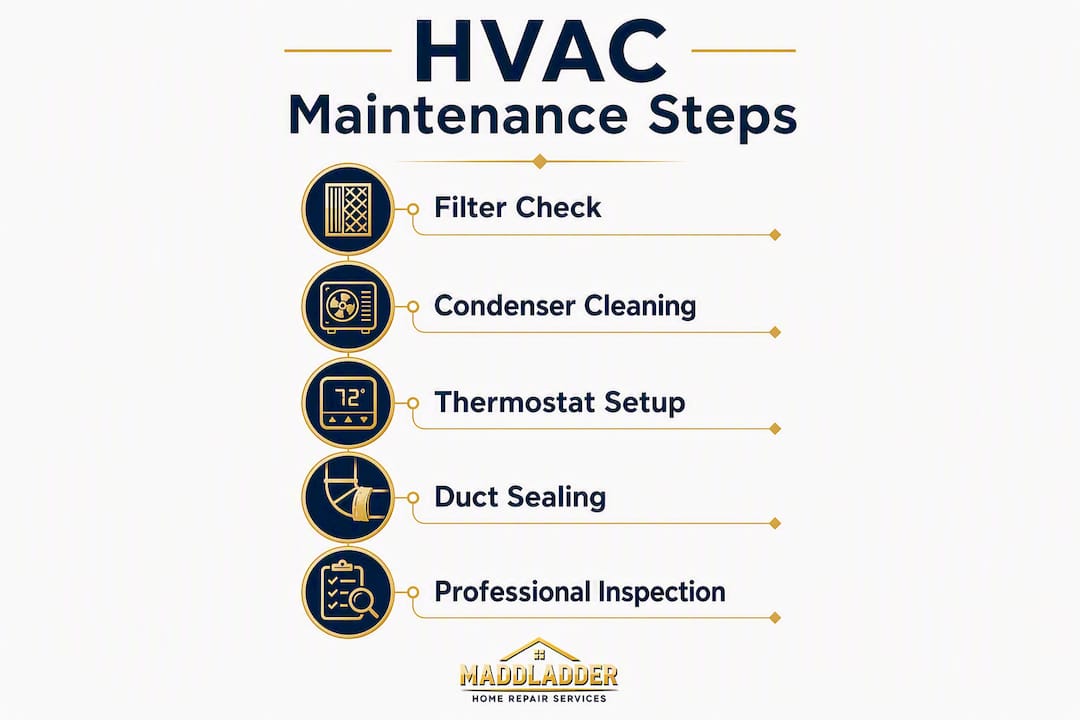
For a full seasonal checklist tailored to Kansas City homes, Maddladder's KC maintenance guide walks through every task by season.
2. Thermostat strategy: schedules, smart controls, and humidity
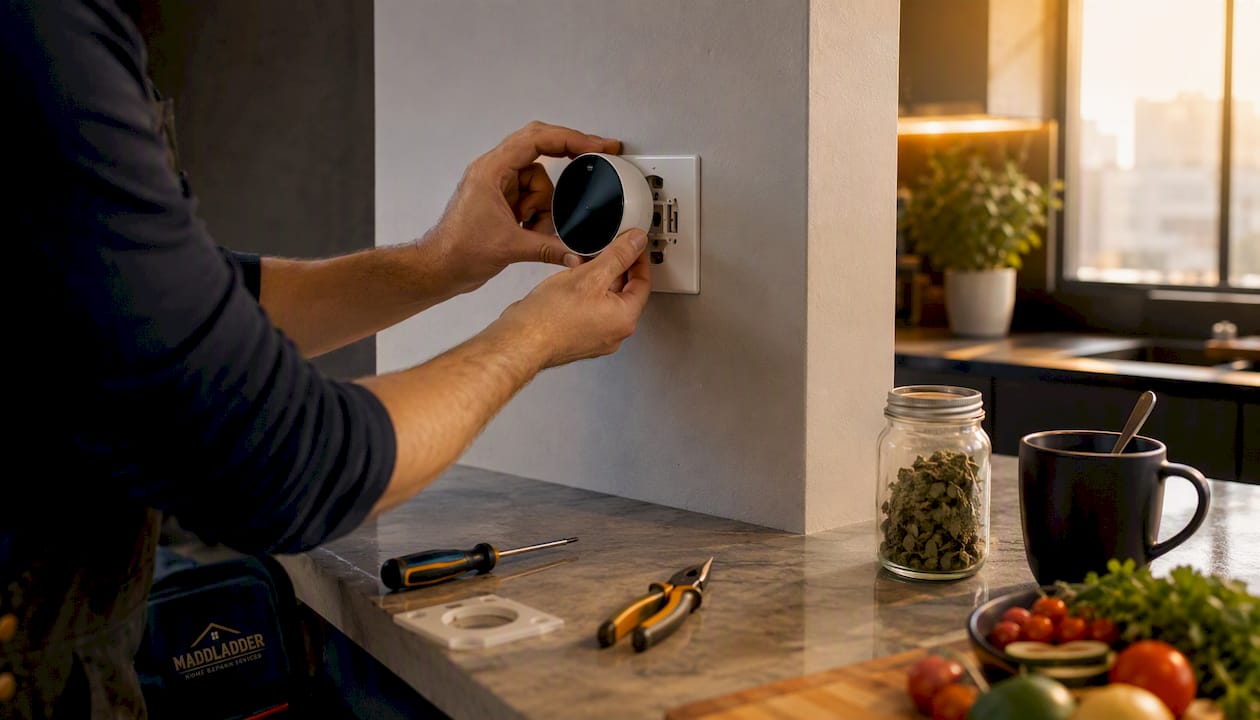
A programmable thermostat is one of the fastest ways to reduce energy consumption without touching the equipment itself. ENERGY STAR-certified smart thermostats go further by learning your schedule and adjusting automatically.
Suggested weekday schedule for cooling season:
- 6:00 AM (wake): 74°F
- 8:00 AM (away): 80°F
- 6:00 PM (home): 76°F
- 10:00 PM (sleep): 78°F
For heating season, reverse the logic: lower setpoints when away or asleep, raise them when home. The DOE Energy Saver guide recommends 7°–10°F setbacks for 8 hours as a reliable way to reduce energy use without sacrificing comfort.
Smart thermostat considerations:
- ENERGY STAR-certified models meet strict efficiency criteria and often qualify for utility rebates.
- Wi-Fi thermostats let you adjust settings remotely, which matters when plans change.
- Zoning systems pair multiple thermostats with dampers to condition only occupied areas.
Pro Tip: Heat pumps behave differently from gas furnaces. A large manual setback on a heat pump triggers the auxiliary electric heat strip during recovery, which can cost more than the setback saved. Use a heat-pump-compatible smart thermostat and configure it to use gradual recovery instead of a sharp temperature jump.
Maddladder installs smart thermostats and home automation upgrades throughout the Kansas City metro, including setup and schedule programming.
3. Duct sealing and building-envelope fixes that stop wasted conditioned air
Leaky ducts are one of the most underestimated efficiency problems in American homes. ENERGY STAR estimates that sealing and insulating ducts in unconditioned spaces can improve system efficiency by up to 20% or more. That's a bigger gain than most equipment upgrades deliver on their own.

Ducts running through attics, crawlspaces, and garages are the worst offenders because temperature differences there are extreme. A duct joint that's merely loose in a conditioned basement becomes a serious energy drain when it's sitting in a 130°F attic.
Quick checks you can run yourself:
- Feel for air movement near duct joints while the system runs.
- Look for visible gaps, disconnected flex duct sections, or duct tape (actual duct tape, not foil tape) that has dried and peeled.
- Check return-air grilles for excessive dust, which signals air is being pulled from unconditioned spaces.
- Walk the house during a heating or cooling cycle and note rooms that never reach setpoint — often a sign of a disconnected or undersized duct run.
Sealing methods: mastic sealant is the professional standard for joints and seams; UL 181-rated foil tape works for accessible straight seams. Neither is a substitute for a full duct pressure test, but both are legitimate DIY fixes for visible gaps.
Pro Tip: Hold a lit incense stick near register edges and return-air grilles while the system runs. Smoke that pulls sideways or flickers erratically points to leakage. This takes five minutes and costs nothing.
Sealing and insulating ducts in unconditioned spaces can improve heating and cooling system efficiency by up to 20% or more. — ENERGY STAR
Pairing duct sealing with home weatherization gives you the biggest combined return on any single efficiency project.
4. When to repair versus replace: SEER, EER, HSPF, and ENERGY STAR explained
Efficiency ratings tell you how much cooling or heating output you get per unit of electricity consumed. Here's what each one means in plain terms:
- SEER (Seasonal Energy Efficiency Ratio): — Measures cooling efficiency over a full season. Higher is better. The federal minimum for new central AC units is 14 SEER in most of the U.S.; ENERGY STAR-certified units start at 15 SEER or higher.
- EER (Energy Efficiency Ratio): — Measures cooling efficiency at a single peak condition (95°F outdoor). Useful for comparing window units and portable ACs.
Proper sizing matters as much as the rating. An oversized air conditioner cools a space quickly but shuts off before it can dehumidify, leaving the air clammy and causing the compressor to cycle on and off repeatedly. That short-cycling accelerates wear. A Manual J load calculation, performed by a licensed contractor, determines the correct capacity for your specific home. Improper installation alone can reduce a high-efficiency system's intended savings by up to 30%, which means a correctly installed 16 SEER unit outperforms a poorly installed 20 SEER unit.
Upgrade triggers worth taking seriously:
Pro Tip: Before signing any replacement contract, ask the contractor to show you the Manual J calculation. If they can't produce one, find someone who can. Guessing at tonnage is how homeowners end up with oversized equipment that underperforms for years.
For more on sizing decisions, this homeowner's guide to sizing air conditioners covers the comfort tradeoffs in detail.
5. Airflow, shading, and occupant habits that reduce your unit's workload
The unit doesn't have to work as hard if the house itself is doing some of the work. These are the occupant-side habits that make a measurable difference.
Summer strategies:
- Close south- and west-facing blinds during peak sun hours (roughly 10 AM–4 PM).
- Run ceiling fans counterclockwise to create a wind-chill effect; this allows you to raise the thermostat setpoint by 4°F without a noticeable comfort change.
- Avoid running the oven, dishwasher, or dryer during the hottest part of the day.
- Keep interior doors open to allow return-air pathways to function correctly.
Winter strategies:
- Reverse ceiling fans clockwise on low speed to push warm air down from the ceiling.
- Seal visible drafts around doors and windows with weatherstripping or rope caulk.
- Use a humidifier to maintain 30–50% relative humidity; properly humidified air feels warmer at lower thermostat settings.
Pro Tip: Ceiling fans don't cool rooms — they cool people. Turn them off when you leave a room. Leaving fans running in empty rooms adds to your electricity bill without any efficiency benefit.
6. Safe DIY tasks you can do today to boost unit efficiency
These steps require no special license, no refrigerant handling, and no electrical panel work. Do them in order.
- Reset or reprogram thermostat schedules — Verify the schedule matches your current routine; a schedule set for a previous occupant's hours wastes energy every day.
Safety hard stops: Never attempt refrigerant recharge, compressor work, or any repair involving the sealed refrigerant circuit. These require EPA Section 608 certification. If you see ice on the refrigerant lines, hear a hissing sound, or notice an oily residue near fittings, stop and call a licensed technician.
7. Signs that need a pro, typical repair costs, and how to vet a technician
Some problems look like efficiency issues but are actually safety or mechanical failures. These signs mean call a pro, not a YouTube tutorial:
- Unit short-cycles (runs less than 5–7 minutes per cycle).
- Ice forms on the indoor coil or refrigerant lines.
- Airflow from registers drops noticeably without a filter change.
- You hear grinding, squealing, or banging from the air handler or condenser.
- The circuit breaker trips repeatedly when the unit runs.
- You smell burning or notice a refrigerant odor (sweet, chemical smell).
- Diagnostic error codes appear on the thermostat or air handler display.
| Repair | Typical Cost Range | Typical Timeline |
|---|---|---|
| Filter replacement (pro visit) | — | Same day |
| Condensate drain clearing | — | Same day |
| Capacitor replacement | — | Same day |
| Fan motor replacement | — | 1–2 days |
| Duct sealing (accessible areas) | — | Half to full day |
| Refrigerant recharge | — | Same day |
| Compressor replacement | — | 1–3 days |
| Full system replacement | — | 1–2 days |
Cost ranges are general estimates for the U.S. market and vary by region, system size, and contractor.
Vetting checklist before hiring:
- Confirm state HVAC license and general liability insurance.
- For replacements, ask for a written Manual J load calculation.
- Request a written estimate before work begins.
- Ask for the SEER rating and ENERGY STAR status of any recommended replacement unit.
- Check Google or Angi reviews for recent work in your area.
Pro Tip: A reputable technician will show you the refrigerant gauge readings and explain what they mean. If a tech recommends a refrigerant "top-up" without identifying the leak source, that's a red flag — refrigerant doesn't deplete on its own.
Scheduling seasonal maintenance before peak season avoids the rush and often gets you better pricing.
8. How Maddladder helps improve your unit's efficiency in Kansas City
Maddladder handles the efficiency tasks that fall between a full HVAC contractor visit and pure DIY. For Kansas City homeowners, that covers a practical range of work: filter and vent service, condenser clearing, smart thermostat installation and programming, minor duct sealing on accessible runs, condensate drain maintenance, and small electrical fixes tied to HVAC performance (outlet replacements, disconnect box checks, detector installs).
A typical Maddladder efficiency visit looks like this:
- Arrival and safety check: power confirmed off at disconnect before any hands-on work.
- Airflow audit: every supply and return register checked for blockage or damage.
- Filter replacement with MERV-rated filter matched to the system.
- Condensate drain flush and pan inspection.
- Outdoor condenser clearance and gentle fin cleaning.
- Thermostat inspection and schedule programming or smart thermostat installation.
- Written report with prioritized fixes, cost estimates for any items beyond the visit scope, and referrals for licensed HVAC contractors when refrigerant or compressor work is needed.
Maddladder's repair and replacement services cover the handyman-scope work; for full HVAC system replacements, the team provides referrals to licensed contractors and can coordinate the surrounding work (drywall, electrical, thermostat wiring).
Pro Tip: Book a Maddladder maintenance visit before the first hot week of summer, not during it. Availability tightens fast once temperatures hit 90°F in Kansas City, and a pre-season visit catches problems while parts and scheduling are easy.
9. Better insulation and window sealing reduce what your unit has to fight
No HVAC unit runs efficiently when the house leaks conditioned air as fast as the system produces it. Attic insulation is the highest-return envelope improvement for most American homes because heat rises and attic floors are often the least-insulated surface in the building.
The DOE Energy Saver guide recommends a professional energy audit as the starting point for insulation decisions, since it uses blower-door tests and thermal imaging to show exactly where air is escaping. Without that data, homeowners often add insulation in the wrong places.
High-return envelope improvements:
- Attic air sealing before insulation: Seal around light fixtures, plumbing penetrations, and the attic hatch before adding insulation batts or blown-in material. Air sealing without insulation helps; insulation without air sealing helps less than expected.
- Door weatherstripping: Worn weatherstripping on exterior doors is a 15-minute fix that pays back immediately.
- Window film or cellular shades: Low-E window film reduces solar heat gain in summer without blocking light. Cellular (honeycomb) shades add an insulating air pocket on cold nights.
- Rim joist sealing: The rim joist (where the floor framing meets the foundation wall) is one of the most common air-leakage points in older homes and is accessible from the basement or crawlspace.
A full weatherization project pairs well with duct sealing and often qualifies for the same utility rebates.
10. Which efficiency improvements give you the biggest savings first
Not all efficiency projects return the same value. Here's a practical priority order based on typical impact and cost:
Tier 1 — Do these first (low cost, high return):
- Replace the air filter and establish a monthly check habit.
- Program or upgrade to a smart thermostat with a proper schedule.
- Clear condenser and all supply/return registers.
- Seal visible duct leaks in attics and crawlspaces with mastic or foil tape.
Tier 2 — Do these next (moderate cost, strong return):
- Schedule an annual professional tune-up.
- Add attic air sealing and insulation if the attic floor is under-insulated.
- Install weatherstripping on exterior doors and seal window gaps with caulk.
- Commission a professional energy audit to identify hidden leaks.
Tier 3 — Consider when Tier 1 and 2 are done (higher cost, longer payback):
- Upgrade to a higher-SEER system when the current unit is at end of life.
- Add zoning or a variable-speed air handler for multi-story homes.
- Replace single-pane windows with double-pane low-E glass.
The logic here is straightforward: a new high-efficiency unit installed in a leaky, poorly insulated house with a clogged filter will never perform at its rated SEER. Fix the house first, then the equipment.
11. DIY vs. professional tasks: a clear breakdown
| Task | DIY | Pro Required |
|---|---|---|
| Filter replacement | Yes | No |
| Thermostat programming | Yes | No |
| Register/vent cleaning | Yes | No |
| Condenser clearance and rinse | Yes | No |
| Condensate drain flush | Yes | No |
| Weatherstripping replacement | Yes | No |
| Accessible duct sealing (mastic/foil tape) | Yes | No |
| Attic insulation (blown-in) | Possible with rental equipment | Recommended |
| Coil cleaning (indoor evaporator) | No | Yes |
| Refrigerant check or recharge | No | Yes (EPA 608 cert.) |
| Electrical panel or disconnect work | No | Yes (licensed electrician) |
| Full system replacement | No | Yes (licensed HVAC) |
| Manual J load calculation | No | Yes |
| Duct pressure testing | No | Yes |
The dividing line is the sealed refrigerant circuit and anything involving the electrical panel. Everything on the DIY side of that line is genuinely safe for a careful homeowner with basic tools.
12. Local rebates and incentives for energy-efficient upgrades
Federal, state, and utility rebates can significantly offset the cost of efficiency upgrades. Here's where to look:
Federal incentives (Inflation Reduction Act): The federal Energy Efficient Home Improvement Credit covers 30% of the cost of qualifying improvements, including ENERGY STAR-certified heat pumps, central air conditioners, and insulation materials, up to annual caps. Consult a tax professional for current eligibility rules, as these provisions can change.
Missouri and Kansas utility rebates: Kansas City-area homeowners are served by Evergy (electric) and Spire (gas). Both utilities offer rebates on qualifying HVAC equipment and smart thermostats. Rebate amounts and qualifying models change annually, so check directly with your utility provider before purchasing equipment.
ENERGY STAR Rebate Finder: The ENERGY STAR website hosts a rebate finder tool that searches by ZIP code and product category. It's the fastest way to confirm what's available in your specific area before you buy.
Pro Tip: Always apply for rebates before installation when the program requires pre-approval. Some utility programs require a pre-inspection or pre-approval form, and missing that step disqualifies the rebate even if the equipment qualifies.
13. How to track energy consumption before and after improvements
You can't confirm savings without a baseline. These tools and methods make tracking straightforward:
- Smart plugs with energy monitoring: — For window units or portable ACs, a smart plug (such as those from Kasa or Emporia) shows real-time wattage and cumulative kWh, making it easy to calculate operating cost.
Track at minimum: monthly kWh, average monthly temperature (from your local weather service), and any changes made with their dates. That three-column log is enough to show real savings.
Key Takeaways
Improving HVAC unit efficiency starts with filter replacement, thermostat scheduling, and duct sealing — three steps that cost little but consistently deliver the highest returns before any equipment upgrade.
| Point | Details |
|---|---|
| Filter first, always | Replace or check the filter monthly; it's the single highest-impact DIY maintenance task. |
| Duct sealing pays big | Sealing ducts in unconditioned spaces can improve system efficiency by up to 20% or more. |
| Smart thermostat scheduling | A programmed setback of 7°–10°F for 8 hours reduces energy use without comfort loss. |
| Size and install correctly | Poor installation can cut a high-efficiency system's savings by up to 30%; always request a Manual J calculation. |
| Maddladder for Kansas City | Maddladder handles filter service, smart thermostat installs, condenser clearing, and maintenance visits across the KC metro. |
The efficiency fixes most homeowners skip — and why they matter most
The pattern that shows up repeatedly in homes that run inefficient HVAC systems isn't a broken compressor or an outdated unit. It's a filter that hasn't been changed in eight months, a thermostat still set to the schedule from three years ago, and duct joints in the attic that have been leaking since the house was built.
Those three problems are fixable in an afternoon. They don't require a permit, a licensed contractor, or a significant budget. Yet most homeowners skip them because they're invisible. The unit still runs, the house still cools, and the higher utility bill gets attributed to "just how it is in summer."
The equipment upgrade conversation is worth having, but only after the basics are locked in. A 20 SEER unit installed in a house with 30% duct leakage and no thermostat schedule will underperform a 14 SEER unit in a tight, well-maintained house. The ratings on the equipment are ceiling numbers, not guarantees.
Kansas City's climate adds a specific wrinkle: the swing between humid summers and cold winters means both cooling efficiency and heating efficiency matter, and heat pump owners need to be especially careful about thermostat settings during shoulder-season temperature swings. A heat-pump-aware thermostat isn't a luxury here; it's the difference between efficient operation and expensive auxiliary heat cycles running all night.
Start with the filter. Set the schedule. Seal what you can reach. Then call a pro for the rest.
Maddladder makes efficiency upgrades easy for Kansas City homeowners
Spending a weekend on efficiency fixes is worthwhile. Spending it on the wrong fixes, or attempting work that needs a licensed hand, costs more than it saves.
Maddladder serves Kansas City metro homeowners with the hands-on efficiency work that sits between pure DIY and a full HVAC contractor call: smart thermostat installation and programming, filter and vent service, condenser clearing, condensate drain maintenance, minor duct sealing on accessible runs, and small electrical repairs tied to HVAC performance. Subscription maintenance plans mean you never have to remember to schedule a seasonal visit.

Every visit includes a written report with prioritized next steps and honest referrals when the work is outside handyman scope. No upselling, no vague estimates. See the full list of services or request a free estimate directly through the Maddladder website. The Kansas City metro, including Overland Park, Lee's Summit, Independence, and surrounding communities, is the full service area.
Authoritative sources and further reading
These are the primary sources worth bookmarking for deeper guidance and rebate searches:
- Heat & Cool Efficiently | ENERGY STAR — Covers filter guidance, duct sealing, thermostat recommendations, and ENERGY STAR certification criteria for HVAC equipment. The rebate finder tool is also accessible from this section.
- Energy Saver Guide | U.S. Department of Energy — The DOE's comprehensive home energy guide covering insulation, duct sealing, thermostat setpoints, and the case for a professional energy audit.
- Home Energy Checklist | Department of Energy — A practical daily, weekly, monthly, and annual checklist for homeowners; useful as a recurring reference after completing the initial efficiency improvements.
- Low- to No-Cost Tips | ENERGY STAR — Focused on no-cost and low-cost behavioral and maintenance changes; good starting point for renters or anyone on a tight budget.
- Energy-saving home upgrades | Maddladder blog — Practical upgrade projects for Kansas City homeowners, including cost-effective priorities and local context.
For rebates specifically, go directly to your utility provider's website (Evergy or Spire for most KC-area homes) and use the ENERGY STAR Rebate Finder with your ZIP code before purchasing any qualifying equipment.