

TL;DR:
- Address mold reports promptly using a three-vendor process: independent assessor, licensed remediator, then repair contractor. Proper documentation and vendor separation protect landlords legally and financially during remediation. Maddladder handles rebuilds after clearance in the Kansas City area, ensuring swift unit turnover.
When a tenant reports mold, the correct path is almost never DIY. Engage an independent assessor first, then a licensed remediator, then a repair contractor for the rebuild. That three-role sequence is what separates a defensible response from a liability.
Start here, in the first hours after a report:
- Acknowledge the report in writing, with a timestamp.
- Stop the moisture source if you can identify it (shut off supply, call a plumber).
- Photograph everything: the affected area, any visible water damage, and the surrounding surfaces.
- Advise the tenant to avoid the area and, if symptoms are present, to consult a physician.
- Do not attempt to clean or disturb the growth before an assessment.
- Contact an independent industrial hygienist or certified mold assessor to schedule an inspection.
Pro Tip: The single most protective action in the first 24 hours is a time-stamped written acknowledgment sent to the tenant by email or text. Courts and insurers look for that timestamp first. Send it before you pick up a phone to call a contractor.
Table of Contents
- What should you do in the first 48 hours after a mold report?
- What does the full remediation and repair process look like?
- Handyman, licensed remediator, or specialist: who do you actually need?
- What do mold remediation and repairs typically cost?
- How should you document the response to limit liability?
- What maintenance steps actually prevent mold from coming back?
- How do you hire a qualified remediation and repair team?
- Key Takeaways
- Why the vendor-separation rule matters more than most landlords realize
- Maddladder handles the repair and make-ready phase after remediation
- Useful sources for landlords managing mold in rentals
What should you do in the first 48 hours after a mold report?
A timed response limits spread, protects occupants, and builds the evidence file you will need if a dispute arises. Properties with formal clearance reports show higher tenant retention, and the recommended timeline starts counting from the moment you receive the report.
- Within hours: Send written acknowledgment. Do not minimize the complaint.
- Within 24 hours: Conduct a visual inspection. Note the approximate square footage, any visible moisture, and whether the growth is surface-level or hidden behind walls or ceilings.
- Within 72 hours: Decide the remediation path. Growth over roughly 10 square feet, any HVAC involvement, or tenant symptoms all require a licensed remediator, not a handyman.
- Immediately, if any of these apply: Suspected HVAC contamination, visible growth in more than one room, occupant reporting respiratory symptoms, or any hidden growth behind drywall. Call an assessor the same day.
- Relocation: If the affected area covers a primary living space or the tenant has documented health symptoms, advise temporary relocation and document that conversation.
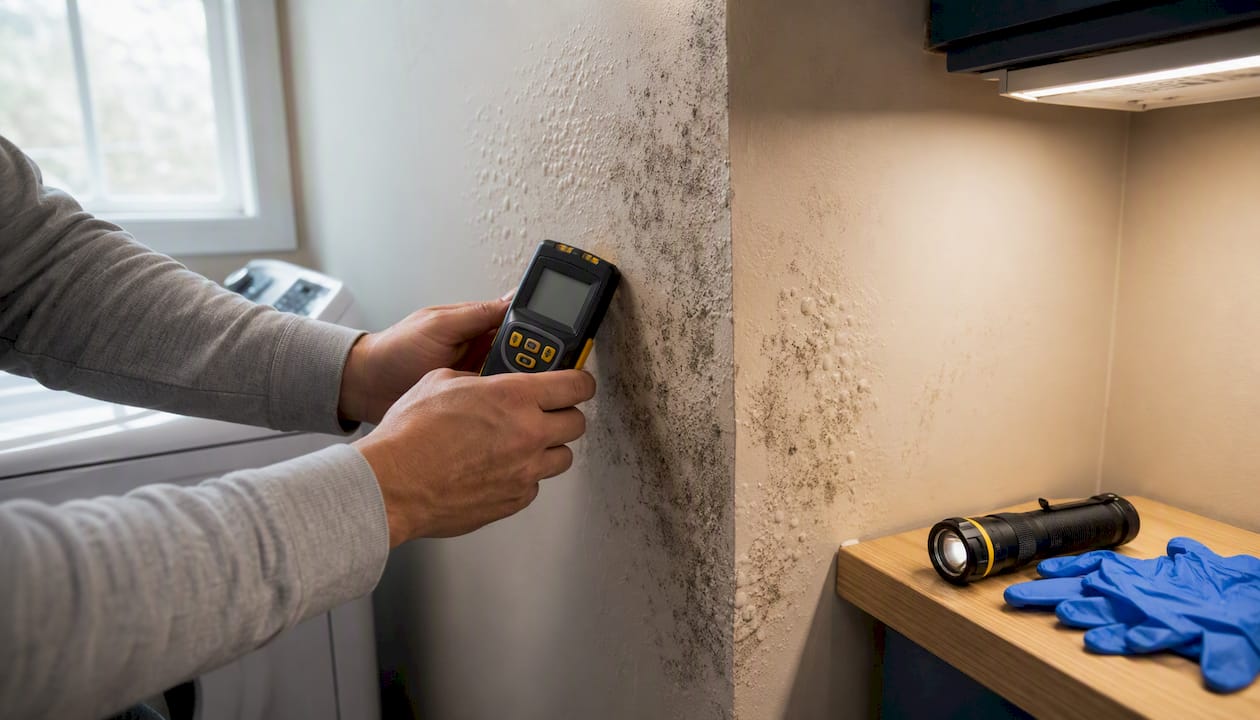
Pro Tip: Take moisture readings with a pin-type or pinless moisture meter before the assessor arrives. Those baseline numbers, logged with the date and time, give the assessor a starting point and give you a record that predates any remediation work.
What does the full remediation and repair process look like?
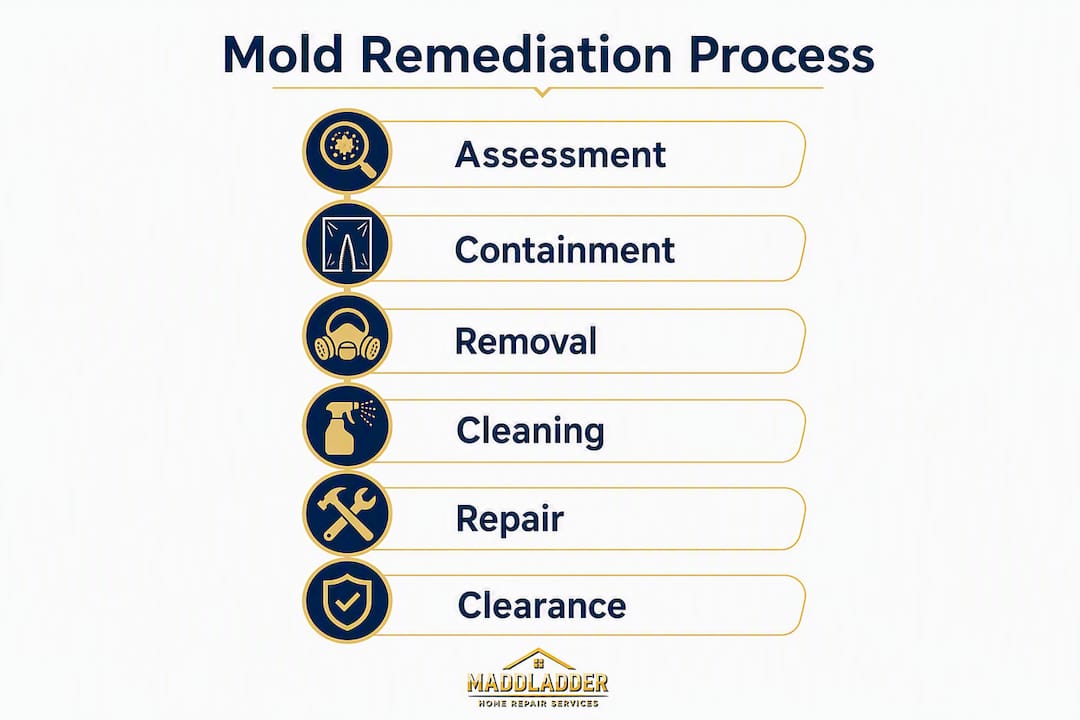
The sequence matters as much as the work itself. ANSI/IICRC S520 is the professional standard that frames this workflow: identify the moisture source, contain, remove unsalvageable porous materials, HEPA-clean remaining surfaces, dry the assembly, and verify.
Three vendors, in order:
- Independent assessor / industrial hygienist — scopes the problem, identifies the moisture source, and produces a written protocol. This person should have no financial interest in the remediation work.
- Licensed remediator — executes the protocol: containment, negative air pressure, removal, HEPA cleaning, drying.
- Repair/restore contractor — rebuilds after clearance. Remediation and restoration are distinct phases; the sequence matters because no rebuild should begin until the clearance report is in hand.
Maddladder enters at phase three, handling drywall repair, trim replacement, fixture work, and make-ready turnover once remediation is verified complete.
Clearance is not a pass/fail test. Effective remediation returns a building to a normal fungal ecology, not a sterile environment. Visual inspection plus moisture verification is standard; air or surface sampling is appropriate when the assessor's protocol calls for it or when occupant symptoms were reported.
| Remediation Activity | Typical Deliverable |
|---|---|
| Assessment and moisture mapping | Written protocol, moisture log, affected-area map |
| Containment setup | Poly barriers, negative air machine, access control |
| Material removal | Itemized list of removed materials, disposal receipts |
| HEPA cleaning and drying | Drying logs, equipment records |
| Clearance verification | Independent clearance letter, post-remediation report |
Pro Tip: Require the remediator to deliver a written scope before any work begins. A legitimate scope names the affected square footage, containment method, negative air machine count, materials to be removed, and the clearance criteria. A single-line price with no detail is a red flag.
Handyman, licensed remediator, or specialist: who do you actually need?
EPA guidance uses roughly 10 square feet as the practical threshold. Below that, on a non-porous surface, with the moisture source already corrected, a handyman can handle surface cleaning. Above it, or when the growth is hidden, involves HVAC, or accompanies tenant symptoms, a licensed remediator is required.
Handyman (Maddladder) is the right call when:
- Remediation is complete and cleared.
- The job is drywall patching, trim replacement, fixture swap, or make-ready turnover.
- Surface cleaning of a small, non-porous area (under 10 sq ft) with a confirmed, corrected moisture source.
Licensed remediator is required when:
- Growth exceeds 10 square feet.
- Growth is hidden behind walls, ceilings, or under flooring.
- HVAC systems are involved.
- Tenant symptoms have been reported.
- Containment and negative air pressure are needed.
The most expensive mistake landlords make is hiring one company to both assess and remediate. That conflict of interest is well-documented: the assessor's findings should drive the remediator's scope, not the other way around. Similarly, hiring a general contractor to perform active remediation, rather than the post-clearance rebuild, skips the containment and HEPA protocols that protect both the property and the tenant.
Pro Tip: Contract remediation and repairs separately. It preserves your ability to hold each vendor accountable to their specific scope and keeps the clearance report independent.
What do mold remediation and repairs typically cost?
Budget anchors by job size, based on industry estimates:
| Job Size | Typical Cost Range | Estimated Timeline |
|---|---|---|
| Limited surface (under 10 sq ft) | $500–$1,500 | 1–2 days |
| Basement contamination (100–300 sq ft) | $2,000–$6,000 | 3 days |
| Whole-house/HVAC-involved | $10,000+ | 2–4 weeks |
Repair and rebuild costs (drywall, trim, fixtures, paint) are separate from remediation and vary by scope. Standard insurance policies often include a fungus exclusion or cap mold coverage at $5,000–$10,000 unless a mold endorsement was purchased. Check your policy before assuming coverage.
Pricing drivers to question in any bid:
- Vague scope with no square footage or material list.
- No clearance deliverable specified.
- Assessment and remediation bundled under one price from one company.
- No itemized breakdown of containment, equipment, labor, and disposal.
- Pressure to sign before an independent assessor has reviewed the site.
How should you document the response to limit liability?
A documented, time-stamped response file is the primary defense against litigation. Insurers and courts both look for evidence that you responded promptly, engaged qualified vendors, and verified the work was complete.
Documents to create and retain:
- Time-stamped written acknowledgment of the tenant's report.
- Dated photos of the affected area before any work begins.
- Moisture meter readings with dates and locations.
- Vendor scopes of work and signed contracts.
- All receipts and disposal records.
- Independent clearance letter from the post-remediation assessor.
- Before-and-after photos with tenant sign-off on completion.
Store the full response file digitally, in a folder organized by property address and date. Share the clearance letter with the tenant in writing. For post-remediation verification specifics, the clearance report should come from the independent assessor, not the remediator who did the work.
What maintenance steps actually prevent mold from coming back?
Stopping the moisture source is the primary objective. Mold is a symptom of a water problem. Fix the water, and recurrence drops sharply.
Inspect and address these sources at every turnover:
- Plumbing supply and drain lines under sinks, behind toilets, and at appliance connections.
- Roof flashing, gutters, and downspout discharge locations.
- HVAC condensate drain pans and drain lines.
- Grout, caulk, and tile seals in bathrooms and kitchens.
- Exhaust fan function in bathrooms (test airflow, not just operation).
- Crawl space and basement vapor barriers.
Add to your make-ready checklist: minor plumbing repairs at every turnover, HVAC filter replacement, and a visual moisture check of all wet areas. A tenant reporting protocol, in writing in the lease, reduces the gap between a leak and your awareness of it.
Pro Tip: Installing a smart humidity sensor in bathrooms and laundry areas costs under $50 per unit and gives you a real-time alert before a moisture problem becomes a mold problem. That's a fraction of the cost of a single remediation call.
How do you hire a qualified remediation and repair team?
Pre-bid checks:
- Verify the remediator holds an IICRC AMRT (Applied Microbial Remediation Technician) or WRT (Water Damage Restoration Technician) credential.
- Confirm the assessor is independent of the remediator.
- Require a certificate of insurance with a mold endorsement, not just general liability.
Bid checklist:
- Written scope specifying affected square footage, containment plan, negative air machine count, materials to be removed, and clearance criteria.
- Itemized pricing (containment, equipment, labor, disposal, clearance).
- Named independent verifier for the post-remediation clearance.
Sample questions to ask a remediator:
- Who performs your post-remediation clearance, and are they independent of your company?
- What containment method will you use, and how many air changes per hour will the negative air machine provide?
- What is your protocol if additional hidden growth is found during work?
Red flags: vague scope, pressure to sign before an assessor visits, bundled assessment and remediation from one company, no COI with mold coverage, and no clearance deliverable in the contract.
Hiring flow:
- Receive report → acknowledge in writing.
- Engage independent assessor → receive written protocol.
- Solicit bids from licensed remediators using the protocol.
- Award remediation contract → require scope and COI.
- Remediation complete → independent clearance inspection.
- Clearance letter received → engage repair contractor (Maddladder) for rebuild and make-ready.
Key Takeaways
Effective mold response in a rental requires three separate vendors in sequence: independent assessor, licensed remediator, and repair contractor, with documentation at every step.
| Point | Details |
|---|---|
| Respond within hours | Send a time-stamped written acknowledgment before contacting any contractor. |
| Separate your vendors | Never let one company assess and remediate; the conflict of interest undermines your defense. |
| Require independent clearance | A clearance letter from a third-party assessor is your primary legal and insurance protection. |
| Fix the moisture source first | Remediation without correcting the water problem will result in recurrence. |
| Maddladder for the repair phase | Once clearance is confirmed, Maddladder handles drywall, trim, fixtures, and make-ready turnover in the Kansas City metro area. |
Why the vendor-separation rule matters more than most landlords realize
Most mold articles focus on the remediation steps. The part that actually determines whether a landlord walks away clean, legally and financially, is the documentation and vendor structure around those steps.
The conventional wisdom is to find a "full-service" mold company that handles everything from assessment through rebuild. That sounds efficient. In practice, this removes the independent check that protects you. When the same company assesses the damage, performs the remediation, and signs off on clearance, there is no one in the chain with an incentive to tell you the job fell short.
Landlords who separate these roles, and who hold an independent clearance letter, have a document that stands on its own in court and in front of an adjuster. Those who don't are left arguing that the work was done correctly, with no third-party verification to back them up.
The repair phase is where efficiency actually makes sense. Once clearance is confirmed, consolidating drywall, trim, fixture, and make-ready work under one licensed handyman service reduces scheduling friction and gets the unit back on the market faster. That's a coordination win, not a conflict of interest.
Maddladder handles the repair and make-ready phase after remediation
Once your licensed remediator hands over the clearance report, the rebuild begins. That's where Maddladder comes in. Serving the Kansas City metro area, Maddladder provides drywall repair, trim and fixture replacement, minor plumbing fixes, and full make-ready turnover services for landlords and property managers who need a unit back on the market fast.

Pricing starts at $75/hour for one-time jobs, with subscription-based Property Manager plans available for landlords managing multiple units. Free estimates, quick response times, and licensed service mean you get the repair phase handled without adding another vendor search to your plate. Request a free estimate at maddladder.com and get your unit back to rent-ready.
Useful sources for landlords managing mold in rentals
- ANSI/IICRC S520 Standard for Professional Mold Remediation — the technical framework remediators should follow; use this to evaluate scopes of work.
- EPA Mold Guidance for Renters and Landlords — practical threshold guidance (the 10 sq ft rule) and general remediation principles.
- DiscoveryMark Landlord Documentation Playbook — covers the response timeline, documentation framework, and insurance exposure in detail.
- Mold Remediation vs. Mold Removal: Key Differences — explains what remediation actually achieves versus removal, useful for setting tenant expectations.
- Post-Remediation Verification Guide — covers clearance testing methods and when air sampling is warranted.
When to call an industrial hygienist versus relying on visual verification: if occupant symptoms were reported, if growth was hidden or HVAC-involved, or if the remediation scope exceeded one room, an industrial hygienist should conduct the post-remediation clearance. Visual-only verification is appropriate only for small, surface-level, confirmed-source jobs.
This article provides general information for landlords and property managers. Mold regulations, disclosure requirements, and landlord obligations vary by state and municipality. Confirm current requirements with your state's housing authority or a qualified attorney before making legal or remediation decisions.