

Most handymen charge between $50 and $150 per hour, with a national average landing around $60 to $85 per hour, according to industry pricing data. Many charge a flat rate for common jobs instead, and most set a minimum service fee to cover the trip. Before you agree to anything, get two or three written estimates and ask upfront whether materials are included in the price.
TL;DR:
- Handymen in high-cost metros like San Francisco or Boston charge between $90 and $150+ per hour, while rural areas can be as low as $40 to $65 per hour.
- Flat-rate pricing is ideal for known, repeatable jobs, whereas hourly rates work better for unpredictable repairs, with a typical minimum fee of $100 to $200.
- Most small jobs under two hours cost less than $200, while larger repairs such as deck or drywall work can exceed $1,500, depending on complexity and scope.
- Be aware that the invoice hourly rate often doesn't reflect the actual take-home pay after travel, admin, and other unbilled costs, which explains the widespread variation.
- Always get written estimates detailing scope, materials, and total costs, and bundle small repairs to lower overall expenses.
Table of Contents
- How Much Does a Handyman Cost on Average Across the US?
- Hourly, Flat-Rate, or Day-Rate: Which Pricing Model Wins?
- What Do Common Handyman Jobs Actually Cost?
- Why Do Some Handyman Quotes Cost More Than Others?
- How Do You Get an Accurate Handyman Quote?
- How Can You Lower Your Handyman Bill?
- MaddLadder: A Local Kansas City Option Built Around Clear Pricing
- What Homeowners Get Wrong About Handyman Pricing
- Sources
- FAQ
How Much Does a Handyman Cost on Average Across the US?
The national numbers are useful, but they hide a lot. Handyman hourly rates typically fall between $50 and $150, and most homeowners land somewhere in that $60 to $85 per hour range for general repair work. Thumbtack's 2026 rate data puts the typical range closer to $60 to $75 per hour, with budget operators around $45 to $50 and specialists pushing past $100 to $125.
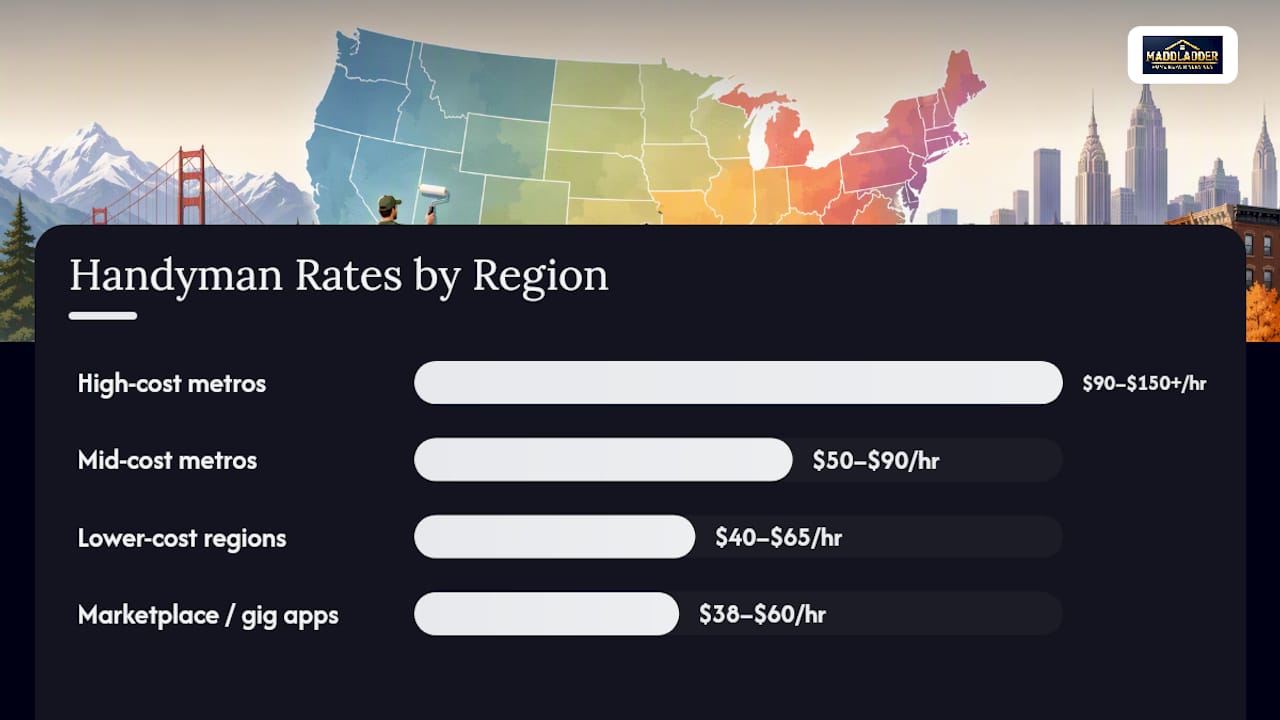
Where you live changes that math substantially. Coastal metros and high cost-of-living cities (think Seattle, Boston, or the San Francisco Bay Area) routinely see rates at the top of the national range or above it, sometimes $90 to $150 per hour. Midwest metros, including Kansas City, tend to run closer to the middle of the pack, often $50 to $90 per hour depending on the job. Rural areas and small towns frequently sit at the low end, but they also come with fewer handymen to choose from, which can offset the savings with longer wait times.
Marketplace platforms complicate the comparison further. TaskRabbit's internal averages run closer to $38 per hour, noticeably below the broader national range. That gap usually reflects less experienced labor, platform fees baked into the total, or both. A lower hourly number on a gig app doesn't automatically mean a lower final bill once you add service fees and the extra time a less experienced tech might need.
There's also a distinction worth understanding before you compare quotes: billed hourly rate versus effective hourly rate. The number on your invoice is what you pay per hour. But a handyman's actual take-home per hour worked is usually lower once you factor in travel time, admin work, and marketing costs that never show up on your bill. This is exactly why minimum service fees exist. A $75 hourly rate with a two-hour minimum isn't really $75. It's $150 for a job that might take 45 minutes, because the pro still had to drive out, load the truck, and write up the invoice.
A few patterns show up consistently across state and metro comparisons:
- High-cost metros (Seattle, Boston, New York, San Francisco): $90 to $150+ per hour
- Mid-cost metros (Kansas City, Denver, Columbus, Indianapolis): $50 to $90 per hour
- Lower-cost regions (rural South, parts of the Midwest and Mountain West): $40 to $65 per hour
- Marketplace/gig platforms: often $38 to $60 per hour, but watch for added fees
Handyman rates by region tend to track local labor costs and licensing requirements almost exactly. A state with stricter contractor licensing thresholds for handyman work usually pushes rates up, because pros carry more insurance and compliance overhead. That's worth remembering the next time a quote from your metro looks high compared to a national average you found online. The number you're seeing might be accurate for a different labor market entirely.
Hourly, Flat-Rate, or Day-Rate: Which Pricing Model Wins?
The right pricing structure depends entirely on what you're having done, and asking for the wrong one can quietly inflate your bill.
Hourly pricing makes the most sense for unpredictable, small-scope repairs where nobody knows exactly how long the job will take until someone opens the wall or looks under the sink. A stuck door, a mystery leak, or "can you look at this and fix whatever's wrong" work all fit better under an hourly model, because a flat rate here forces the handyman to price in worst-case scenarios, which usually costs you more.
Flat-rate pricing wins for repeatable, well-defined installs. TV mounting, ceiling fan swaps, faucet replacements, and similar jobs have a known scope and a known time investment, so a flat rate protects you from a slow afternoon turning into a bigger bill. About 60% of handymen use hourly billing for general work, while project-based flat pricing dominates for these defined, repeatable tasks.
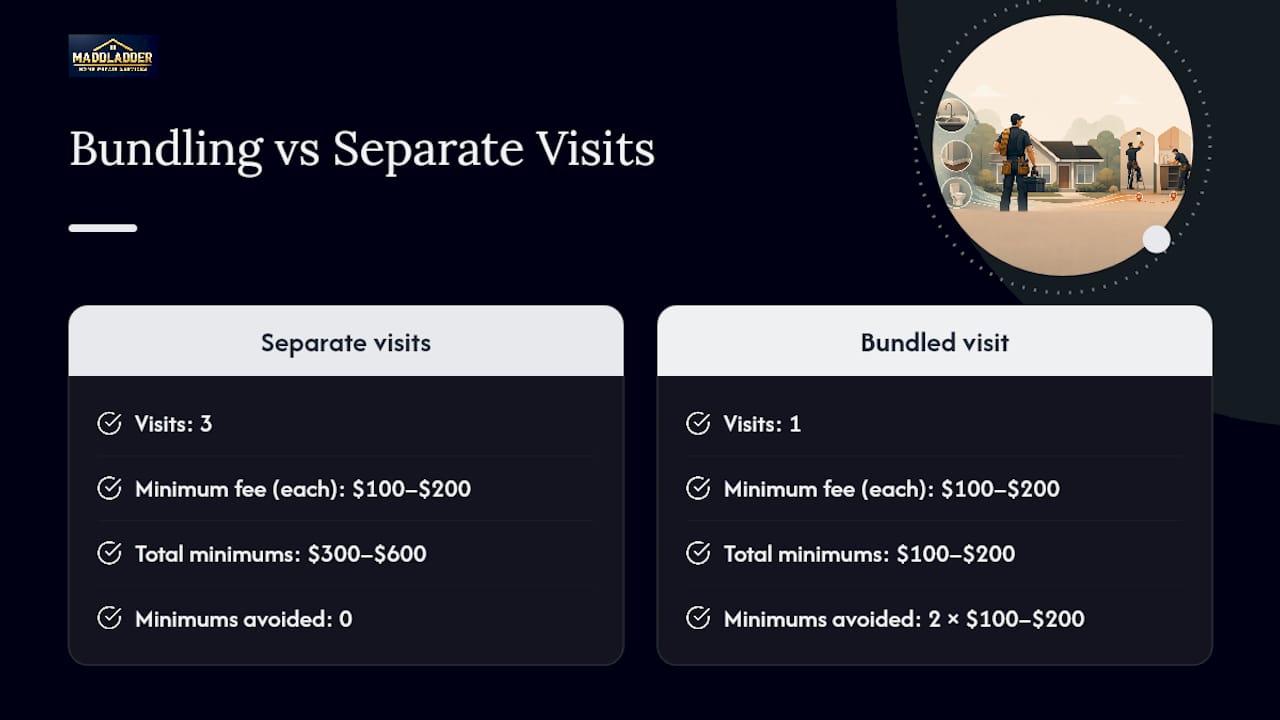
Minimum and call-out fees typically run $100 to $200 and exist to cover the drive, the loading, and the admin time that hourly billing alone doesn't capture. If you only have one 20-minute task, expect to pay close to that minimum regardless of how little time is actually spent on your property. Day rates become worth negotiating once you're stacking several hours of mixed tasks, since a flat day price often beats paying hourly plus multiple minimums across separate visits.
- Hourly: best for diagnostic or unpredictable repairs
- Flat-rate: best for known, repeatable installs
- Minimum/call-out fee ($100 to $200): standard for any single small job
- Day rate: best when bundling several hours of varied work
Pro Tip: Before agreeing to hourly pricing, ask for a "not-to-exceed" ceiling or at minimum an estimated hour range. A handyman who's confident in the scope will usually give you one without pushback, and it protects you from an open-ended bill on a job that runs long.
What Do Common Handyman Jobs Actually Cost?
Real numbers beat vague ranges. Here's what homeowners typically pay for the jobs that come up again and again, based on flat-rate data compiled across major pricing guides.
A few notes on reading this table correctly. The low end usually assumes materials already on-site and easy access. The high end typically reflects added complexity: a fan install that needs new wiring instead of a simple swap, or a drywall patch that turns into a small water-damage repair once the wall is opened up.
Small jobs (TV mounting, a single fixture swap, a faucet repair) generally fall under $200 total and take under two hours. These are the jobs where a flat rate protects you best, and where bundling two or three of them into one visit saves you from paying a second minimum fee.
Medium jobs (furniture assembly for a full room, gutter cleaning on a typical single-family home, multiple small repairs done in one visit) usually run $200 to $500. This is also where hourly billing with a not-to-exceed cap tends to work in your favor, since the scope is bigger but still predictable.
Large jobs (deck repair, multi-room drywall work, anything touching structural elements) can run well past $1,500 and start bumping into territory where a licensed contractor, not a handyman, is the right call. Deck repair specifically varies enormously depending on whether it's cosmetic (replacing a few boards) or structural (replacing joists or footings), which is why the range above spans $300 to $1,500.
A few cost factors apply across nearly every job on this list:
- Materials markup typically runs 20% to 50% when the handyman supplies parts instead of you
- Trip or mileage fees may apply for properties outside a pro's normal service radius
- Disposal fees are common for jobs generating debris, like deck repair or drywall removal
- Permits become a factor once work moves into licensed-contractor territory, particularly for electrical panel work, structural changes, or major plumbing
If a quote for door replacement or repair comes in surprisingly high, it may be because the door itself, not just the labor, is driving the cost, and some door issues are genuinely trickier than they look. One Day Doors & Closets breaks down why door work that looks simple on paper often isn't, which is a useful gut check before assuming a quote is padded.
Why Do Some Handyman Quotes Cost More Than Others?
A handful of concrete variables explain most of the spread between a $75 quote and a $200 quote for what looks like the same job.
Specialization and licensing top the list. Smart home installs, minor electrical work, and accessibility upgrades like grab bars or ramps typically carry a premium because they demand specific technical knowledge, specialized tools, and liability coverage that general repair work doesn't. A handyman who's insured and trained for electrical work isn't overcharging by pricing that skill higher than a basic shelf install.
Materials and permits add cost in less obvious ways. If a job needs a permit, and some electrical or structural work does, that's added time and paperwork the handyman has to account for, even if they're not the one pulling the permit. In many cases, handymen working near a licensing threshold will limit their scope or recommend a licensed contractor rather than take on regulated work themselves.
Access and timing matter more than most homeowners expect. A cramped crawlspace, a second-story exterior repair, or a job that requires moving furniture all add time that shows up on the bill. Off-hours and rush requests, evenings, weekends, or "I need this today" calls, commonly carry a surcharge as well.
Travel and mileage round out the list. Many handymen calculate trip fees using a per-mile rate, and the IRS 2026 business standard mileage rate of 72.5 cents per mile is a common benchmark professionals reference when setting that fee. If you're outside a pro's normal service area, expect that distance to show up as a line item.
- Specialization (electrical, smart home, accessibility): adds a premium for skill and insurance
- Materials and permits: add cost even when the pro isn't pulling the permit themselves
- Access and working conditions: tight spaces or upper floors add time
- Off-hours or rush requests: commonly carry a surcharge
- Travel and mileage: often calculated against IRS-style per-mile benchmarks
How Do You Get an Accurate Handyman Quote?
A vague quote is how homeowners end up with a bill that's double the number they expected. Ask for these six things before any work starts, and get the answers in writing.
- Labor model. Is this hourly, flat-rate, or a day rate, and what's the minimum charge?
- Materials. Are parts included in the quoted price, or billed separately with a markup?
- Permit responsibility. Will the handyman pull any required permits, or is that on you?
- Timeline. How long will the job take, and is there a not-to-exceed cap on hours?
- Warranty. Is there a guarantee on the work, and does it change if you supply your own materials?
- Total cost. What's the full expected number, including trip fees, disposal, and tax?
A simple script works well here: "Can you send me a written estimate that itemizes labor, materials, and any trip or disposal fees, with a not-to-exceed total?" Most professional handymen will give you this without hesitation. Hesitation itself is useful information.
When you're comparing two or three quotes side by side, don't just look at the bottom-line number. Compare:
- Total cost, not just the hourly rate
- Scope of work (does one quote cover more than the other?)
- Timeline and availability
- Warranty terms on labor and materials
Supplying your own materials can lower your total cost, but confirm it won't void any workmanship guarantee first. Some pros only warranty their labor when they've supplied and vetted the parts themselves.
How Can You Lower Your Handyman Bill?
A handful of small decisions consistently keep the final invoice lower without cutting corners on the work itself.
Bundle small tasks into one visit. This is the single biggest lever homeowners have. Since minimum service fees typically run $100 to $200 per visit, combining three small repairs into one appointment instead of scheduling them separately can save you two extra minimum charges outright.
Supply your own materials for non-specialty items. Paint, basic hardware, and standard fixtures are usually fine to buy yourself, saving the typical 20% to 50% markup pros charge on parts. Just confirm the warranty implications first, since some guarantees only apply when the handyman sources the materials.
Ask about scheduling flexibility. Weekday and off-peak appointments sometimes come with lower rates than rush or weekend calls. It doesn't hurt to ask directly.
Consider a maintenance subscription if you're a homeowner or property manager with recurring needs. A flexible pricing arrangement built around ongoing maintenance, rather than one-off calls, often costs less per task over a year than paying full minimums every time something small comes up.
Pro Tip: Keep a running list on your phone of small repairs as they come up (a loose cabinet hinge, a squeaky door, a wobbly towel bar) instead of calling someone the moment each one appears. Batch them into a single visit and you'll likely cut your total annual repair spend noticeably.
MaddLadder: A Local Kansas City Option Built Around Clear Pricing
If you've been reading through these ranges and wondering what a straightforward quote actually looks like, MaddLadder handles general repairs, drywall and trim work, furniture assembly, and installations across the Kansas City metro, with one-time services starting at $75 per hour.

Beyond single-visit repairs, MaddLadder also covers the specialized work that tends to carry a premium elsewhere: minor plumbing and electrical fixes, smart home installs like thermostats and video doorbells, and safety upgrades including grab bars, ramps, and other accessibility modifications. For homeowners and landlords juggling recurring maintenance instead of one-off jobs, tiered subscription plans are built specifically to help avoid the repeated minimum-fee problem covered earlier in this guide. You can browse the full repair and installation services MaddLadder offers, or check current pricing tiers to see which plan fits your situation.
Getting a number is simple: request a free estimate through MaddLadder's website or call directly to talk through your specific job before committing to anything.
What Homeowners Get Wrong About Handyman Pricing
The biggest mistake homeowners make isn't picking the wrong pricing model. It's accepting a verbal quote and assuming it's binding. A number said over the phone has no paper trail, and "about $150" has a way of becoming $280 once materials, a longer-than-expected repair, and a trip fee all get added after the fact. Get it in writing every time, even for small jobs.
The second mistake is treating every job like it belongs to a handyman. Deck repairs involving structural framing, anything touching a main electrical panel, or work that clearly needs a permit isn't a corner-cutting opportunity. It's a signal to ask whether the job needs a licensed contractor instead. A good handyman will tell you this upfront rather than take the work anyway.
And the smallest, most overlooked fix: bundle your repairs. Homeowners who call for one thing at a time are paying minimum fees over and over for work that could have been knocked out in a single visit.
— Jennifer
Sources
The rates and ranges in this guide draw from a mix of industry pricing platforms and government data:
- Handyman Price Guide 2026: Hourly Rates & How To Set Prices
- 2026 Handyman Hourly Rates | Get Free Estimates on Thumbtack
- 2026 Handyman Price List | Avg. Pricing for Handyman Services - HomeAdvisor
FAQ
What Is a Fair Price to Pay a Handyman per Hour?
A fair hourly rate typically falls between $50 and $85 for general repair work, based on national averages, with specialized tasks like electrical or smart home installs running higher. Rates above $100 per hour usually reflect a high cost-of-living metro or a specialized skill set, not necessarily overcharging.
Why Are Handymen So Expensive?
Handyman rates reflect more than time on-site. Insurance, licensing, tools, materials markup, and unbilled travel and admin time all factor into the number, which is why a $75 hourly rate rarely translates to $75 of your actual take-home cost per hour.
Is It Better to Pay a Handyman by the Hour or by the Job?
Flat-rate pricing usually works better for well-defined, repeatable jobs like TV mounting or fixture swaps, while hourly pricing suits unpredictable repairs where the scope isn't clear until the work starts. Asking for a not-to-exceed cap protects you either way.
What Is the Average Hourly Rate for a Handyman in Florida?
Florida rates generally track the national mid-range, often falling between $50 and $90 per hour depending on the metro area, with South Florida markets like Miami typically landing at the higher end due to cost of living.
How Much Should I Budget for a Small Home Repair Project?
Small jobs like a faucet repair or TV mount typically run $75 to $200 total, while bundling two or three small tasks into one visit usually costs less overall than scheduling them as separate calls.