
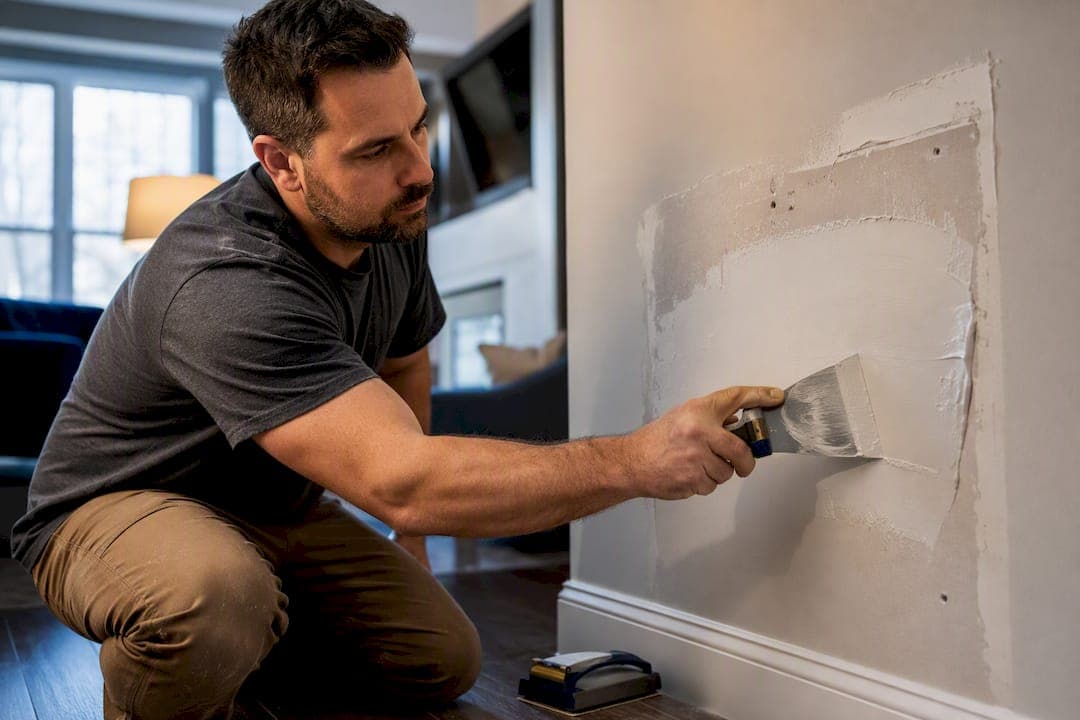
Most homeowners pay between $500 and $620 for a standard professional drywall repair, though the full national range runs $295 to $925 depending on the job. The two biggest swing factors are damage size and finish level, since matching texture and paint can quickly increase the cost of a simple hole repair.
TL;DR:
- Small holes under 4 inches typically cost $150 to $300 due to minimum job fees, despite low material costs.
- Larger damage over 10 square feet or ceiling repairs can range from $350 to over $1,500, influenced by staging and visibility.
- Water damage repairs are usually between $500 and $2,000, as they require full removal, mold checks, and possibly insulation replacement.
- Most quotes are driven by labor, finish level, and access difficulty, not raw material costs, making bundling repairs cost-effective.
- Verify texture matching and final paint inclusion upfront, as the absence of guarantees can lead to double-paying for cosmetic fixes.
Table of Contents
- How Much Does Drywall Repair Cost Nationally?
- Cost by Damage Type: Small Holes, Big Holes, Ceilings, and Water Damage
- What Actually Drives the Price of a Drywall Repair?
- How Do Pros Actually Price a Drywall Job?
- How to Estimate Your Own Drywall Repair Cost
- Should You DIY It or Call a Pro?
- Do Drywall Repairs Come With a Warranty?
- What Extra Fees Should You Expect on a Drywall Repair Bill?
- The Real Lesson Buried in All These Numbers
- Get a Free Estimate on Your Drywall Repair
- Where to Verify These Numbers Yourself
- Sources
How Much Does Drywall Repair Cost Nationally?
Contractor-reported data puts the national average around $609, with most jobs landing somewhere in the $295 to $925 window. A separate national tally from Thumbtack shows a similar spread of $294 to $920, with many homeowners reporting bills closer to $515 to $609 for typical single-repair jobs. Those numbers agree closely enough that you can treat $500 to $620 as a realistic planning midpoint for one straightforward repair.
Homewyse's cost model, which adjusts for local labor rates and site conditions, estimates a starting range of $297 to $472 per repair for basic patch jobs before accounting for extras like texture matching or hard-to-reach walls. That lower band usually applies to small, easy-access holes that don't require ceiling work or paint blending.
Quick snapshot: National average: $609. Typical range: $295–$925. Small standalone patch: often $150–$500 due to minimum job fees.
Per-square-foot pricing matters more once damage spreads past a single patch. Contractors typically quote:
- Under 1 square foot (nail holes, doorknob dings): usually billed at a flat minimum, not by square footage
- 1 to 10 square feet: often $2 to $5 per square foot, plus setup time
- 10+ square feet or full wall sections: usually $1.50 to $3 per square foot, since the setup cost spreads across more area
Geography shifts these numbers too. Labor is the dominant cost driver behind any drywall bill, and Bureau of Labor Statistics wage data shows construction labor costs vary significantly by metro area. Urban markets with higher costs of living tend to run above the national average, while smaller towns and rural areas often land below it. Kansas City sits closer to the national midpoint than either coast, which is one reason local averages tend to track the broader national figures fairly closely.
Cost by Damage Type: Small Holes, Big Holes, Ceilings, and Water Damage
Not all drywall damage costs the same to fix, even when the hole looks similarly sized. What actually drives the price is how much prep, backing, and finish work each repair type demands.
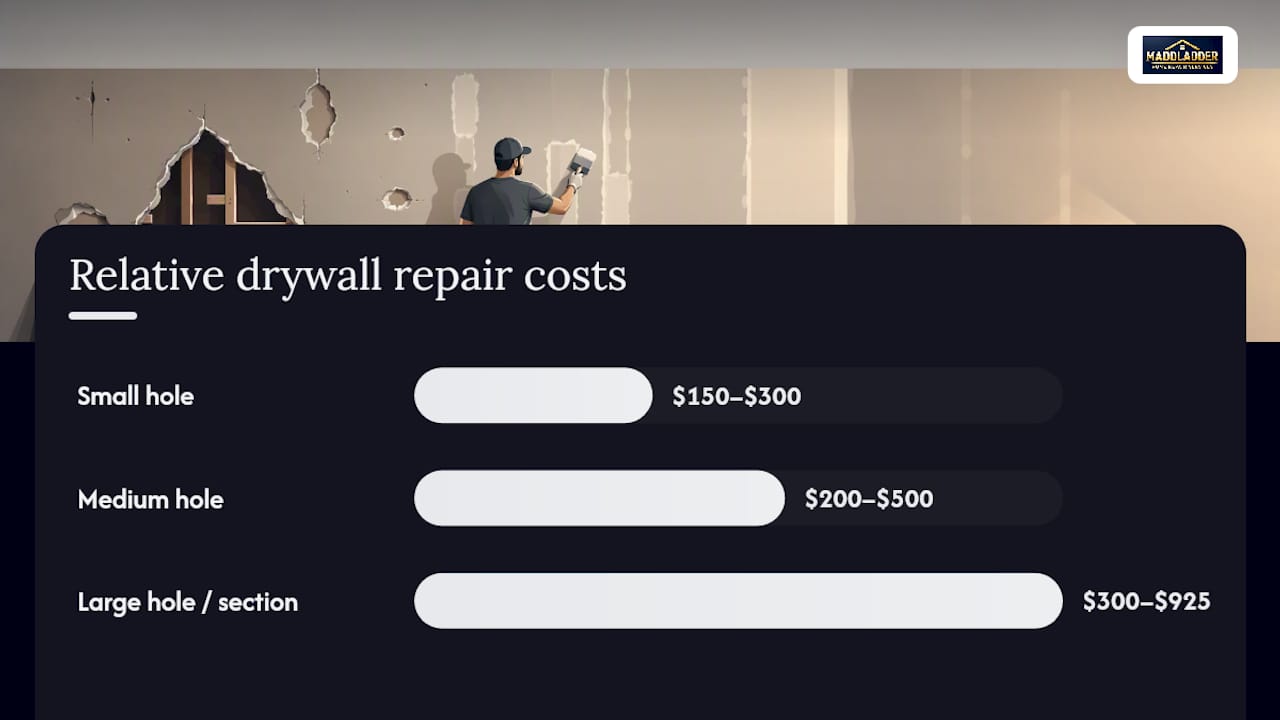
Small holes (under 4 inches, think doorknob dents or picture-hanging mistakes) are technically cheap to fix but expensive to book. The material cost is nearly nothing, but most contractors charge a flat minimum because driving out, unpacking tools, and cleaning up takes the same time whether the hole is the size of a dime or a fist. That's why a single tiny hole often costs $150 to $300 as a standalone call, even though the labor itself takes 20 minutes.
Medium holes (4 to 12 inches, common from doorknobs punching through or accidental impacts) usually need a backing patch or mesh tape before compound goes on. Expect two to three coats of joint compound with drying time between each, plus sanding and priming. These typically run $200 to $500 depending on texture matching.
Large holes and wall sections often require cutting back to the nearest studs, installing new drywall, and taping every seam. Contractor data shows these jobs commonly falling between $300 and $925, with costs climbing further if insulation or wiring is exposed behind the damaged section.
Ceiling repairs cost noticeably more than wall repairs of the same size. Working overhead is slower and often requires scaffolding or ladder staging, and any imperfection is more visible from below under normal room lighting. Ceiling patches commonly run $350 to $1,500 or more, especially if the damage stems from a roof leak that also needs addressing.
Water damage is the most expensive category by a wide margin. Wet drywall has to be fully cut out rather than patched, and contractors need to check for mold growth and soaked insulation before closing the wall back up. Water damage repairs often start around $500 for contained spots and can exceed $2,000 once mold remediation or insulation replacement enters the picture.
| Damage Type | Typical Cost Range | Key Cost Driver |
|---|---|---|
| Small hole (under 4") | $150–$300 | Minimum job fee, not materials |
| Medium hole (4–12") | $200–$500 | Backing patch, multiple compound coats |
| Large hole or section | $300–$925 | Framing, studs, full retaping |
| Ceiling repair | $350–$1,500+ | Overhead labor, staging, visibility |
| Water damage | $500–$2,000+ | Cut-out, insulation, mold risk |
- Multiple-room jobs on the same visit reduce the per-repair average because setup time gets spread across all the work.
- A single ceiling water stain rarely stays a $200 fix once the source of the leak gets factored in.
What Actually Drives the Price of a Drywall Repair?
Materials are almost never the reason a drywall quote comes in high. A patch kit, joint compound, tape, and a can of primer add up to well under $30 in most cases. What moves the number is everything around those materials.
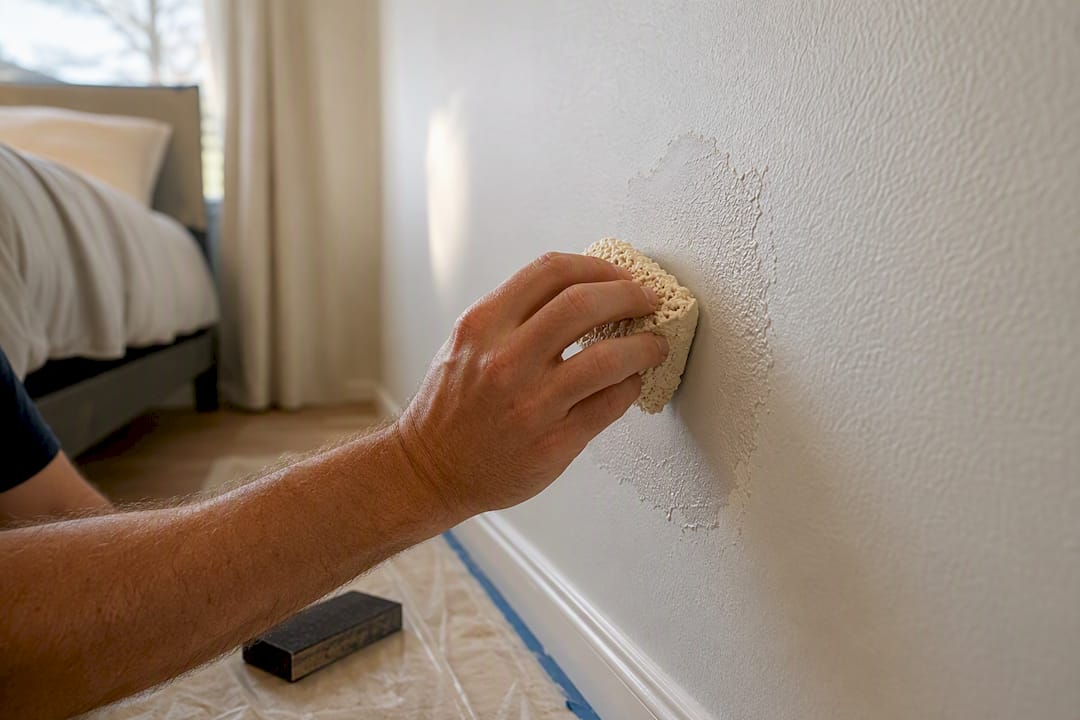
Finish level is the hidden cost most people underestimate. A rough patch that just stops air from moving through a hole takes one visit. A patch that disappears completely under painted light takes skim coating, multiple sanding passes, and careful texture matching, especially on orange peel or knockdown textures that are notoriously hard to blend by eye. That extra labor is often the single biggest gap between a $250 quote and a $600 one.
A contractor paying Kansas City wages prices differently than one working in a high-cost coastal market, even for an identical hole.
Other factors that push a quote higher:
- Access difficulty: vaulted ceilings, tight closets, or walls behind furniture that has to be moved
- Drying time between coats, which can force a second or third visit rather than one continuous job
- Hidden problems discovered mid-repair, like exposed wiring, old water stains, or soft spots suggesting rot behind the surface
Pro Tip: Ask any contractor upfront whether their quote includes texture matching and a final paint coat. Some quotes cover the patch only and leave you to hire a separate painter, which can add $100 to $300 you didn't budget for.
How Do Pros Actually Price a Drywall Job?
Understanding how a quote gets built helps you tell a fair price from an inflated one.
- Hourly rates typically run $38 to $75 per hour depending on region and contractor experience, with TaskRabbit data showing a national average near $38 per hour for basic tasks, though full-service handyman rates often run higher once travel, setup, and finish work are included.
- Minimum job fees usually range from $150 to $250 for a single small repair, regardless of how quickly the actual patching takes.
- A typical invoice breaks down into travel and setup, patch or cut-out labor, compound application across two or three coats, sanding time, and primer or paint if requested.
- Ask about guarantees before booking: does the quote include a texture-match guarantee, and what happens if the patch shows through the paint after it dries?
- Get the rework policy in writing. A contractor who stands behind blend quality will usually return for a touch-up at no extra charge if the patch is visible under raking light.
How to Estimate Your Own Drywall Repair Cost
Running your own ballpark before calling anyone takes about five minutes and saves you from sticker shock later.
- Measure the damage in square feet or note it as a small standalone hole if it's under roughly a hand's width across.
- Classify the type: wall patch, ceiling patch, or water-damaged section, since each carries a different price band.
- Pick your pricing method: use a flat minimum fee for anything under 1 square foot, or per-square-foot pricing ($2 to $5) for larger patches.
- Add finish costs if you want a paint-ready result rather than a raw patch, roughly Typical hourly labor rates vary. to $150 extra for texture matching and priming.
- Add a contingency of 15% to 20% for hidden issues like soft framing or old water intrusion you can't see until the wall is open.
Example: A single doorknob-sized hole booked alone might run $200 to $300 after the minimum fee. The same hole bundled with two other small repairs on one visit often drops to $120 per hole, since the trip charge gets split three ways.
Example: A 10 square foot wall patch from a removed shelf bracket, priced at $3 per square foot plus $100 in finish work, lands around $130 in materials and labor for the patch itself, plus finish costs, putting the total closer to $230 to $280 before contingency.
Should You DIY It or Call a Pro?
Small, low-visibility patches on textured-free walls are reasonable DIY territory if you're comfortable with a putty knife and don't mind a slightly imperfect finish. Everything else tends to go sideways faster than people expect.
Call a professional when the job involves:
- Ceiling repairs, where overhead work and visibility make mistakes obvious
- Any texture or paint matching where a mismatch will stand out permanently
- Water damage, where mold risk and hidden rot need a trained eye
- Multiple repairs across a rental unit, where code compliance and consistent finish matter for future tenants
Pro Tip: If you're a landlord juggling several units, batching repairs into one scheduled visit is one of the most reliable ways to keep per-repair cost down, since the setup fee gets absorbed across the whole job instead of charged per hole. Maddladder's drywall repair guidance for Kansas City rentals walks through exactly how that math works for property managers juggling multiple units.
A trained eye also catches what a homeowner might miss: soft spots signaling old moisture, wiring too close to the surface, or a patch that will telegraph through paint under certain lighting. Getting it right the first time usually costs less than paying twice.
Do Drywall Repairs Come With a Warranty?
Most established handyman and repair companies back their drywall work with some form of workmanship guarantee, though the length and terms vary by provider. A common structure covers 30 to 90 days on the patch itself, meaning if the compound cracks, the texture doesn't blend, or the paint shows a visible seam within that window, the contractor returns to fix it at no extra charge.
Some providers extend coverage further for larger structural patches, since a properly taped and mudded seam should hold indefinitely under normal conditions if it was done correctly the first time. What the warranty typically does not cover is new damage. If a different area of the same wall cracks from a separate cause, like foundation settling or a new impact, that falls outside the original guarantee and counts as a new repair.
Before booking any drywall job, ask directly what the guarantee covers and for how long. A contractor who hesitates to answer that question in writing is worth a second look. Reputable providers are usually upfront about it because a solid patch rarely needs a return visit anyway. The warranty exists mainly as reassurance that if a texture match looks slightly off once it dries and cures fully, which can take a few days longer than the paint itself, you're not stuck paying for a redo.
What Extra Fees Should You Expect on a Drywall Repair Bill?
The quoted repair price rarely tells the whole story. A handful of common add-on fees show up on final invoices that homeowners don't always anticipate when comparing quotes.
Disposal and cleanup fees cover hauling away old drywall, dust removal, and general job-site cleanup. For a small patch this is often bundled into the base price, but larger tear-outs involving full wall sections can add $25 to $75 for debris removal, particularly if a dumpster or multiple trash trips are required.
Travel and trip charges apply when a job site sits outside a contractor's normal service radius. This is less common for local handyman services working a defined metro area, but worth asking about if you're outside the core service zone.
Emergency or same-day service carries a premium almost everywhere, typically 25% to 50% above standard scheduled rates, since it means bumping other clients or working outside normal hours. Water damage repairs are the most common trigger for this fee, since delaying a wet-drywall repair even a day or two raises mold risk significantly.
Multiple-visit fees can appear on jobs that require drying time between compound coats, though most contractors build this into their original quote rather than charging separately for each return trip. Confirm this upfront rather than assuming it's included.
Ask for an itemized quote before work begins. A contractor who lists disposal, travel, and any rush fees separately is easier to compare against competitors than one who buries everything into a single lump number.
The Real Lesson Buried in All These Numbers
The conventional advice on drywall repair cost mostly stops at "get three quotes," which is fine but misses the actual lever homeowners control: bundling. The data backs this up clearly. Labor and minimum job fees, not materials, drive most of what you pay, and a single small hole booked alone almost always costs more per square inch than the same hole fixed alongside two or three others on one visit.
What gets overrated in most guides is the emphasis on national averages themselves. Knowing the country pays $295 to $925 tells you very little about what your specific wall, in your specific city, with your specific texture, will actually cost. What matters more is understanding the mechanics behind the number: minimum fees, finish level, and access difficulty. Those three factors explain almost every dollar of variance you'll see between quotes.
If there's one thing worth prioritizing first, it's asking about texture-match guarantees before signing anything. A cheap quote that leaves a visible patch on your wall isn't actually cheap. It's a bill you'll pay twice.
— Jennifer
Get a Free Estimate on Your Drywall Repair
A professional handyman service handles drywall repair across the Kansas City metro with one licensed technician on one visit, avoiding separate calls for patching, paint matching, or reinstalling fixtures afterward. That matters most for the small jobs this guide just walked through, since booking three tiny repairs separately means paying three minimum fees instead of one.

Maddladder's repair and replacement services cover everything from small hole patches to full ceiling sections, priced with the same hourly and flat-rate logic described above. Estimates are free, and most jobs get scheduled after a quick phone or on-site walkthrough where the technician confirms damage type, finish needs, and whether texture matching is realistic for your specific wall.
If your repair also involves rehanging a shelf, mirror, or fixture that came down with the damaged section, Maddladder's installation and assembly services can handle that in the same visit. Before booking, ask specifically about texture-match guarantees and whether bundling multiple small repairs into one appointment reduces the per-repair price. Contact the provider to request a free estimate and written quote before any work starts.
Where to Verify These Numbers Yourself
For a hands-on estimate specific to your zip code, Homewyse's drywall repair calculator adjusts for local conditions. To check current labor-rate trends by region, the BLS wage database covers construction trades directly. For a deeper breakdown by damage type, DigitalEstimating's cost guide is worth the extra read. Homeowners in the Kansas City area specifically can also check Maddladder's local cost breakdown for regional context, and anyone weighing a DIY door or trim job alongside drywall work might find this partner breakdown of common DIY pitfalls useful before picking up a tool.
Sources
- 2026 Drywall Repair Costs | Cost to Patch Holes & Repair Ceilings
- How Much Does Drywall Repair Cost? (2026 Guide)
- Cost to Repair Drywall - 2026 Cost Calculator (Customizable)
- How Much Does Drywall Repair Cost? (TaskRabbit cost guide)
- Bureau of Labor Statistics Occupational Employment Statistics