
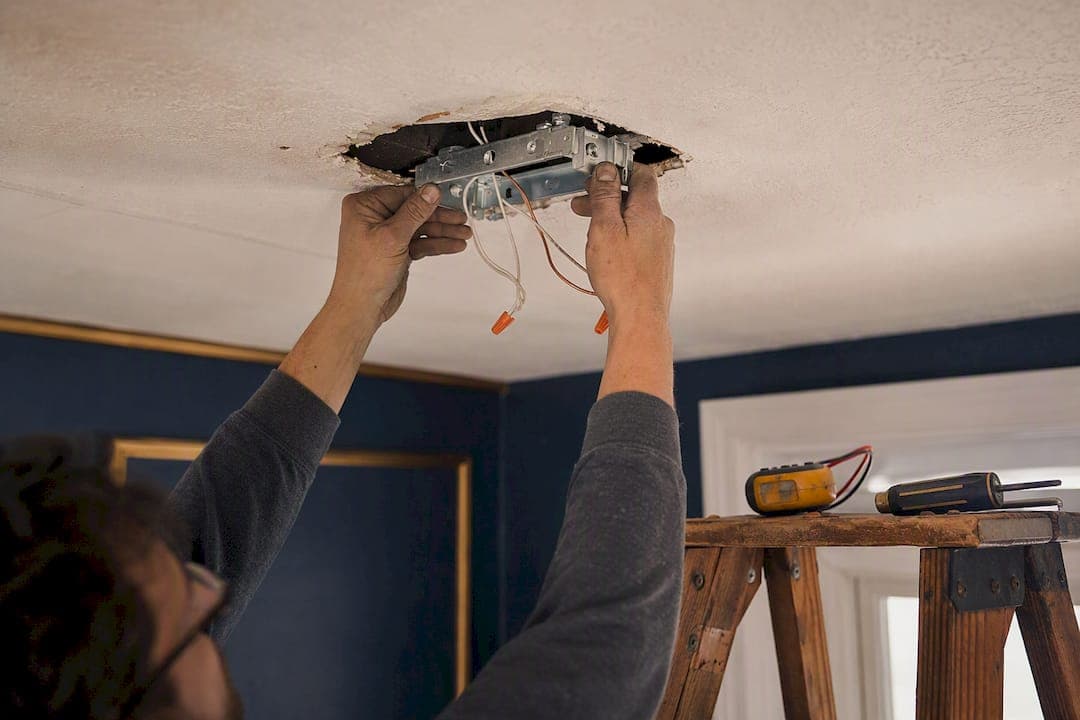
Most homeowners pay a few hundred dollars for professional ceiling fan installation, with a like-for-like swap typically costing less. The number that actually decides your bill isn't the fan, it's the box: if your ceiling already has a fan-rated electrical box, you're near the low end. If it doesn't, or you're running new wiring or working around a vaulted ceiling, expect to pay several hundred dollars more.
TL;DR:
- Replacing a ceiling fan on an existing fan-rated box typically costs between $150 and $300, with higher costs if additional wiring or upgrades are needed.
- Costs increase significantly for jobs involving new wiring, ceiling height challenges, or non-fan-rated boxes, often exceeding $500 and reaching up to $2,000 for vaulted ceilings.
- Permits usually add $50 to $150 if new circuits or wiring are involved, but simple swaps without permit requirements remain less costly.
- Electrician rates generally range from $75 to $150 per hour, with a one-hour minimum, and part costs for boxes, downrods, and controls vary widely.
- Always confirm whether your existing box is fan-rated before bidding, as misjudging this leads to unexpected expenses and safety hazards.
Table of Contents
- Ceiling Fan Installation Cost: National Averages And What "Installed" Covers
- Price Bands By Installation Scenario
- Cost Breakdown: Labor, Parts, And Fan Prices
- Regional Variation And Sample City Differences
- Permits, Code, And Common Add-Ons That Increase Cost
- What To Expect On Installation Day
- DIY Vs. Hiring A Licensed Pro
- MaddLadder's Take On Booking And Budgeting Your Install
- Book A Licensed Ceiling Fan Install With MaddLadder
- Sources
Ceiling Fan Installation Cost: National Averages And What "Installed" Covers
Cost estimators don't fully agree on a single number, but they land in the same neighborhood. Homewyse's calculator puts a standard installation in a broad national range once labor and basic materials are factored in, while Angi reports a national average around $253 for a straightforward job. Split the difference and you get a workable planning number: budget roughly $250 for a simple installation, more if your situation isn't simple.
By the numbers: Angi's national average sits near $253, while scenario-based calculators price a basic swap at $150 to $300 and a full new-wiring job at $400 to $1,000 or more.
A quoted "installed" price typically covers:
- Removing the old fixture (light, fan, or a bare junction box cover)
- Mounting hardware and basic wiring connections
- Balancing and testing the fan once it's hung
- A brief walkthrough of the remote or wall control
What most quotes exclude: permit fees, upgrading a non-fan-rated box, and anything requiring a ladder taller than a standard 6-footer. Fan unit prices vary a lot too. Basic 42 to 52 inch fans without lights run roughly $50 to $150, mid-range fans with LED kits and remotes land between $150 and $350, and premium designer or smart fans (think DC motors, app control, integrated lighting) can run $350 to $800 or more before installation. Home Depot's electrical department is a decent place to see current tiering if you want to compare against a quote.
Price Bands By Installation Scenario
The scenario you're in matters more than almost anything else on the invoice. Here's how the four common jobs typically break down:
- Like-for-like fan swap. You're replacing one ceiling fan with another on an existing fan-rated box. Labor alone runs $75 to $150; all-in with a mid-range fan, expect $150 to $300.
- Light fixture to ceiling fan conversion, with box upgrade. The existing box isn't rated to hold a fan's weight and motion, so the installer swaps it for a proper fan-rated brace box. Labor and materials for the box itself push the total to $250 to $500.
- New wiring or a new circuit. No existing fixture, or the wiring can't support a fan safely. This means fishing new cable, possibly adding a switch, and sometimes opening drywall. All-in costs run $400 to $1,000, occasionally more with a longer wire run.
- High or vaulted ceilings. Extra height means scaffolding, extension ladders, or a lift, plus a downrod and sloped-ceiling adapter. Combined with the labor premium for working overhead, this installs often run $500 to $2,000.
A 2026 compilation of real customer quotes backs this up almost exactly: simple swaps clustered at $150 to $350, while light-to-fan conversions with access issues or added scope ran anywhere from several hundred dollars to $1,500-plus.
Before you compare bids, ask every contractor the same question: "Do you expect to reuse the existing box, or will this need a fan-rated brace box?" That single answer tells you which price band you're actually shopping in.
Cost Breakdown: Labor, Parts, And Fan Prices
Electricians and handyman services typically bill $75 to $150 an hour, though rates climb in major metro areas. Most charge a one-hour minimum even for a 30 to 45 minute job, which explains why a quick swap still lands at $150 or more. That first-hour minimum covers truck time, diagnostics, and cleanup, not just the wrench work.
Typical parts pricing:
- Fan-rated ceiling box: $10 to $30 in parts, but $80 to $200 installed with labor
- Downrod (for higher ceilings): $15 to $50
- Sloped-ceiling adapter kit: $20 to $60
- Wall control or smart switch: $30 to $120 installed
Line-item snapshot: a basic hourly rate of $75 to $150, a one-hour minimum on most calls, and $80 to $200 just to swap in a compliant fan-rated box, is a fairly consistent pattern across quotes nationally.
Most quotes also fold in a small allowance for miscellaneous materials (wire nuts, screws, mounting brackets) and local sales tax on parts. Disposal of an old fixture rarely costs extra unless it's a large, awkward chandelier-style unit.
Regional Variation And Sample City Differences
Labor rates track local cost of living closely. BLS wage data for electricians shows meaningful spread between metro areas, and that spread shows up directly in your quote. The Northeast corridor and California coastal cities tend to run 20% to 40% above the national average; the Midwest and much of the South tend to run at or below it.
- New York City / San Francisco Bay Area: expect $300 to $700+ for anything beyond a simple swap
- Chicago / Denver: mid-range, often $200 to $500
- Kansas City, Midwest metros, and most of the South: typically $150 to $400 for comparable scope
Taskrabbit lists an average starting rate near $44 an hour for handyman-tier work, though that's a starting rate before minimums and materials, not a full installed price. Weekend, evening, and holiday calls commonly carry a 1.5x premium. Booking a weekday morning slot is the easiest way to dodge that surcharge entirely.
Permits, Code, And Common Add-Ons That Increase Cost
The code requirement that trips up more DIYers and budget quotes than anything else is NEC 314.27(C), which requires any box supporting a ceiling fan to be specifically listed and rated for that weight and vibration. A standard light box doesn't meet that bar, so swapping it out adds labor and a new part to the job.
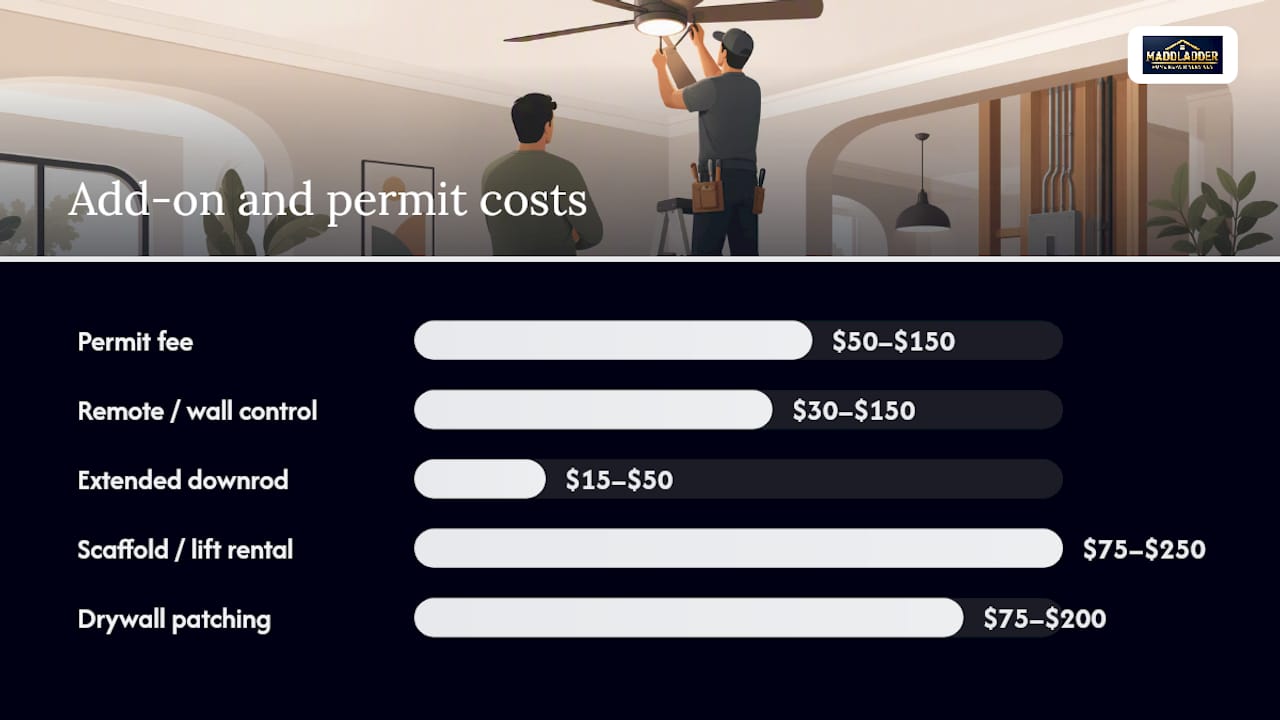
Permit and inspection fees vary by city and generally apply when new wiring or a new circuit is involved, not on simple swaps. Where required, permit fees typically run $50 to $150.
Common add-ons to budget for (review our new home utility cost benchmarks to set your monthly home improvement budgets):
- Remote or smart wall control upgrade: $30 to $150
- Extended downrod for tall or vaulted ceilings: $15 to $50
- Scaffold or lift rental for hard-to-reach ceilings: $75 to $250
- Drywall patching after a box relocation: $75 to $200
Pro Tip: Ask your installer directly whether your city requires a permit for the specific scope of your job. Some jurisdictions only trigger a permit when new circuits are added, not for box swaps.
What To Expect On Installation Day
Onsite time varies by scenario: a straightforward swap takes 30 to 60 minutes, a box upgrade runs 1 to 2 hours, new wiring can take 2 to 4 hours, and vaulted-ceiling jobs often take half a day once access equipment is factored in.
- The installer arrives, confirms the scope, and checks the existing box or wiring.
- Power gets shut off at the breaker before any work starts.
- The old fixture comes down and the new box or fan-rated brace goes in if needed.
- The fan is mounted, wired, balanced, and tested on all speeds.
Confirm ahead of time who's supplying the fan (you, or the contractor), clear the work area below the ceiling, and book during standard business hours to avoid after-hours rates.
DIY Vs. Hiring A Licensed Pro
A handful of red flags mean this isn't a weekend DIY project: no existing fan-rated box, any need for new wiring, a multi-switch or smart control setup, ceilings above 10 feet, or a fan heavier than about 35 pounds. Any one of those pushes the job past basic handy skills and into licensed-electrician territory.
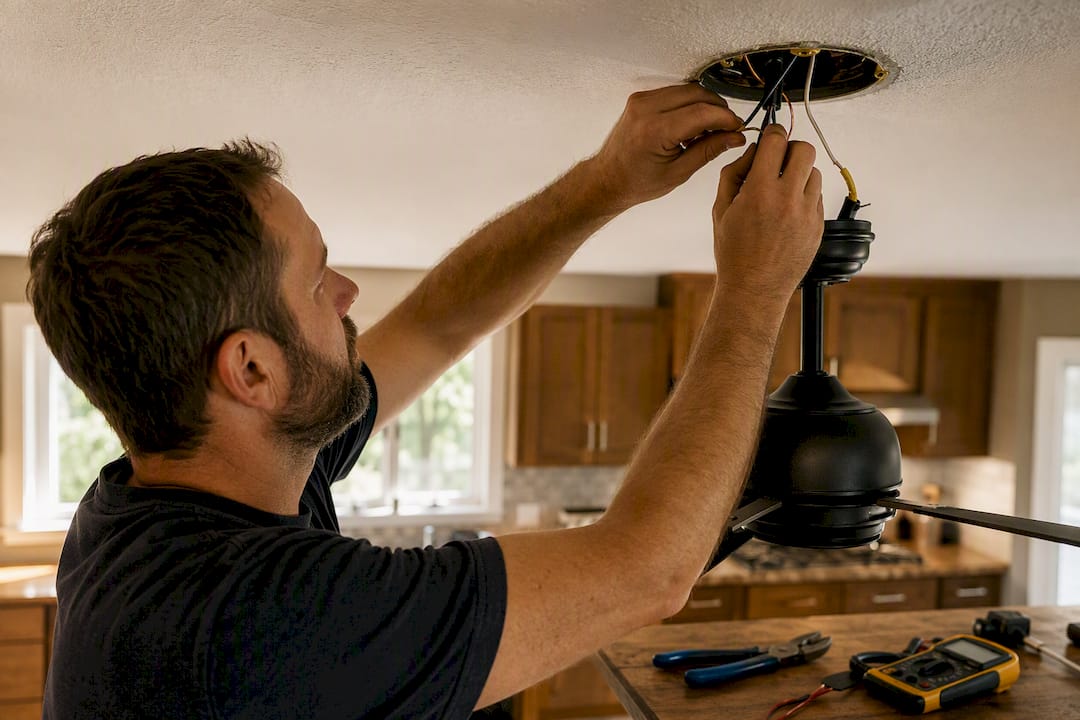
The real risk with DIY isn't just a wobbly fan. It's code noncompliance under NEC 314.27(C), which can surface during a home sale inspection or an insurance claim after a fan falls from an unrated box. A loose mount also voids most fan warranties. Our electrical repair guide for KC homes covers which small electrical fixes are genuinely safe to DIY and which aren't.
To get faster, more accurate quotes, take a photo of your current ceiling box or fixture, measure your ceiling height, and note whether you already own the fan or need one recommended.
Pro Tip: If you're unsure whether your existing box is fan-rated, don't guess. A licensed installer can tell in under a minute, and getting it wrong is exactly what leads to a fan crashing down months later.
MaddLadder's Take On Booking And Budgeting Your Install
Get at least two quotes before booking, and make sure both bidders answer the same two questions: is the existing box fan-rated, and who's responsible for pulling a permit if one's needed? Quotes that skip those details tend to balloon once work starts.
At Maddladder, we structure ceiling fan estimates around the actual scope of the job rather than a flat rate that assumes the easiest scenario. We offer free estimates and both hourly and flat-fee options depending on complexity. Sending a couple of photos of your ceiling and current fixture before we arrive usually gets you a tighter, more accurate number and a faster appointment.
— Jennifer
Book A Licensed Ceiling Fan Install With MaddLadder
Big-box retailers and general contractors will quote you a fan installation, but you're often waiting days for a callback or paying for a truck roll minimum that assumes the worst-case scenario. Maddladder is the local alternative for Kansas City homeowners who want a licensed pro who actually shows up on schedule and prices the job for what it is, not what it might be.

Our repair and replacement services cover everything from a simple fan swap to a full box upgrade, and our minor electrical and plumbing team handles new wiring when a job calls for it. Every estimate is free, and you can see our published hourly and plan-based pricing structure on our pricing page before you ever commit to a date. Send us a photo of your ceiling and current fixture, and we'll give you a real number, not a placeholder, so you know exactly what you're paying for before we schedule the visit.
Sources
Check Homewyse for a national line-item breakdown, Taskrabbit for city-level hourly rates, and BLS wage data for regional electrician pay bands. Use national averages for early budgeting, but run a zip-code-specific calculator once you're ready to compare real quotes against your actual metro area.
- Bureau of Labor Statistics — Occupational Employment and Wage Statistics (OES)
- Cost to Install a Ceiling Fan — Homewyse
- Cost of Ceiling Fan Installation by Electrician Calculator — UseCalcPro
- How Much Does It Cost to Install a Ceiling Fan? 2026 Data — Angi