

TL;DR:
- Subscription maintenance offers homeowners scheduled, preventive visits that reduce long-term repair costs. It builds ongoing relationships with service providers and aligns visits with seasonal property needs. Property managers benefit from predictable scheduling, documented records, and lower emergency repair expenses.
Subscription maintenance is a recurring service agreement where homeowners pay fixed fees for scheduled preventive visits that prevent costly emergency repairs. This model, often called a preventive maintenance plan or service agreement in the industry, shifts your home upkeep from reactive firefighting to planned, predictable care. Why opt for subscription maintenance? Because preventive maintenance reduces long-term costs by minimizing unexpected repairs and improving equipment lifespan. For homeowners and property managers in the Kansas City metro area, that shift from surprise bills to scheduled service visits changes everything about how you manage a property.
What is a maintenance subscription and how does it work?
A maintenance subscription is an ongoing contract between a homeowner and a service provider. You pay a fixed monthly or annual fee, and the provider schedules a set number of preventive visits throughout the year. Plans typically include 2–12 visits per year with task-based checklists covering items like HVAC filter replacements, water heater flushes, and safety inspections. That structure removes the guesswork from home upkeep entirely.
Each visit follows a defined checklist rather than a reactive call for something already broken. Providers use scheduling software like Housecall Pro to automate appointment reminders, track completed tasks, and manage billing. That automation keeps visits from slipping through the cracks. For property managers overseeing multiple units, this kind of systematic tracking is the difference between organized operations and constant chaos.
Pricing varies by plan tier and scope. Retail providers like Lowe's have offered HomeCare Plus plans at around $99/year with defined visit quantities, discounted parts, and specific service tasks. Local handyman services like Maddladder structure their plans in tiers: Essential, Home Care, and Property Manager. Each tier scales in visit frequency and task scope to match the size and complexity of the property.
Subscription plans differ from home warranties in one critical way. Warranties are insurance-shaped; subscriptions are service-shaped. A warranty pays out after something breaks, subject to claim approval and coverage limits. A subscription schedules work before things break, with no claims process and no negotiation. That distinction matters when a furnace fails in january and you need a technician, not an adjuster.
Here is what a typical subscription plan includes:
- Scheduled preventive visits (2–12 per year depending on tier)
- Task checklists covering HVAC, plumbing, electrical, and safety items
- Discounted rates on parts and additional labor
- Priority scheduling over non-subscriber customers
- Automated reminders and digital records of completed work
Why choose subscription maintenance over reactive or warranty-based models?
Reactive maintenance is the most expensive way to care for a home. You wait until something fails, then pay emergency rates for a technician, replacement parts, and sometimes collateral damage repair. Preventive maintenance keeps issues predictable while reactive maintenance leads to unexpected and expensive repairs. The financial gap between those two approaches compounds over years of ownership.

The comparison below shows how subscription maintenance stacks up against the two most common alternatives:
| Factor | Subscription maintenance | Reactive repairs | Home warranty |
|---|---|---|---|
| Cost structure | Fixed monthly or annual fee | Variable, often high per incident | Annual premium plus deductibles |
| Timing | Scheduled before failure | After failure occurs | After failure, pending claim approval |
| Scope control | Defined tasks per visit | Unlimited but unpredictable | Limited by policy exclusions |
| Response speed | Priority scheduling | First available slot | Subject to claim processing |
| Relationship | Ongoing provider relationship | One-off transactions | Third-party claims handler |
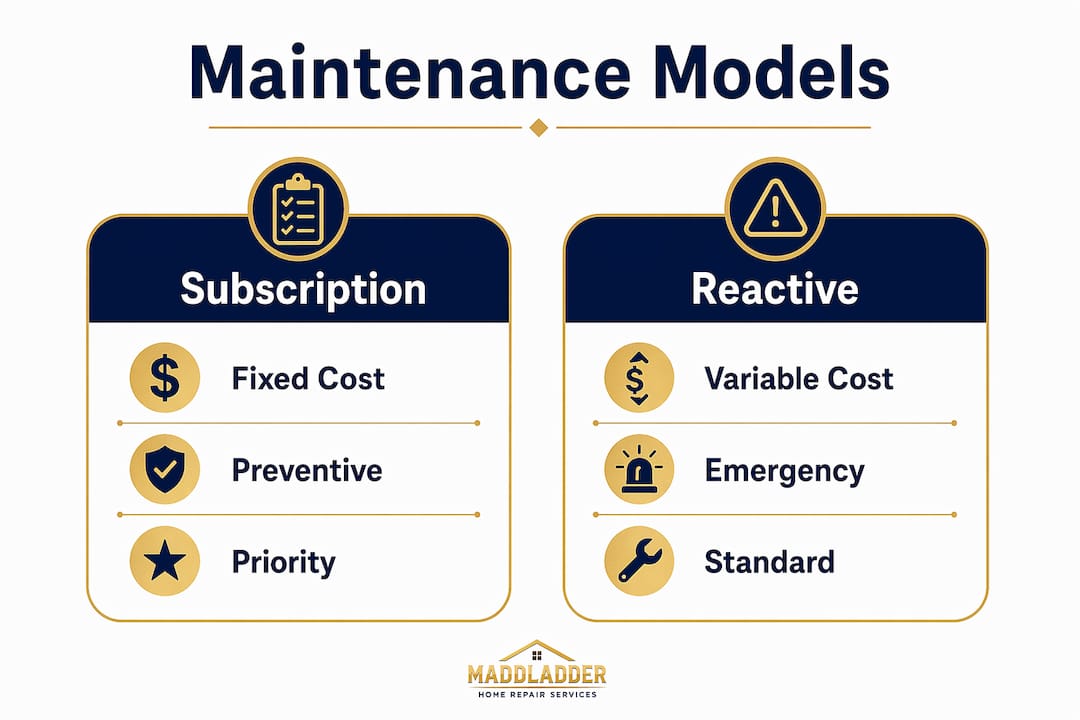
The operational cadence of a subscription plan also builds a relationship between you and your service provider. Recurring reminders and fixed visit schedules improve task completion rates compared to one-off jobs. That consistency means your provider learns your home's systems, quirks, and history. A technician who has serviced your HVAC twice a year for three years spots problems faster than a stranger called in for the first time.
Pro Tip: Before signing any subscription plan, ask specifically what "priority service" means in writing. Some providers use the term loosely. A real priority commitment means a defined response window, not just a verbal assurance.
Service agreements also convert one-time customers into long-term relationships. Operators often run warranties in the first year and then transition customers to service agreements for ongoing maintenance revenue. For homeowners, that transition is actually a benefit. It means your provider has a financial incentive to keep your systems running well rather than waiting for them to fail.
How are subscription maintenance plans tailored to home and property needs?
The best subscription plans align their visit schedules to seasonal demands. A well-structured plan does not treat a february HVAC inspection the same as an october gutter cleaning. Property managers optimize subscription value by aligning tasks to building seasonality and ensuring access to avoid emergency calls. That seasonal alignment is what separates a useful plan from a generic one.
A properly tailored plan for a Kansas City home might look like this:
- Spring visit: HVAC tune-up, air filter replacement, exterior inspection after winter, and smoke detector testing.
- Summer visit: Plumbing check, water heater flush, attic ventilation inspection, and outdoor faucet review.
- Fall visit: Furnace inspection, gutter cleaning, weatherstripping check, and carbon monoxide detector test.
- Winter visit: Pipe insulation check, heating system performance review, and safety grab bar or ramp inspection for accessibility needs.
Property managers with multiple units benefit from this structure even more than individual homeowners. Coordinating maintenance across ten or twenty units without a subscription plan means constant reactive calls, scheduling conflicts, and inconsistent service quality. A subscription plan with a provider like Maddladder gives property managers a single point of contact, predictable visit windows, and documented records for each unit.
HVAC maintenance plans commonly include 2 preventive tune-up visits per year along with priority scheduling and emergency service availability where offered. That visit frequency matches the seasonal demand of heating and cooling systems in the Midwest, where temperature swings are significant. Skipping one of those visits often means discovering a problem in the middle of a heat wave or cold snap.
Pro Tip: Ask your provider for a written task list for each scheduled visit before you sign. Vague descriptions like "general inspection" tell you nothing. Specific tasks like "flush water heater sediment" and "replace 1-inch air filter" are what you should see.
Understanding priority service terms before committing to a plan protects you from disappointment. Priority service often does not guarantee emergency response. It typically means you move to the front of the regular scheduling queue. That is still valuable, but it is not the same as a guaranteed same-day response.
What are the financial and operational benefits of subscription maintenance?
Subscription maintenance replaces large, unpredictable repair bills with smaller, predictable expenses spread across the year. Preventive maintenance leads to smaller, predictable expenses rather than large emergency bills, reducing maintenance risk and cost over time. For a homeowner budgeting monthly expenses, that predictability is genuinely valuable. You know what maintenance costs before the calendar year starts.
The financial benefits extend beyond just avoiding emergency repairs:
- Equipment lifespan: Systems that receive regular tune-ups last longer. An HVAC unit serviced twice a year consistently outlasts one that only gets attention when it breaks.
- Energy efficiency: Clean filters, flushed water heaters, and calibrated thermostats run more efficiently. That efficiency shows up directly in monthly utility bills.
- Avoided damage escalation: A small roof leak caught during a fall inspection costs far less to fix than the water damage it causes if left until spring.
- Discounted parts and labor: Most subscription plans include reduced rates on additional repairs, so when something does need fixing, you pay less.
- Documented maintenance history: Records of completed work add value when selling a property. Buyers and inspectors respond well to documented upkeep.
For property managers, the operational benefits are equally significant. Subscription plans reduce emergency callouts, which are the most disruptive and expensive type of maintenance event. Tenants experience fewer system failures, which directly affects satisfaction and lease renewal rates. A provider relationship built on recurring visits also means faster response when something does go wrong outside the scheduled visits.
Operational cadence from recurring subscriptions drives fewer missed visits and better maintenance outcomes than ad hoc scheduling. That cadence is the structural advantage of a subscription model. It removes the human tendency to delay maintenance until something feels urgent.
Key Takeaways
Subscription maintenance is the most cost-effective and predictable approach to home upkeep, replacing reactive emergency repairs with scheduled preventive visits that protect equipment, reduce costs, and build long-term provider relationships.
| Point | Details |
|---|---|
| Subscriptions prevent costly breakdowns | Scheduled preventive visits catch small problems before they become expensive emergency repairs. |
| Fixed costs beat surprise bills | A defined annual or monthly fee replaces unpredictable repair expenses that spike without warning. |
| Plans should match your property's seasons | Align visit tasks to spring, summer, fall, and winter demands for maximum protection and efficiency. |
| Subscriptions outperform warranties | Service-shaped plans schedule work proactively; warranties only pay out after something already breaks. |
| Read priority service terms carefully | Priority scheduling means front-of-queue access, not a guaranteed same-day emergency response. |
What I have learned from watching homeowners pick the wrong plan
Most homeowners choose a subscription plan based on price alone. That is the wrong filter. The plan that costs $20 less per year but covers only one visit with vague task descriptions delivers far less value than a slightly pricier plan with four defined visits and a specific checklist. I have seen homeowners sign up for a plan, assume they are covered, and then discover mid-winter that their "priority service" means a three-day wait.
The scope mechanics of a plan matter more than the payment model. The tasks scheduled and discounts offered are what determine real value, not just the fee structure. Before committing, ask for the actual task list for each visit, the response window for priority service, and the discount percentage on additional repairs. If a provider cannot answer those questions clearly, that tells you something important about how they operate.
Property managers have the most to gain from subscription maintenance, but also the most to lose from a poorly structured plan. Managing ten units with a vague service agreement is worse than managing them reactively, because you have a false sense of coverage. The best approach is to treat subscription maintenance the way you treat a lease agreement. Read every term, ask about every exclusion, and confirm every commitment in writing before you sign.
One more thing most articles skip: the transition from warranty to service agreement is a natural and smart move. If your appliances or systems are coming off manufacturer warranty, that is exactly the right moment to lock in a subscription plan. You are moving from defect coverage to ongoing care, and the timing aligns perfectly with when systems start to need real maintenance attention.
— Jennifer
Maddladder's subscription plans for Kansas City homeowners
Maddladder serves homeowners and property managers across the Kansas City metro area with tiered home maintenance subscription plans built around scheduled preventive visits, not reactive calls. The Essential, Home Care, and Property Manager tiers scale to match your property size and visit frequency needs.
Maddladder's plans cover plumbing and electrical repairs, smart home upgrades like thermostats and cameras, and general repairs across all major home systems. Free estimates are available, and the team responds quickly across the Kansas City metro and surrounding communities. If you are ready to replace unpredictable repair bills with a plan that actually fits your home, Maddladder is a practical starting point.
FAQ
What is a maintenance subscription plan?
A maintenance subscription is a recurring service contract where you pay a fixed fee for scheduled preventive visits throughout the year. Plans typically include 2–12 visits with defined task checklists covering HVAC, plumbing, and safety systems.
How does subscription maintenance differ from a home warranty?
A home warranty is insurance-shaped and pays out after something breaks, subject to claim approval. A subscription plan is service-shaped, scheduling preventive work before failures occur with no claims process involved.
Is subscription maintenance worth it for property managers?
Subscription maintenance reduces emergency callouts, improves tenant satisfaction, and gives property managers documented maintenance records across all units. The operational consistency of scheduled visits outperforms ad hoc reactive repairs at scale.
What does priority service actually mean in a subscription plan?
Priority service typically means you move to the front of the regular scheduling queue, not that you receive a guaranteed same-day emergency response. Understanding service-level agreements before signing protects you from mismatched expectations.
When is the best time to start a subscription maintenance plan?
The best time to start is when your home systems are coming off manufacturer warranty. That transition point is when ongoing preventive care replaces defect coverage and real maintenance needs begin to emerge.