
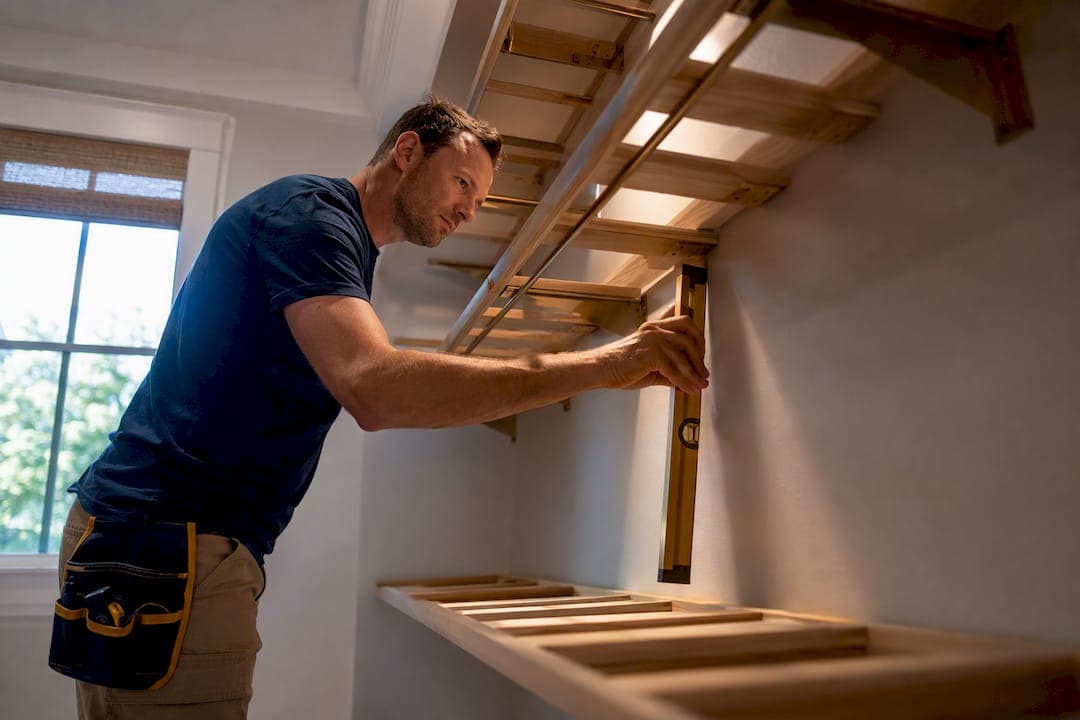
Expect to pay roughly $21.67 to $33.48 per linear foot in labor for shelving installation, based on 2026 national labor benchmarks, which puts most simple wall-shelf jobs at $100 to $400 total. That figure covers labor only. It excludes materials, anchors, permits, and engineering, all of which can push a project well past the base number. For Kansas City area homeowners and property managers who want a licensed pro to handle the work, MaddLadder offers a straightforward path to a written estimate.
TL;DR:
- Material choice and wall type significantly impact installation costs, with masonry walls requiring specialized anchors that increase labor and hardware expenses.
- Shelving projects vary widely in total cost, from around $150 for small floating shelves to over $30,000 for extensive warehouse rack systems, depending on size, material, and complexity.
- Getting an accurate quote demands detailed measurements, material specifications, and written estimates that separate labor, materials, permits, and additional costs.
- DIY shelving is suitable only for simple projects like floating shelves anchored into drywall, while complex or heavy-duty installations should be handled by licensed professionals.
- Always verify contractor credentials, request references or photos, and clarify whether quotes include all soft costs to avoid surprises that can double or triple initial estimates.
Table of Contents
- What Does Shelving Installation Cost by Project Type?
- Why Do Shelving Installation Quotes Vary So Much?
- How Much Does Each Shelving System Cost Installed?
- How Do You Get an Accurate Shelving Installation Quote?
- Should You DIY Shelving or Hire a Licensed Pro?
- What Questions Should You Ask a Shelving Installer?
- What Do Homeowners Get Wrong About Shelving Costs?
- Get a Free Shelving Installation Estimate From MaddLadder
- Sources
What Does Shelving Installation Cost by Project Type?
The per-linear-foot benchmark is a useful yardstick, but it does not tell the whole story for every project. A basic floating shelf costs far less in total than a run of pantry shelving, and both cost less than a built-in bookcase system.
Here's how the numbers break down for common home projects:
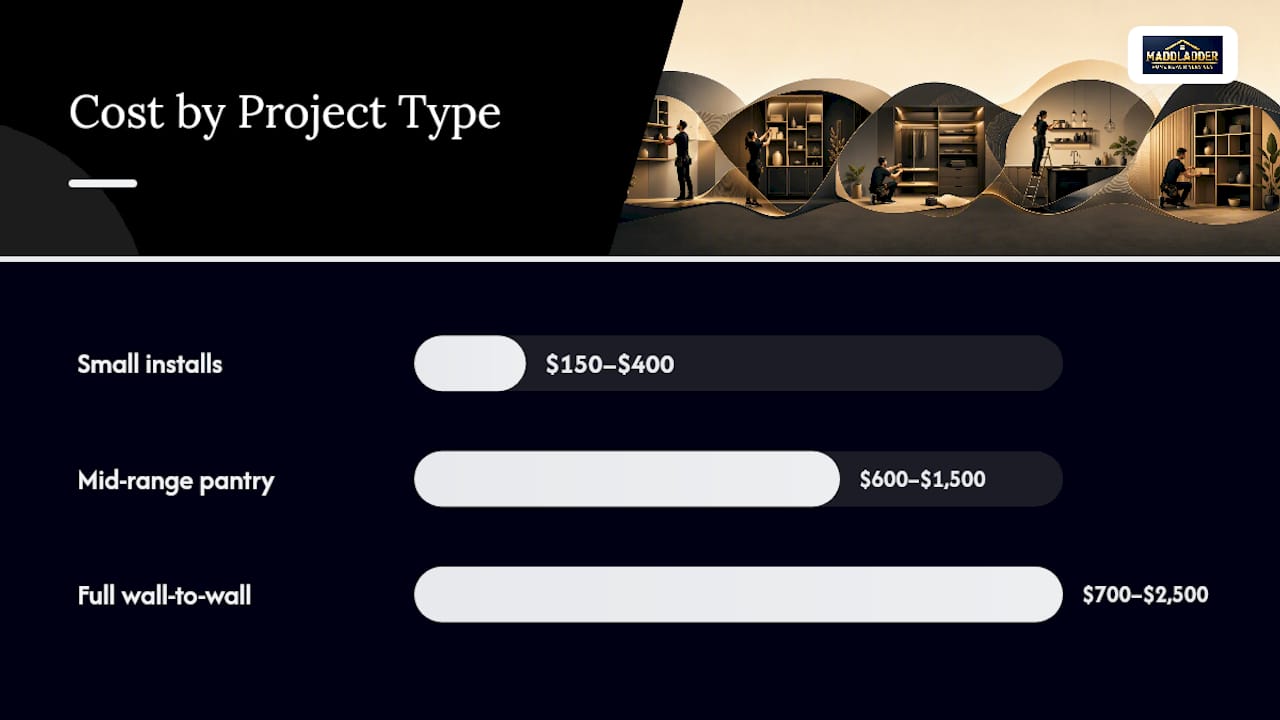
- Small installs (a shelf or two): $150 to $400 total, according to LatestCost's 2026 data, which lines up with Homewyse's labor-only range once you add basic hardware.
- Mid-range pantry or wall runs: $600 to $1,500, depending on shelf depth, material, and whether the wall needs patching or paint work afterward.
- Full wall-to-wall or built-in projects: $700 to $2,500 on the lower end, climbing past $1,800 for custom carpentry, per LatestCost's guidance.
To translate linear feet into a rough total, take the benchmark rate and add a materials allowance. A 4-foot floating shelf with basic brackets lands around $90 to $150 installed. A 25-foot pantry run with mid-grade wire or wood shelving typically runs $650 to $1,000. A 100-foot commercial or garage storage run using metal shelving can total $2,200 to $3,500 once materials and mounting hardware are factored in.
These numbers are starting points. Site conditions, wall type, and finish choices will move the final quote up or down, sometimes by hundreds of dollars.
Why Do Shelving Installation Quotes Vary So Much?
Two homes with the same linear footage can get wildly different quotes, and the gap almost always traces back to five variables.
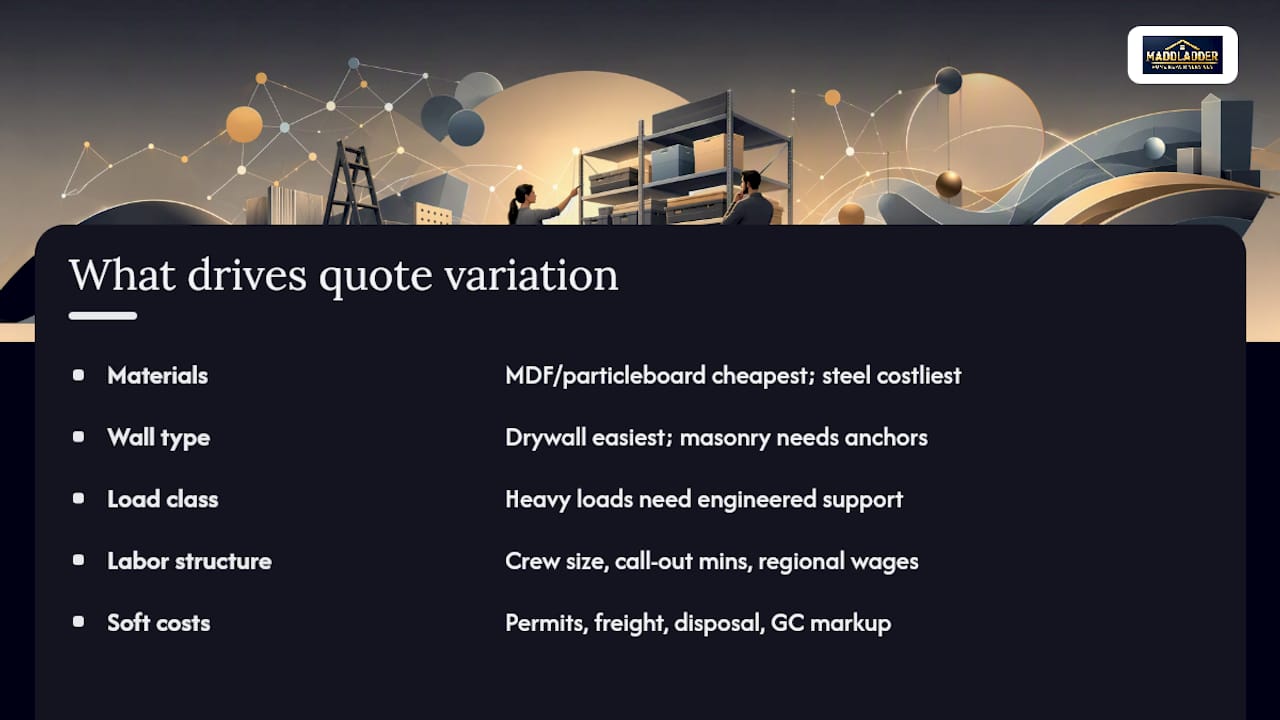
Materials drive a large share of the swing. MDF and particleboard shelving costs the least, solid wood sits in the middle, and powder-coated metal or commercial-grade steel costs more but holds heavier loads over time.
Wall type and anchoring matter more than most homeowners expect. Drywall over studs is the easiest scenario. Masonry, concrete, or brick walls require concrete anchors or through-bolts, which add both material cost and labor time.
Load class changes the engineering requirements. A few decorative shelves need nothing beyond standard anchors, but heavy storage systems or pallet racking often call for engineered support and additional bracing.
Labor structure affects the bottom line too. Crew size, minimum call-out charges, and hourly rates all vary by market, and BLS wage data shows real regional differences in installer pay that show up in your quote.
Soft costs round out the list: permits, engineering review, freight for bulk orders, disposal of old shelving, finish work, sales tax, and any general contractor markup.
Pro Tip: Ask every contractor whether their quote includes a minimum labor charge. Many companies bill a two-hour minimum even for a 20-minute job, and that detail changes the math on small projects.
How Much Does Each Shelving System Cost Installed?
Different shelving systems carry very different installed costs, mostly because they carry different weight loads and require different mounting hardware.
Wire shelving is the cheapest and fastest to install, common in closets and pantries. Boltless rivet shelving, popular in garages and basements, assembles quickly but needs a solid wall or floor anchor for stability. Metal shelving units step up in load capacity and price. Pallet racking and warehouse bay systems sit at the top of the cost scale because they demand engineered anchors, often seismic bracing, and sometimes mezzanine-level structural review. Built-in carpentry, while not industrial, carries premium labor costs because of custom fitting and finish work.
| System type | Typical installed range | Notes |
|---|---|---|
| Wire shelving | $150–$400 per project | Lowest cost, common in closets |
| Boltless/rivet shelving | $150–$700 per project | Fast install, needs wall or floor anchoring |
| Metal shelving units | $600–$1,500 per bay | Cost climbs with gauge and height |
| Pallet rack (warehouse) | $700–$2,500 per bay | Often requires engineered anchors |
| Heavy-duty commercial | $700–$2,500 per bay | Mid-tier between metal units and full rack |
A 25-foot run of wire or metal shelving typically lands between $650 and $1,800 installed. Scale that to 100 feet of pallet racking and the total can reach $13,000 to $30,000 once engineering, mezzanine work, or seismic anchoring get added in.
How Do You Get an Accurate Shelving Installation Quote?
A vague phone estimate rarely matches the final bill. Following a short checklist before you call anyone keeps quotes comparable.
- Measure linear feet and note shelf depth, intended load, and the number of bays or sections.
- Record wall type and access, including whether trim, patching, or paint touch-up will be needed after mounting.
- Decide on material grade and finish level so every contractor is pricing the same product, not guessing.
- Request a written, itemized quote that separates labor, materials, anchors, permits, delivery, disposal, taxes, and any general contractor markup.
- Compare warranties, proof of insurance and licensing, project timeline, and change-order rules before signing anything.
Skipping this step is the single biggest reason homeowners end up comparing quotes that are not actually comparable.
Should You DIY Shelving or Hire a Licensed Pro?
A single light floating shelf on drywall, anchored into studs, is a reasonable DIY project. You need a stud finder, a drill, a level, and about 30 to 60 minutes.
Hiring a pro makes more sense once the job gets complicated:
- Heavy storage loads or multiple bays that need consistent leveling
- Masonry or concrete walls requiring specialized anchors
- Built-ins or custom carpentry work
- Any project where permits or engineering sign-off apply
MaddLadder's licensed handyman services start at $75 an hour with free estimates, and homeowners deciding between DIY and professional repairs in the Kansas City area often find that the anchoring risk alone justifies the hire. Whoever you choose, verify local permit requirements and ask for proof of insurance and licensing before work begins.
What Questions Should You Ask a Shelving Installer?
Get these items in writing before any work starts: a line-item quote, who is responsible for permits, an expected timeline, warranty terms, proof of insurance, and photos or references from similar past jobs.
Watch for red flags that predict trouble later:
- A quote with no breakdown between labor and materials
- No proof of insurance when asked directly
- A bid that comes in far below every other estimate you collected
- Reluctance to share references or job photos
Pro Tip: Request a short in-person site visit instead of a phone-only estimate, and put every change order in writing before the crew touches the wall. A five-minute walkthrough catches masonry, wiring, or plumbing surprises that a phone call never will.
What Do Homeowners Get Wrong About Shelving Costs?
The surprise cost driver on almost every project I've reviewed isn't the shelving itself, it's the wall. A homeowner budgets for a simple $200 shelf, then learns mid-quote that the basement wall is concrete and needs specialty anchors, adding hundreds in labor and hardware. My advice stays consistent: always ask for an itemized quote, and never let anchoring into masonry or heavy loads get handled by anyone without a license.
— Jennifer
Get a Free Shelving Installation Estimate From MaddLadder
Skip the guesswork on anchors, wall type, and load capacity. Shelving installation services are available in many metro areas at reasonable hourly rates, with no long-term contract required unless the customer opts for a home maintenance plan.

Estimates generally come itemized, showing labor, materials, and any anchor or hardware upgrades separately, so customers know what they are paying for before work starts. Professional crews typically carry proof of insurance and licensing, and most residential shelving jobs get scheduled in a timely manner. If you're weighing a closet organization overhaul alongside your shelving project, organization system options can help you plan the full space before calling for a quote.
Ready to see your number in writing? Request a free estimate through MaddLadder's services page and get a real, itemized quote instead of a rough guess.
Sources
- Cost to Install Shelving - Homewyse cost calculator
- Cost to Install Shelves in the Home (LatestCost, 2026)
- Occupational Employment and Wage Statistics (BLS)