
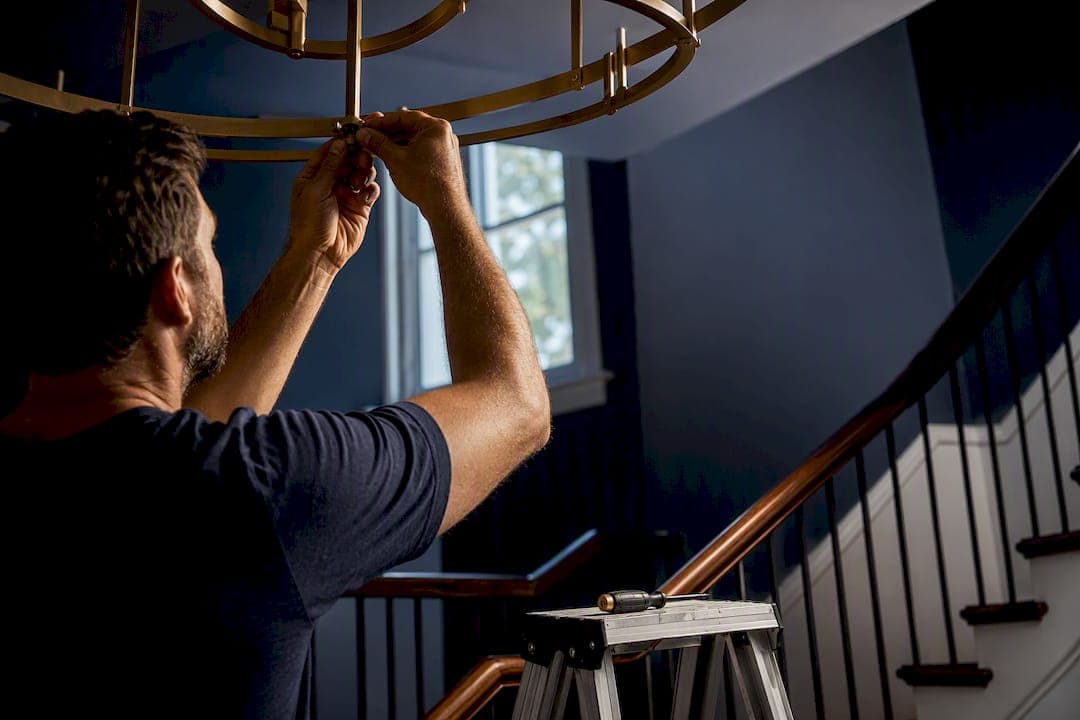
Expect to pay between $100 and $650 per fixture for a licensed installation, with most simple swaps landing near $199 in national averages. The biggest swing factor isn't the fixture itself. It's whether your electrician can reuse the existing wiring and junction box or has to run new circuitry, cut into ceiling drywall, or rig scaffolding for a two-story foyer chandelier.
TL;DR:
- Reusing existing wiring and junction boxes can keep installation costs close to the national average of $199, while new wiring can add $150 to $400.
- Retrofit recessed lights can cost between $200 and $500 per can, with drywall patching increasing total expenses, especially in complex or high ceilings.
- Heavy fixtures over 35 pounds or chandeliers over two stories may require reinforced boxes, scaffolding, or lifts, significantly raising labor and equipment costs.
- Multi-fixture jobs or installing multiple fixtures in one visit can reduce per-unit labor costs by up to 25 percent, making larger projects more economical.
- Permits, regional labor rates, and specific access challenges are key variables that can increase total costs, with permits alone ranging from $30 to $150.
Table of Contents
- What Does Light Fixture Installation Cost by Fixture Type?
- How Much Do Different Fixture Types Really Cost to Install?
- What Drives the Final Price on Your Quote?
- What Do Labor Rates and Permit Fees Actually Cost?
- How Do You Estimate Your Total Project Cost?
- Should You Install a Light Fixture Yourself or Hire a Pro?
- Why Trust This Guidance on Light Fixture Costs?
- A Practical Take on Budgeting for Fixture Installs
- Get a Straight Quote From Maddladder Before You Buy a Fixture
- Sources
What Does Light Fixture Installation Cost by Fixture Type?
Fixture type sets the floor, and access or wiring complexity sets the ceiling. A flush mount swap in a single-story ranch costs almost nothing to install compared to a chandelier hanging over a stairwell that needs a lift and two installers.
The table below reflects typical installed ranges reported for 2026, combining fixture cost and labor for a straightforward, like-for-like replacement:
That split flips on cheap flush mounts, where labor is nearly the whole bill, and on premium chandeliers, where the fixture cost can dwarf install time.
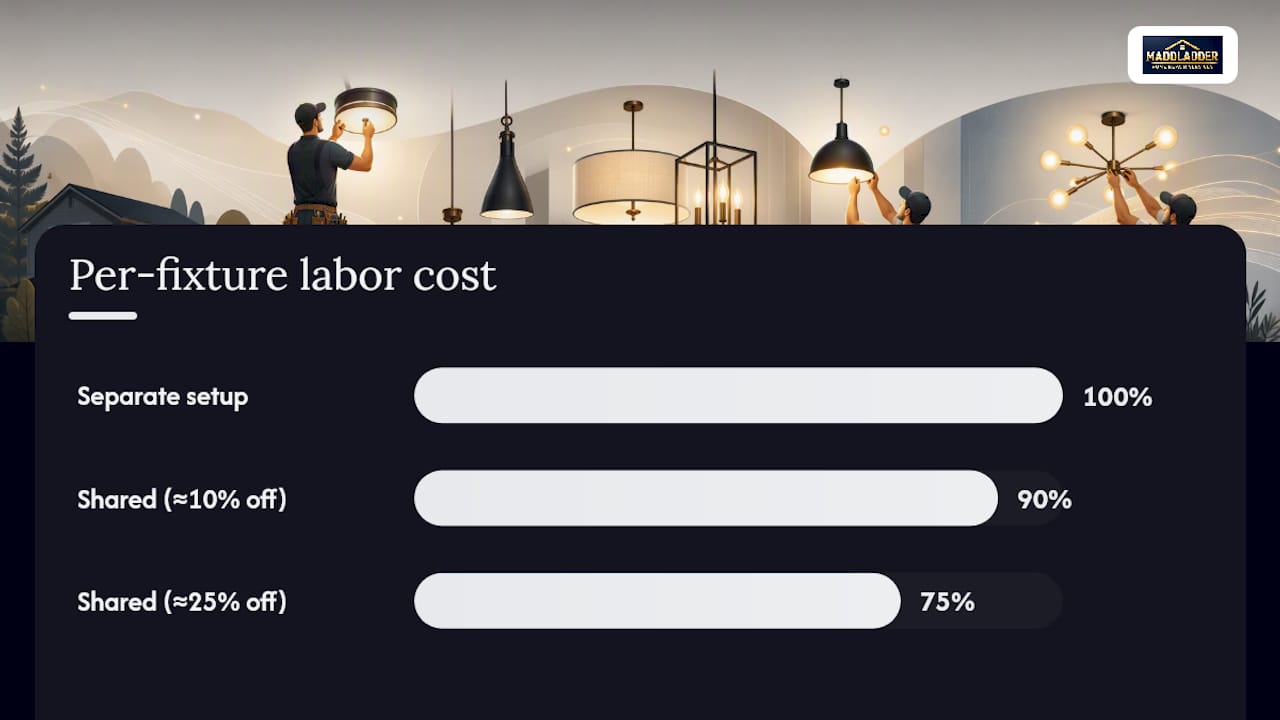
One detail worth building into your budget from the start: installing four or more fixtures in the same visit typically lowers the per-fixture labor cost by 10% to 25%, since the electrician only has to set up tools and safety gear once. If you're rewiring a kitchen island or redoing recessed cans through a whole living room, book it as one job.
How Much Do Different Fixture Types Really Cost to Install?
Every fixture category comes with its own labor logic. Knowing what the electrician is actually doing helps you spot a fair quote from an inflated one.
- Flush mounts and basic ceiling lights. A like-for-like swap, same box, same wiring, usually takes 30 to 60 minutes. You're mostly paying for the electrician's time and a trip fee, which is why Bob Vila's cost data puts the national average near $199 including materials.
- Pendants and vanity lights. Hanging a single pendant is close to flush-mount pricing, but a three-pendant kitchen island set adds real labor: measuring drop length, leveling each fixture against the counter, and wiring a shared junction box. Vanity bars over a mirror need careful spacing if you're matching an existing light pattern.
- Recessed lighting. This is where retrofit versus new construction makes or breaks your budget. Retrofit cans in an existing ceiling run $200 to $500 each because the crew has to cut drywall, fish wire through joists, mount the housing, wire it, then patch, mud, sand, and paint. Plan on 2 to 4 hours per can when finishing work is included. New-construction recessed lights, installed before drywall goes up, cost just $65 to $175 per can because there's no patching labor at all.
- Chandeliers. Weight and height drive everything here. A 15-pound dining room chandelier on a 9-foot ceiling is a two-person, one-hour job. A 60-pound iron chandelier over a two-story foyer often needs scaffolding or a lift, a second installer for safety, and reinforced ceiling bracing. That's why chandeliers routinely top the per-fixture cost chart at $650 or more.
- Ceiling fans with lights. Fans need a fan-rated electrical box, not a standard light box, because of the vibration and load. If your existing box isn't rated, swapping it adds real time and cost before the fan even goes up. Balancing the blades afterward is a quick step but skipping it leads to wobble complaints later. For homeowners planning this upgrade, ceiling fan installation costs deserve their own line item.
- Outdoor fixtures. Weatherproofing pushes outdoor jobs above indoor equivalents. Sconces and post lights need weather-rated boxes, sealed connections, and often a GFCI-protected circuit or a photocell for dusk-to-dawn operation. HomeAdvisor's data puts the average outdoor fixture replacement near $510, with a wide range from $70 for a simple porch light to $1,200 for a wired landscape lighting run. Fixtures near pools or wet areas carry extra code requirements worth checking with your installer.
What Drives the Final Price on Your Quote?
Five variables explain almost every dollar difference between a $150 quote and a $650 one, and most of them are things you can check before the electrician even arrives.
- Same-location vs. new-location installs. Reusing the existing box and wiring keeps costs near the low end of the range. Moving a fixture to a new spot, or adding one where none existed, means running new wire and cutting a fresh junction box, which typically adds $150 to $400 depending on distance from the panel and attic access.
- Ceiling height and access. Standard 8 to 9-foot ceilings need nothing special. Vaulted ceilings, stairwells, or anything above 12 feet often require a ladder upgrade, a lift rental, or scaffolding, adding $75 to $300 in equipment and setup time.
- Fixture weight. Anything over 35 to 50 pounds usually needs a fan-rated or heavy-duty electrical box plus additional bracing, since a standard box can pull loose from the ceiling joist over time.
- Regional labor rates. Electrician rates vary by market, and that variance compounds fast on a multi-fixture job. A five-fixture project at a $50 hourly rate costs meaningfully less than the same job at $130 an hour.
- Permits and inspections. Straight fixture swaps almost never require a permit. New circuits, panel work, or structural changes to support a heavy fixture usually do. Expect permit fees between $30 and $150 depending on your city and the scope of work.
Pro Tip: Ask your electrician upfront whether your job needs a new circuit. That single question separates a $200 afternoon job from a $500 project with a permit application attached to it.
What Do Labor Rates and Permit Fees Actually Cost?
Electricians typically bill $50 to $130 per hour depending on region and experience, according to HomeAdvisor's cost breakdown, and most charge a minimum call fee, often one to two hours' worth, even for a five-minute fix. That minimum is why bundling several small jobs into one visit saves money.
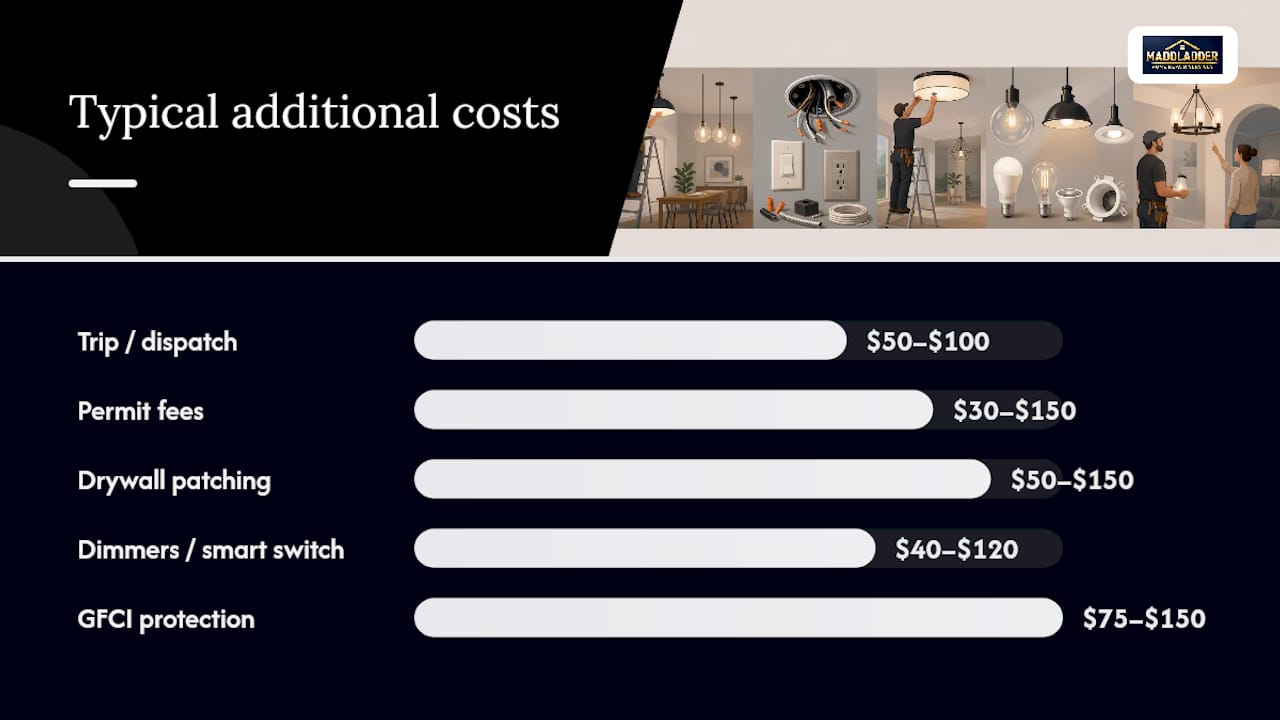
Beyond the base hourly rate, watch for these common line items on a quote:
- Trip or dispatch fees. Some electricians charge $50 to $100 just to show up, credited toward the job if you hire them.
- Permit fees. Usually $30 to $150 for residential electrical work requiring a new circuit or panel modification.
- Drywall patching and paint. Retrofit recessed lighting almost always needs this. Budget $50 to $150 per patched area depending on ceiling texture and paint matching.
- Dimmers and smart switches. Adding a dimmer or smart switch during the same visit typically adds $40 to $120 in parts and installation time.
- GFCI protection. Required for many outdoor and bathroom circuits, usually adding $75 to $150 if one isn't already in place.
Ask for a written, itemized quote before work starts. If a bid just says "labor: $400" with no breakdown, ask which of these categories apply. A legitimate electrician can explain every line without hesitation.
How Do You Estimate Your Total Project Cost?
Build your budget with a simple formula: fixture cost, plus base labor, plus any wiring or access premium, plus permit fees if applicable, plus add-ons like dimmers, plus a contingency of 15% to 25% for surprises behind the wall.
- Single flush-mount swap. Fixture: $80. Labor (one hour, like-for-like): $100. No permit needed. Total: roughly $180, close to the national average.
- Three-pendant kitchen island set. Fixtures: $90 each, $270 total. Labor for leveling and wiring three pendants off one junction box: about $350. Total: roughly $620, or just over $200 per pendant thanks to shared setup time.
- Six recessed retrofit cans with drywall patching. Labor and housings at $300 per can for six cans: $1,800. Drywall patch and paint across the room: $400. Total: roughly $2,200, or about $367 per can, which tracks with retrofit recessed pricing data.
Get at least two written quotes before committing, especially on anything above $500. Buying your own fixture and requesting labor-only pricing can also cut 20% to 40% off the fixture markup contractors typically build into a bundled quote.
Should You Install a Light Fixture Yourself or Hire a Pro?
A confident DIYer can usually handle a like-for-like swap: same box, same wiring, breaker off, wires matched by color, fixture reattached. Our step-by-step fixture replacement guide and DIY fixture replacement checklist cover the safety basics: shutting off power at the breaker, not just the switch, and testing wires with a non-contact voltage tester before touching anything.
Hire a licensed electrician, no exceptions, for these situations:
- Running a new circuit or moving a fixture to a location with no existing wiring
- Installing anything over roughly 35 pounds that needs a reinforced or fan-rated box
- Any outdoor circuit, especially near water or requiring GFCI protection
- Older homes with knob-and-tube or aluminum wiring, where mistakes carry real fire risk
There's also a paperwork angle homeowners overlook. If a job later requires a permit and inspection, unlicensed work can complicate insurance claims or a future home sale. A licensed electrician pulls the permit, passes inspection, and stands behind the work, which tends to prevent the callback visits and rework that eat up more time than hiring right the first time.
Why Trust This Guidance on Light Fixture Costs?
Maddladder is a licensed handyman service built around straightforward, itemized pricing for exactly this kind of work, which shapes how this guide breaks down labor, materials, and add-ons. The company's repair and replacement services cover fixture swaps, wiring troubleshooting, and the drywall touchups that often follow recessed light retrofits, priced with free estimates before any work begins.
A trustworthy quote should separate fixture cost, labor hours, permit fees, and any drywall or paint work into distinct lines, not one lump number. Before hiring anyone, ask directly:
- Are you licensed and insured for electrical work in this state?
- Will this job need a permit, and who pulls it?
- What's your hourly rate versus your minimum call fee?
- Do you warranty the installation, and for how long?
- Can you provide references from similar fixture installs?
A contractor who answers all five without hesitation is one worth trusting with your ceiling.
A Practical Take on Budgeting for Fixture Installs
The homeowners who overspend aren't the ones who hire a pro. They're the ones who assume every fixture swap is a $150 job and get blindsided by a $500 permit-and-drywall bill on a recessed retrofit. Budget conservatively, get quotes in writing with fixture and labor broken out separately, and add that 15% to 25% contingency before you fall in love with a chandelier your ceiling isn't built to hold. If you want a real number instead of a guess, Maddladder offers free estimates for exactly this kind of project.
— Jennifer
Get a Straight Quote From Maddladder Before You Buy a Fixture
A licensed handyman service can handle the fixture swap, the wiring check, and the drywall patch in a single visit, with pricing itemized before anything gets cut open.

One-time services start at $75 an hour, and if you've got more than one fixture on your list, or a whole punch list of small jobs waiting, a subscription home maintenance plan can cover recurring work at a lower effective rate than booking each job separately. Every project can start with a free estimate and a written, line-item quote, so you know exactly what you're paying for before work begins. Whether it's a single pendant over a kitchen island or a full room of recessed retrofits, the install and assembly team handles the wiring, the fixture, and the cleanup. Request your free estimate on the Maddladder homepage and get a real number instead of a guess.
Sources
Run your own numbers against these before committing to a quote:
- What’s the Average Cost to Replace a Light Fixture? - Bob Vila
- Light Fixture Install Cost Calculator | UseCalcPro
- How Much Does It Cost to Install a Light Fixture? (HomeGuide)
- Light Fixture Installation Cost: Price Ranges, Components, and Savings 2026 – Current Cost
- Light fixture installation cost (HomeAdvisor)
Running a ZIP-based calculator alongside a written quote from a local electrician is the fastest way to catch a bid that's out of line with your market.