

TL;DR:
- Negotiating repair service contracts requires locking in scope, SLAs, and pricing before trading benefits. Focus on clear scope, measurable SLAs with credits, fair pricing caps, and strong termination rights to ensure a solid agreement. Prioritize legal review only for high-value or complex contracts exceeding specific thresholds.
Negotiate repair service contracts by locking in scope, SLAs, pricing rules, and remedies first — then trade benefits like contract length or guaranteed volume to close the deal on your terms.
Before your first call with a provider, run through this checklist:
- Aggregate your spend. Add up what you currently pay across all repair and maintenance vendors. That total is your leverage number.
- Define your priorities. List the three things you will not compromise on: usually response time, parts quality, or price ceiling.
- Set a walkaway limit. Know the maximum rate, markup, or term length you will accept before you walk.
- Pull your service history. Past invoices, repair logs, and call frequency tell the vendor you know your own numbers.
- Identify your bundling opportunities. Can you consolidate two vendors into one? That alone can unlock a volume discount.
- Decide which clauses need legal eyes. High-value or multi-year agreements with broad indemnities warrant a targeted attorney review before you sign.
That six-step sequence covers the fastest, highest-impact preparation. The rest of this guide goes clause by clause, tactic by tactic, so you can walk into any negotiation ready.
Table of Contents
- What is a repair/maintenance service contract, and how does it differ from a one-off repair?
- How to negotiate repair service contracts: the clause-by-clause breakdown
- Tactics that actually work in repair contract negotiations
- Ready-to-use sample clauses and negotiation scripts
- When should you bring in a lawyer to review a service contract?
- Key Takeaways
- What the standard negotiation advice gets wrong
- Maddladder handles the repair side so you can focus on the negotiation
- Useful sources and further reading
What is a repair/maintenance service contract, and how does it differ from a one-off repair?
A repair or maintenance service contract is an ongoing agreement where a provider commits to performing defined work over a set period, at pre-agreed pricing, under specified conditions. A one-time repair order is transactional: you call, they fix it, you pay, done. A service contract creates continuing obligations on both sides, which is exactly why the terms matter so much more.
Most contracts fall into one of three structures. A Master Service Agreement (MSA) paired with a Statement of Work (SOW) is the most common for commercial or multi-property relationships. The MSA sets the legal defaults (liability, indemnity, termination), while the SOW controls the operational specifics (what gets done, when, at what price). According to ReviewMyContract's MSA guide, vendors often accept SOW-level control for price and deliverable terms while keeping the MSA for legal defaults — which means you can negotiate each document separately and get better outcomes on both.
A standalone service plan bundles labor, parts, and scheduled visits into a single monthly or annual fee. These are common for HVAC, appliances, and home maintenance subscriptions. A purchase-order-based repair agreement is looser: each job gets its own PO against a pre-negotiated rate card, with the master terms living in a short framework agreement.
The legal consequences differ sharply. A one-time repair order gives you limited recourse if the fix fails. A service contract can include SLA credits, warranty periods, termination rights, and dispute-resolution procedures — all of which you negotiate upfront.
How to negotiate repair service contracts: the clause-by-clause breakdown
NIST's asset management guidance recommends structured preventive maintenance schedules and documentation standards as the foundation of any service program. That principle translates directly into contract language: if it is not written down with measurable criteria, it will not get done consistently.
Scope of work and exclusions
Define scope at the unit level. A clause that says "general maintenance of HVAC systems" is a dispute waiting to happen. Instead, attach an exhibit listing each asset, the tasks covered, the frequency, and what is explicitly excluded. Exclusions matter as much as inclusions — cosmetic damage, pre-existing conditions, and code-upgrade work are common carve-outs that vendors will try to leave vague.

Pricing rules: rate cards, markup, and escalators
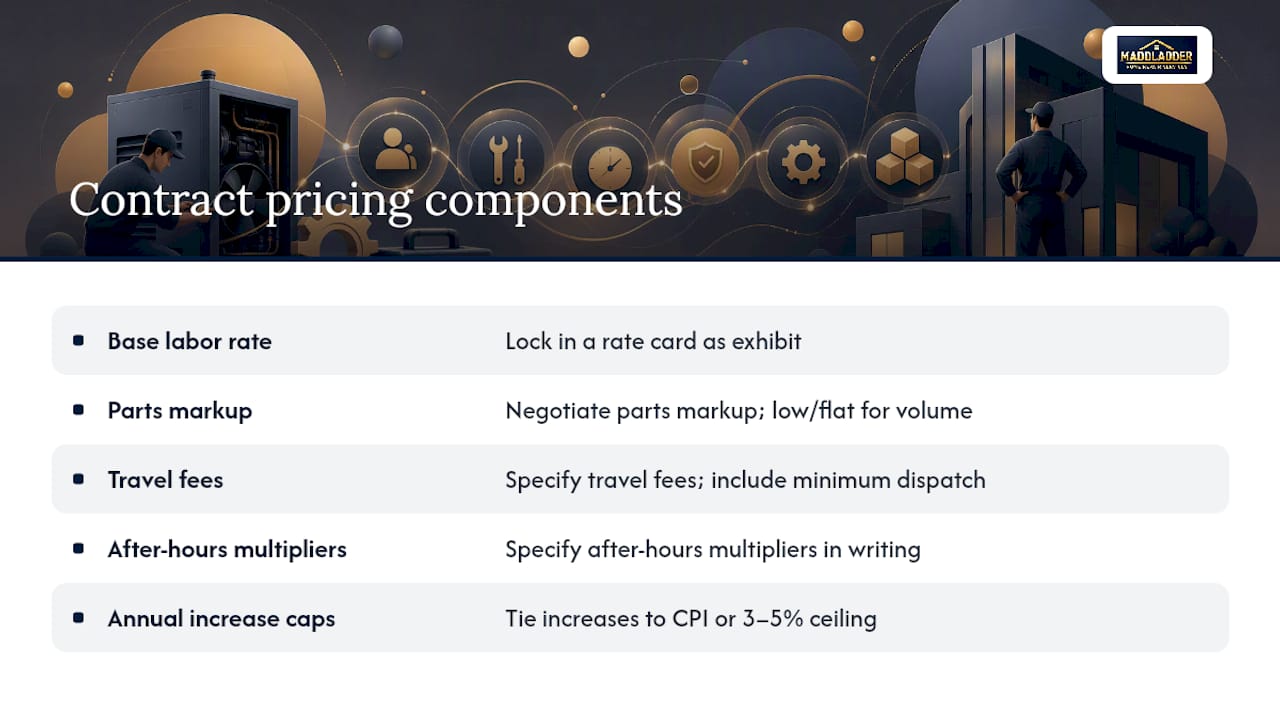
Lock in a rate card as an exhibit. Negotiate the parts markup percentage (industry standard is a moderate parts markup; push for a low markup or a flat-fee parts model for high-volume relationships). Specify travel fees, minimum dispatch charges, and after-hours multipliers in writing. Cap annual increases — tie them to a published index like the Bureau of Labor Statistics CPI or set a hard ceiling (commonly 3–5%).
Liability, indemnification, and insurance
DLA Piper's service agreement guidance flags liability caps and indemnity scope as the highest-risk clauses in any service agreement. Ask for a mutual cap tied to the total fees paid in the prior 12 months. Require the provider to carry general liability insurance at reasonable coverage levels for residential and commercial work, workers' compensation, and ask for a certificate of insurance naming you as an additional insured.
Termination, renewal, and auto-renewal protections
Negotiate termination for convenience with 30–60 days' written notice and no penalty after the first year. Auto-renewal clauses are a common trap: OxMaint's property manager guide identifies unmanaged auto-renewals as one of the largest sources of uncontrolled vendor spend. Require a written notice window of at least 60 days before any auto-renewal kicks in, and add a right to renegotiate pricing at each renewal.
Change orders, acceptance testing, and warranties
Require written change orders for any work outside the original SOW before the provider starts. Add an acceptance-testing clause: you have a defined window (typically 5–10 business days) to inspect completed work and raise deficiencies. Warranty language should specify a minimum repair guarantee period — 90 days on labor and parts is a reasonable floor for most residential and light-commercial work.

Pro Tip: Ask for a service report after every visit, documenting diagnosis, parts used, and labor time. Without that paper trail, the provider controls the repair history and you lose leverage at renewal time.
Tactics that actually work in repair contract negotiations
The most common mistake in service contract talks is treating it as a price negotiation. It is a trade-negotiation. You have things the provider wants: a long contract, guaranteed volume, fast payment, and a low-hassle client relationship. Those are your chips.
- Bundle vendor categories. ContractsCounsel's service agreement negotiation guide notes that consolidating scope under one agreement gives you stronger negotiating position than splitting work across multiple vendors. One vendor, one relationship, one point of accountability.
Pro Tip: When a vendor resists a specific clause, ask "What would make this work for you?" rather than restating your position. That question surfaces the real objection and usually reveals a trade you can make.
For local service relationships, local providers often offer faster response times and more flexible terms than national chains, precisely because they value the ongoing relationship more. That flexibility is a negotiating asset on both sides.
Ready-to-use sample clauses and negotiation scripts
These are starting-point templates. Adapt the specifics to your situation, and have an attorney review any clause before it goes into a high-value agreement.
| Clause | Sample Language |
|---|---|
| SLA with credit remedy | "Provider shall arrive on-site within 4 hours of a Priority 1 service request. For each hour of delay beyond this window, Provider shall issue a service credit equal to 5% of the monthly retainer fee, up to a maximum of 25% per incident." |
| Parts markup cap | "Parts shall be invoiced at Provider's documented cost plus a maximum markup of 20%. Provider shall provide original supplier invoices upon request." |
| Annual price escalator | "Rates shall not increase by more than 3% per contract year, or the 12-month change in the U.S. Bureau of Labor Statistics CPI-U, whichever is lower." |
| Termination for convenience | "Either party may terminate this Agreement for convenience upon 45 days' written notice after the initial 12-month term, with no termination penalty." |
| Change order requirement | "No work outside the agreed Scope of Work Exhibit shall be performed without a written change order signed by both parties prior to commencement." |
| Service report requirement | "Provider shall deliver a written service report within 24 hours of each visit, documenting the work performed, parts used, labor hours, and any recommended follow-up." |
Short negotiation scripts
Opening the commercial terms conversation: "Before we get into pricing, I'd like to agree on the scope exhibit and SLA tiers. Once we have those locked, the pricing conversation will be straightforward."
Proposing a trade on rate: "We're prepared to commit to a 24-month term and a guaranteed minimum of [X] service calls per year. In exchange, we'd like to see the labor rate held flat for the full term and a Priority 2 SLA tier included at no additional charge."
Handling a pushback on the markup cap: "I understand 20% is tight. If the parts volume justifies it, we're open to revisiting that cap at the 12-month renewal. For now, can we agree to 20% with a review clause?"
Closing on a disputed clause: "We've agreed on scope, pricing, and SLAs. The one remaining item is the liability cap. We're proposing a mutual cap at 12 months' fees. What would make that work on your end?"
When should you bring in a lawyer to review a service contract?
Not every repair contract needs an attorney. A one-year residential maintenance plan at $150/month probably does not. A three-year commercial agreement covering a portfolio of properties at $50,000 annually almost certainly does.
Use these thresholds as a guide:
- Contract value over $10,000 annually or total exposure over $25,000 across the term
- Broad indemnity language that requires you to cover the provider's own acts or omissions
- IP or data clauses — relevant when smart home systems, cameras, or connected devices are in scope
- Confidentiality obligations that restrict how you share service records or vendor performance data
- Unusual termination restrictions or liquidated damages clauses
When you do hire an attorney, keep the engagement targeted. Ask for a redline of five specific clauses rather than a full contract rewrite. The five to prioritize, per DLA Piper's service agreement guidance and ReviewMyContract's MSA negotiation matrix:
- Liability cap and mutual cap structure
- Indemnity scope (especially "hold harmless" language)
- Termination for convenience and any associated penalties
- Unilateral amendment rights
- IP and data ownership (if applicable)
Bring a marked-up draft to the attorney rather than asking them to start from scratch. That alone can cut review time significantly. If you are using a provider's standard form, ask your attorney to flag the three highest-risk clauses and suggest alternative language for each — that is a focused, cost-controlled engagement.
Key Takeaways
Negotiating a repair service contract comes down to four fundamentals: define scope precisely, set measurable SLAs with real remedies, control pricing through rate cards and caps, and protect your exit rights with clear termination language.
| Point | Details |
|---|---|
| Lock scope before price | Agree on a detailed SOW exhibit before discussing rates — it anchors every other negotiation. |
| Measurable SLAs with credits | Negotiate all three SLA tiers (response, on-site, resolution) and attach a credit remedy for misses. |
| Cap pricing and escalators | Negotiate parts markup at 20% or less and annual increases tied to CPI or capped at 3–5%. |
| Protect your exit rights | Require termination for convenience after year one with 30–60 days' notice and no penalty. |
| Get legal review at the right threshold | Contracts over $10,000 annually or with broad indemnities warrant a targeted attorney redline. |
| Maddladder's approach | Maddladder structures repair and maintenance agreements for Kansas City homeowners and property managers with documented SOWs, written service reports, and flexible tiered plans. |
What the standard negotiation advice gets wrong
Most guides tell you to "negotiate everything." That sounds thorough, but it is actually the fastest way to stall a deal and burn goodwill with a provider you will need to call at 7 PM on a Friday.
The smarter approach is to negotiate selectively and trade deliberately. A provider who feels like every clause is a battle will price in a risk premium — or simply walk. A provider who sees you as a long-term, low-friction client will give you better terms on the things that actually matter.
The clauses that genuinely move the needle are scope clarity, SLA metrics with real credits, the parts markup cap, the annual escalator, and the termination right. Everything else is secondary. Spend your political capital on those five, and trade the rest: offer a longer term, a volume commitment, or faster payment in exchange for the concessions you actually need.
One more thing most guides skip: the service report requirement. Insisting on a written report after every visit is not bureaucratic — it is how you build the repair history that gives you leverage at renewal. Without it, the provider controls the narrative about what has been done and what your property needs. With it, you walk into every renewal conversation with data.
Maddladder handles the repair side so you can focus on the negotiation
Knowing how to structure a service agreement is one thing. Having a provider who shows up on time, documents every visit, and works within a clear scope is another.
Maddladder serves homeowners, landlords, and property managers across the Kansas City metro with licensed handyman services that map directly to what a well-negotiated contract looks like in practice: written scopes, documented service reports, and flexible pricing plans that include tiered maintenance subscriptions starting at a predictable monthly rate. Whether you need a one-time repair handled cleanly or a recurring maintenance plan with clear deliverables, Maddladder's repair and replacement services give you the documentation and reliability that make a service agreement worth having in the first place. Get a free estimate and see what a straightforward service relationship actually looks like.
Useful sources and further reading
- NIST.AMS.100-18.pdf
- Service Agreement Negotiation: Key Terms, Tips, Legal Help
- Negotiating service agreements
- Repair service agreement (ContractsCounsel)
- Master Service Agreement Guide: Clauses, Red Flags & Negotiation (2026) | ReviewMyContract
- How Do You Negotiate Service Contracts With Equipment Manufacturers or Third Parties? – Skelcore
- How to Sell Service Contracts: A Practical Guide for Small Field Service Teams - Repair-CRM
- The Property Manager's Guide to Maintenance Vendor Contract Negotiation