
The five modifications that matter most are grab bars and a curbless shower, a no-step entry, better lighting and contrast, wider paths and doorways, and lever-style hardware. Most of these are quick, affordable fixes a licensed handyman can install in a day or two. If there's already been a fall, a mobility change, or a recovery in progress, start with an occupational therapist assessment; otherwise, request a free estimate and tackle the list room by room.
TL;DR:
- Most essential home modifications, like grab bars and no-step entries, can be installed quickly and affordably by a handyman within a day or two.
- Bathroom upgrades, especially installing grab bars and non-slip flooring, provide the fastest safety benefits due to the high fall risk in that space.
- Costs for modifications vary widely, with grab bars costing $100–$400 and full shower conversions reaching up to $9,000, often not covered by Medicare.
- Prioritize low-cost, quick fixes such as better lighting and wider pathways first, reserving expensive structural projects for long-term planning.
- Funding options include VA grants for veterans, Medicaid waivers, USDA and HUD programs, and nonprofit assistance, but most are limited and require early application.
- ✓Grab bars and ramps
- ✓Drywall, trim, and fixture replacements
- ✓Minor plumbing and electrical repairs
- ✓Smart home upgrades
Table of Contents
- Aging in Place Modifications, Room by Room
- What Do Aging-in-Place Upgrades Cost, and Who Pays For Them?
- Aging in Place Modifications: Three-Tier Prioritization
- Aging in Place Modifications: DIY, Handyman, or Specialist?
- How Maddladder Handles Aging-in-Place Projects
- How These Modifications Actually Help Caregivers
- Why the Standard Advice on This Topic Falls Short
- Get a Free Estimate for Your Home Safety Upgrades
- Where to Apply and Research Aging-in-Place Funding
- Sources
Aging in Place Modifications, Room by Room
Not every room carries equal risk. Bathrooms cause the most falls, entries create the biggest daily barrier, and kitchens quietly wear people down through reach and grip strain. A systematic review of home modification research found that 13 of 20 studies confirmed measurable benefits for fall prevention, daily-function improvement, or cost savings, which is a strong enough signal to treat this room-by-room list as more than guesswork.
Bathroom
The bathroom is where home accessibility modifications delivers the fastest safety return, because it combines wet surfaces, hard fixtures, and awkward transfers in one small space.
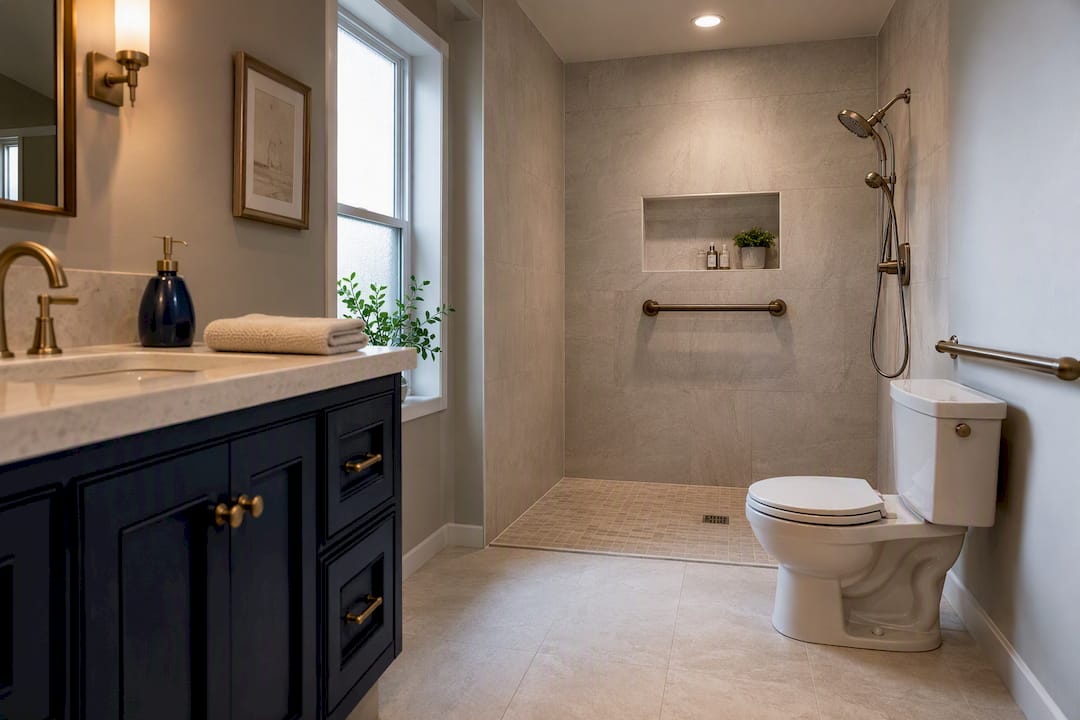
- Grab bars mounted into wall studs (not just drywall anchors) near the toilet and inside the shower are relatively low-cost and quick to install.
- Curbless walk-in shower with a handheld sprayer and built-in seat involves structural work, usually requiring re-sloping the floor for drainage, with costs varying by project scope.
- Comfort-height toilet swap: a same-day quick-install job in most cases.
- Non-slip flooring or a textured coating over existing tile: quick-install, low cost.
- Anti-scald mixing valves on tub and shower plumbing: a minor plumbing job, but one that should go to a licensed pro given the pipe work involved.
Pro Tip: Before mounting any grab bar, check for a stud or add a reinforcement plate behind the drywall. A bar that's only anchored into drywall can pull loose under real body weight during exactly the moment it's needed most.
Entry and exterior
A home with even one step at the front door effectively locks someone out of their own house once mobility declines. Creating at least one no-step entry, whether through regrading the walkway or adding a permanent ramp built to a 1:12 slope ratio, solves that in one project. Temporary aluminum ramps work for short-term recovery and run under $500; permanent wood or concrete ramps built to code run higher and count as structural work. Add a covered landing and motion-sensor lighting at every exterior door, since falls on unlit steps at night are one of the more preventable incidents in this category.
Kitchen
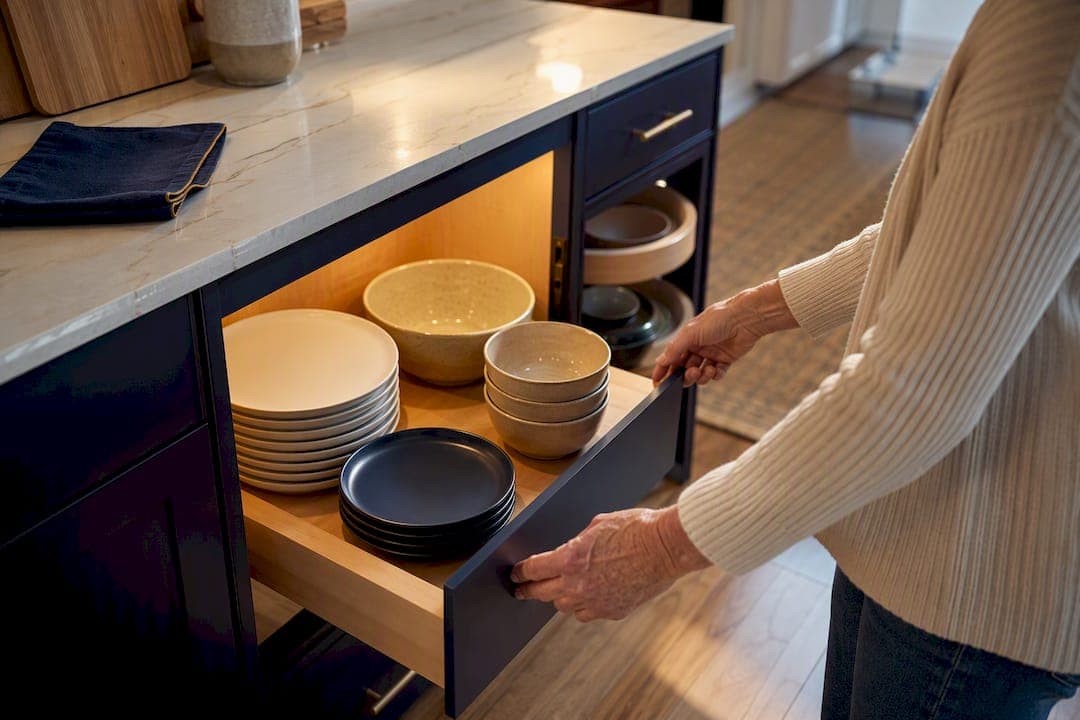
Kitchens hide their hazards in cabinets and countertops rather than on the floor. Pull-out shelves and lazy Susans put everyday items within reach without a step stool. Side-opening (French-door) wall ovens replace the drop-down door that forces a hot rack to be lifted and carried. Where a full remodel is realistic, an adjustable-height counter section helps anyone using a wheelchair or seated for stability. Anti-scald valves belong here too, on any faucet feeding hot water to a food-prep sink.
Stairs
Stairs force one of the bigger decisions in this whole project: repair the stairs or bypass them. A straight stairlift runs $3,000 to $15,000 depending on curve and length, while converting a first-floor room into a bedroom sidesteps the stairs entirely, often for less money if a suitable room already exists. Short of either move, continuous handrails on both sides and a contrast strip on each step edge cut the risk for anyone still using the stairs daily.
Bedroom and living areas
Circulation width decides whether a walker or wheelchair can actually move through a room. Aim for 42 to 48 inches of clear path between furniture. Lever door handles replace round knobs that are hard to grip with arthritis and are generally low-cost to swap, as discussed in interior doors as focal points for home design improvements. Raising electrical outlets and lowering light switches by a few inches each puts both within easy reach without bending or stretching. Add a plug-in or hardwired night-light along the bedroom-to-bathroom path, since that's the single most common route for a middle-of-the-night fall.
What Do Aging-in-Place Upgrades Cost, and Who Pays For Them?
Costs swing widely by project scope, and the installed cost ranges below reflect national averages; expect a premium in higher-cost metro markets.
| Modification | Typical Installed Cost |
|---|---|
| Grab bar set (multiple bars) | $100 to $400 |
| Portable threshold ramp | Under $200 |
| Walk-in shower conversion | $4,000 to $9,000 |
| Straight stair lift | $3,000 to $8,000 |
| Curved stair lift | $8,000 to $15,000 |
| Residential elevator | $20,000 to $50,000+ |
Medicare generally doesn't cover home modifications, which surprises a lot of families expecting it to. The funding actually available comes from a handful of specific programs:
- VA Specially Adapted Housing (SAH) and Special Housing Adaptation (SHA) grants offer substantial funding for eligible veterans with qualifying service-connected disabilities, while the smaller Home Improvements and Structural Alterations (HISA) benefit covers more targeted work.
- Medicaid Home and Community-Based Services (HCBS) waivers cover environmental modifications in most states, but rules, caps, and waitlists vary enormously by state, and some waitlists run for months or years.
- USDA Section 504 Home Repair offers grants up to $10,000 and loans up to $40,000 for eligible rural homeowners aged 62 and older.
- HUD's Older Adults Home Modification Program (OAHMP) funds accessibility work through local grantees.
- Nonprofits like Rebuilding Together and Habitat for Humanity's Aging in Place programs sometimes cover labor or materials for qualifying households.
On the financing side, an FHA 203(k) renovation loan folds accessibility work into a mortgage refinance, a HELOC taps existing home equity, and a Home Equity Conversion Mortgage (HECM) is available to homeowners 62 and older. Some modification costs may also qualify as an IRS medical expense deduction when a physician documents medical necessity, though the rules are specific enough to warrant a conversation with a tax preparer. Start early: contact your local Area Agency on Aging or the nearest VA regional office, since waiver waitlists in particular reward people who apply well before they need the work done.
Aging in Place Modifications: Three-Tier Prioritization
Trying to do everything at once is how projects stall out. Splitting the work into three tiers keeps the highest-safety-value fixes first without ignoring the bigger structural questions.
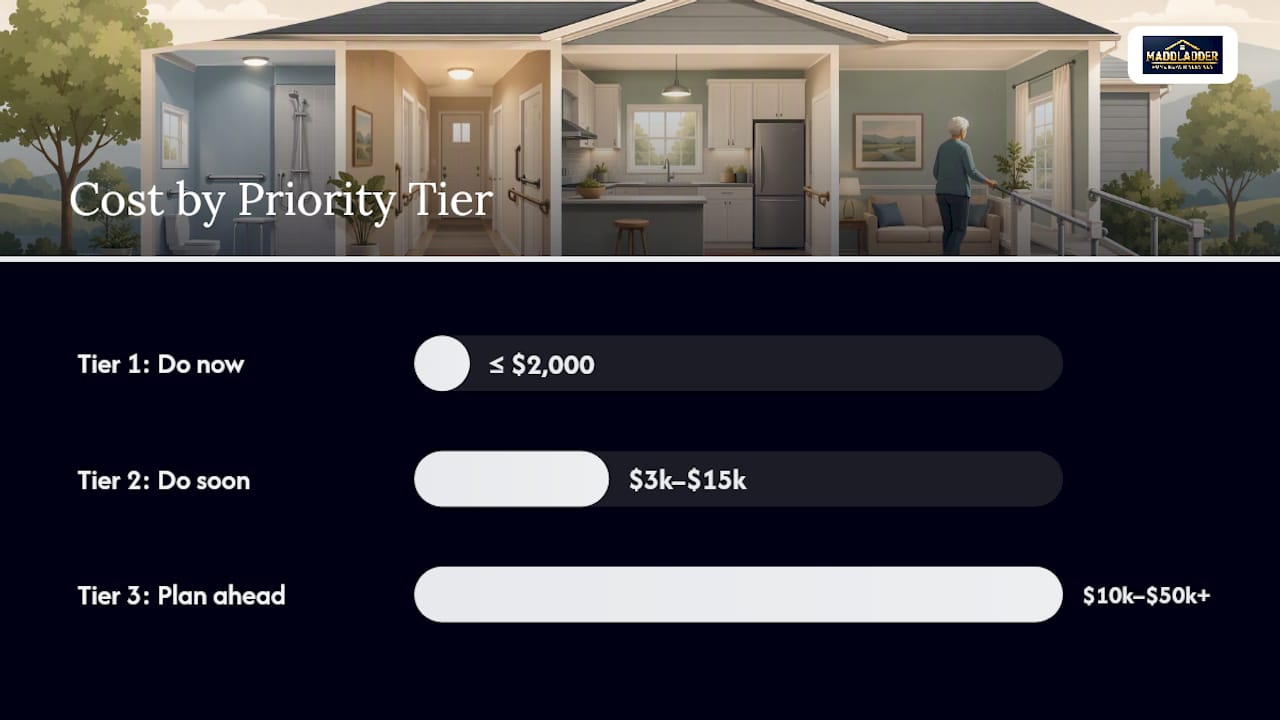
- Tier 1: Do now. Days to weeks, typically under $2,000. Grab bars, lever hardware, non-slip flooring treatments, better lighting, and a threshold ramp all fall here.
- Tier 2: Do soon. Weeks to months, roughly $3,000 to $15,000. Curbless shower conversions, a stair lift, or widening a doorway or two land in this tier.
- Tier 3: Plan ahead. Months of lead time, often $10,000 to $50,000 or more. A first-floor bedroom conversion, a residential elevator, or a full kitchen reconfiguration belong here.
To decide urgency, ask a few direct questions: Has there been a fall in the last six months? Is a walker, cane, or wheelchair already in use? Is this a temporary recovery from surgery, or a permanent change in mobility? A recent fall or a permanent mobility change pushes Tier 2 items up the list fast.
Pro Tip: If a kitchen or bathroom remodel is already on the calendar for other reasons, fold in the accessibility upgrades at the same time. Widening a doorway or lowering a countertop costs far less as part of an existing project than as a standalone job later, since the walls and plumbing are already open.
Aging in Place Modifications: DIY, Handyman, or Specialist?
Plenty of this work is genuinely simple. A grab bar into a stud, a lever handle swap, a plug-in motion light, or a temporary threshold ramp are all reasonable jobs for a handy homeowner or a general handyman.
Other tasks need a licensed trade or a permit, full stop: any load-bearing wall change, plumbing rerouted for a curbless shower drain, electrical work for a stair lift or elevator, or ramp framing built to meet local building code. Skipping the permit on structural or electrical work isn't a shortcut, it's a liability waiting to surface at resale inspection.
Two credentials are worth knowing. An occupational therapist (OT) home assessment evaluates a person's actual functional limitations and prioritizes fixes accordingly. A Certified Aging-in-Place Specialist (CAPS), a designation issued through NAHB training, signals a contractor trained in code-compliant accessibility construction. As one planning resource on contractor certifications puts it, OTs and CAPS contractors work as a pair: the OT identifies the functional need, the CAPS contractor turns it into a real, buildable renovation.
| Ask before hiring | Why it matters |
|---|---|
| Are you licensed and insured for this trade? | Protects against liability on plumbing/electrical work |
| Have you completed CAPS training? | Signals accessibility-specific code knowledge |
| Will this require a permit? | Structural, electrical, and some plumbing work usually does |
| Can you coordinate with an OT's recommendations? | Keeps the project matched to actual functional needs |
How Maddladder Handles Aging-in-Place Projects
Maddladder handles the bulk of Tier 1 and much of Tier 2 work directly: grab bar and rail installation, ramp construction, fixture and hardware replacement, minor plumbing and electrical repairs, and smart home installs like video doorbells and voice-activated lighting that make daily routines easier to manage from a distance.
The process is straightforward:
- Request a free estimate and describe the specific rooms or concerns.
- Get a prioritized punch list based on safety impact and budget.
- Have the work completed, often within the same visit for smaller items.
- Set up an ongoing maintenance plan if there's more work coming later.
Maddladder's ADA safety and mobility service line covers most of the room-by-room list above. Where a project crosses into load-bearing structural changes, full bathroom re-plumbing for a walk-in shower conversion, or a case that genuinely needs an OT's functional assessment first, that's a fair moment to bring in a CAPS-certified remodeler or a licensed OT alongside the handyman work.
Home modifications work best when the small, high-frequency risks get fixed fast, and the bigger structural questions get planned with the right specialist.
How These Modifications Actually Help Caregivers
Every modification on this list does double duty: it protects the person aging in place, and it lightens the physical and mental load on whoever is caring for them.
A curbless shower with a handheld sprayer means a caregiver isn't bracing someone over a tub wall twice a day. A comfort-height toilet reduces the physical strain of assisting a transfer. Grab bars placed at the right height let someone move independently for stretches of the day, which gives a caregiver actual breathing room instead of constant supervision.
Lighting and smart home features matter here too. A caregiver managing care remotely, or juggling a full-time job alongside caregiving duties, benefits from a video doorbell that shows who's at the door, a smart lock that lets in a home health aide without a spare key changing hands, or a motion light that reduces late-night fall risk without anyone needing to get up and check.
Clear circulation paths also mean a caregiver isn't navigating furniture with a walker, wheelchair, or hospital-style bed in tight quarters. And a well-placed grab bar or stair rail can be the difference between a caregiver needing to physically support every transfer and simply being nearby in case help is needed. The goal isn't just fewer falls. It's fewer moments where a caregiver has to choose between someone's independence and someone's safety.
Why the Standard Advice on This Topic Falls Short
Most guides to aging-in-place modifications treat every fix as equally urgent, which isn't how real households actually experience risk. A grab bar and a residential elevator get listed side by side as if they belong on the same to-do list, when one takes an afternoon and the other takes a construction loan. That framing overwhelms people into doing nothing.
The research actually supports a narrower, more useful claim: a handful of cheap, quick fixes carry most of the fall-prevention benefit, and the expensive structural projects matter more for long-term independence than for immediate safety. Not every house is even worth the investment. A split-foyer layout or a narrow, multistory footprint can make full retrofitting prohibitively expensive, and that's worth admitting honestly rather than pushing a one-size renovation plan.
Prioritize the cheap wins this month. Get an OT assessment if there's already been a fall or a diagnosis in play. Save the big structural decisions for when you know they're actually necessary, not just theoretically nice to have.
— Jennifer
Get a Free Estimate for Your Home Safety Upgrades
A local handyman service is a practical starting point for most of the Tier 1 and Tier 2 work covered above, often without the wait times or minimum project sizes that come with a full remodeling contractor. Grab bars, ramps, rail installation, lever hardware swaps, and smart home upgrades like video doorbells and smart locks are all jobs such services handle directly, often with flexible pricing or maintenance plans for households expecting more work down the line.

Getting started is simple: request a free estimate and describe the rooms or concerns involved. On a first visit, expect a walkthrough of the space, a straightforward cost breakdown, and honest guidance on what can be handled that day versus what needs scheduling. If a project turns out to need full plumbing rework for a shower conversion or crosses into structural territory, the handyman service will say so directly and point toward a CAPS-certified remodeler or an OT-led plan rather than taking on work outside its scope. For the full range of installation and safety services, start with a call or an online estimate request today.
Where to Apply and Research Aging-in-Place Funding
A few U.S. resources cover most of what a homeowner or caregiver needs to research or apply for funding:
- Medicaid HCBS waivers: contact your state Medicaid office or local Area Agency on Aging, since coverage and waitlists vary by state.
- USDA Section 504 and HUD's OAHMP: research eligibility through USDA Rural Development offices and HUD-approved local grantees.
- NAHB's CAPS directory: find a certified contractor trained specifically in accessibility construction.
- Rebuilding Together and Habitat for Humanity's Aging in Place programs: check for nonprofit assistance with labor or materials in your area.
Sources
- A Systematic Review of Home Modifications for Aging in Place in Older Adults
- Aging In Place Remodeling: Planning tool and contractor certifications (extension/sdhub resource)
- Aging in Place Home Modifications — Complete Guide & Costs 2026 | BuildCalc Pro