

TL;DR:
- Customer testimonials serve as credible social proof that reduce buyer risk and influence service selection. Video testimonials outperform text by creating stronger emotional trust, especially when placed near decision points like pricing and booking forms. Regularly updating genuine, specific, and authentic reviews ensures maximum impact in building trust and AI visibility.
Customer testimonials are authentic, third-party endorsements that serve as the most credible form of social proof a service business can display. The role of testimonials for services goes far beyond a wall of five-star quotes. They reduce buyer risk, build trust before a first conversation, and directly influence whether a prospect chooses you or a competitor. Research from BrightLocal and Allied Insight confirms that testimonials are now embedded into every stage of the buying journey, from initial search to final approval. For service providers in Kansas City and beyond, understanding how testimonials work is no longer optional.
How do testimonials influence trust and service selection?
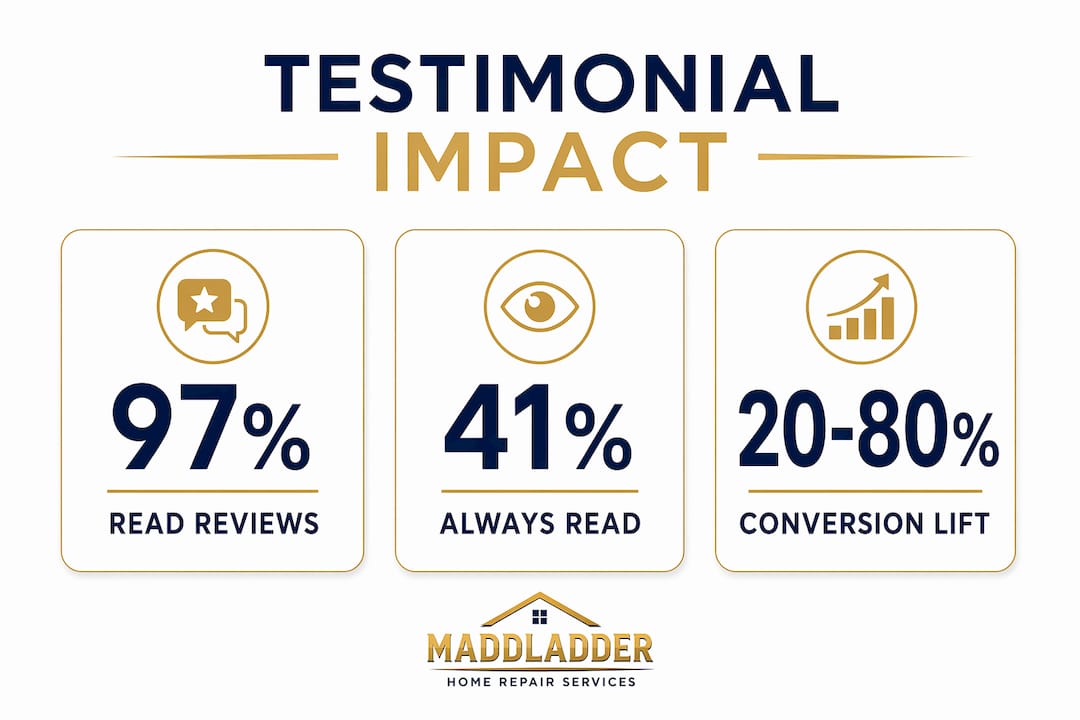
Consumer behavior around reviews has shifted dramatically. 97% of consumers read reviews when researching local businesses in 2026. That number means virtually every prospect who finds your service page will look for peer validation before making contact.
The shift is not just in volume. The share of consumers who always read reviews jumped from 29% in 2025 to 41% in 2026. Buyers are more deliberate, cross-checking multiple platforms before committing. A single glowing review on your own website no longer closes the gap.
The role of testimonials in service selection is fundamentally about risk reduction. Hiring a handyman, a contractor, or any service provider involves uncertainty. Buyers cannot test the service before purchasing. Testimonials replace that missing experience with someone else's verified outcome. They answer the question every prospect is silently asking: "Did this actually work for someone like me?"
Specific themes drive the most trust in service testimonials:
- Reliability: Did the provider show up on time and finish as promised?
- Responsiveness: How quickly did they communicate and resolve issues?
- Workmanship quality: Did the result meet or exceed expectations?
- Value: Was the price fair relative to the outcome delivered?
Pro Tip: When asking customers for feedback, prompt them specifically on reliability and responsiveness. Those two themes resolve the most common objections buyers have before hiring a service provider.
What testimonial formats drive the highest conversions?
Not all testimonials carry equal weight. Format and placement determine whether a testimonial changes a decision or gets ignored.
Video testimonials are the highest-performing format for service businesses. Landing pages with video testimonials can see conversion rate lifts of 20–80%, with quote request increases of 40–60%. The reason is trust transfer. A real person speaking on camera, with facial expressions and tone of voice, communicates authenticity in ways that text cannot replicate.

Text testimonials still work, but they require more specificity to earn trust. A quote like "Great service, highly recommend!" carries almost no persuasive weight. A quote that reads "Maddladder fixed our drywall and replaced two fixtures in one visit. The tech arrived on time and the work passed our landlord inspection" tells a story. It names the service, confirms reliability, and delivers a measurable outcome.
The table below shows how format affects buyer perception across key trust factors:
| Testimonial Format | Emotional Trust Transfer | Specificity Potential | Best Placement |
|---|---|---|---|
| Video | High | Medium | Landing pages, proposals |
| Detailed text | Medium | High | Near pricing, service pages |
| Star rating only | Low | None | Secondary reinforcement |
| Case study style | Medium | Very High | Proposals, objection pages |
Placement matters as much as format. Testimonials placed at buyer decision moments like pricing pages or proposal reviews act as persuasion tools, not decoration. A testimonial about scheduling reliability placed next to your booking form directly addresses the fear a buyer has at that exact moment.
Pro Tip: Structure your best testimonials as condensed case studies: problem, turning point, and outcome. "Our fence gate was broken for months. Maddladder came out the next day and fixed it in under two hours" is three times more persuasive than a generic compliment.
Does authenticity actually change how buyers perceive testimonials?
Authenticity is the single most important factor in testimonial credibility. Buyers in 2026 are sophisticated. They recognize generic praise, and they discount it immediately.
Consumers expect recent, relevant testimonials that reflect their specific situation. Stale reviews from three years ago create trust gaps at the exact moment a buyer is deciding. A service business with no reviews from the past six months signals either low activity or low satisfaction. Neither reading helps you win the job.
Transparency around how testimonials are sourced also affects buyer perception. Research on sponsorship disclosure in testimonials shows that explicit disclosure can improve perceived transparency and increase purchase intention, particularly when the information quality of the testimonial is lower. When testimonials are clearly authentic and detailed, implicit disclosure is sufficient. When they are thin or incentivized, buyers notice.
The risks of poor testimonial practices include:
- Undisclosed incentives: Offering discounts for reviews without disclosure erodes trust if discovered.
- Vague sourcing: Testimonials with no name, location, or service context feel fabricated.
- Outdated content: Reviews older than 12 months lose relevance for most service categories.
- Overly polished language: Testimonials that sound like marketing copy rather than real speech trigger skepticism.
"Specificity and relevance trump testimonial volume for resolving buyer ambiguity in services." — PlanLeft
The fix is straightforward. Collect testimonials consistently, keep them current, and let customers speak in their own words. When you read about how Kansas City homeowners decide between DIY and professional service, authenticity in peer reviews is one of the top deciding factors.
How should service providers collect and deploy testimonials strategically?
Most service businesses treat testimonials as a passive byproduct of good work. The providers who win more business treat them as a deliberate sales asset. Here is how to build a testimonial system that actually drives conversions.
- Ask immediately after delivery. The best time to request a testimonial is within 24–48 hours of completing a job. Satisfaction is highest, and the details are fresh.
- Guide the response with specific prompts. Ask customers to describe the problem they had, why they chose your service, what the turning point was, and what the outcome looked like. Structured collection asking for problem, choice reason, and outcomes creates testimonials you can actually use in sales conversations.
- Embed testimonials near objections, not just on a testimonials page. Place reliability-focused testimonials near your scheduling or booking section. Place workmanship testimonials near your service descriptions. Embedding testimonials adjacent to specific objections improves decision confidence far more than a dedicated review page.
- Refresh your testimonial pool every quarter. Rotate in new reviews and retire anything older than 12–18 months for active display. Freshness signals ongoing quality.
- Optimize for AI discovery. 45% of consumers now use AI tools for local business recommendations in 2026, and those users double-check against real reviews. Testimonials on Google Business Profile, your website, and third-party platforms all feed AI-assisted recommendations. Credible, recent testimonials are your best asset for appearing in AI-generated shortlists.
Pro Tip: Ask your top customers if they would record a 60-second video on their phone describing their experience. Offer to make it easy with three simple prompts. Even one or two video testimonials on your service pages can outperform dozens of text reviews.
For service providers looking to understand how AI tools amplify the reach of customer reviews, AI and local service searches is worth reading alongside your testimonial strategy.
Key takeaways
Testimonials are the most cost-effective trust asset a service business controls, and their placement and specificity determine whether they convert prospects or get ignored.
| Point | Details |
|---|---|
| Testimonials reduce buyer risk | Authentic peer outcomes replace the missing pre-purchase experience in service decisions. |
| Video outperforms text | Video testimonials can lift conversions by 20–80% by adding emotional trust transfer. |
| Placement beats volume | Testimonials near pricing or objection points outperform a generic testimonials page. |
| Specificity drives credibility | Problem, turning point, and outcome structure makes testimonials usable sales assets. |
| Freshness signals quality | Testimonials older than 12 months lose persuasive power; refresh your pool quarterly. |
What most service providers get wrong about testimonials
I have reviewed the testimonial strategies of dozens of service businesses, and the same mistake shows up repeatedly. Providers collect testimonials, dump them on a single page, and call it done. That approach wastes the most persuasive content you have.
The businesses that actually convert more prospects treat each testimonial as a targeted tool. A quote about a fast turnaround on a plumbing repair belongs next to your emergency service offer, not buried three scrolls deep on a reviews page. A video from a property manager praising your reliability belongs on your Property Manager plan page, where that exact buyer is making a decision.
The second missed opportunity is specificity. Most providers accept whatever a customer writes and post it as-is. The better move is to guide the response. When a customer says "great job," follow up and ask what specifically impressed them. That follow-up question turns a throwaway compliment into a conversion asset.
The third shift I would push every service provider toward is AI awareness. Nearly half of buyers now start their search with an AI tool, and those tools pull from your public review profiles. A thin or outdated review presence means you may not appear in AI recommendations at all. Treating testimonials as a live, managed channel rather than a static page is the difference between being found and being invisible.
The bottom line is this: testimonials are not marketing decoration. They are the closest thing to a sales conversation you can have with a prospect before they ever contact you. Build them with intention.
— Jennifer
See how Maddladder builds trust through every service

Maddladder applies these exact principles across every service it offers in the Kansas City metro area. Customer testimonials are placed at the moments that matter most, from booking to proposal review, so homeowners and property managers can make confident decisions. Whether you are exploring home repair and replacement services or considering smart home upgrades like thermostat installations and security cameras, real customer outcomes back every service category. Free estimates make the first step easy, and a track record of verified reviews makes the decision easier. Visit Maddladder's full services page to see what Kansas City homeowners and landlords are saying.
FAQ
What is the role of testimonials in service marketing?
Testimonials serve as social proof that reduces buyer uncertainty and builds credibility before a first contact. They replace the missing pre-purchase experience by showing verified outcomes from real customers.
How do video testimonials compare to text reviews for service businesses?
Video testimonials deliver higher emotional trust transfer through face and voice, with conversion lifts of 20–80% on landing pages compared to text alone. Text testimonials remain effective when they include specific problem-and-outcome details.
Where should service providers place testimonials for the best results?
Testimonials placed near pricing pages, booking forms, or specific service descriptions outperform a generic testimonials page. Matching the testimonial theme to the buyer's objection at that exact moment drives the strongest decision confidence.
How often should service businesses update their testimonials?
Refreshing your active testimonial pool every quarter keeps content relevant. Reviews older than 12–18 months lose persuasive power because buyers expect recent evidence of consistent quality.
Do testimonials affect ai-assisted local service recommendations?
Yes. With 45% of consumers using AI tools for local business recommendations in 2026, credible and recent testimonials on Google Business Profile and third-party platforms directly influence whether your business appears in AI-generated shortlists.